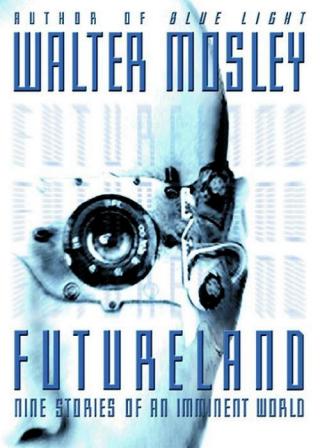
Futureland: Nine Stories of an Imminent World
- Автор: Мосли Уолтер
- Год: 2001
- Язык: английский
- Год: Aspect / Warner Books
- ISBN: 978-0-446-52954-9
- Жанр: Научная фантастика

Электронная книга - «Futureland: Nine Stories of an Imminent World». Краткое содержание книги:
When he came into the room he saw men, maybe a dozen of them, with the third-degree burns of the cinder blast eating through their skins. On a cement dais the plasteel drum stood upright. Neil pointed his X rays at the heart of its murky amber contents.
One one thousand, two one thousand, three...
“Down under!” someone shouted in a clear cowboy drawl. Five one thous...
Blue Nile fell into the room from the doorway, blood cascading from what had been his chest.
Seven one thousand...
Blaun threw himself in between Neil and the onrushing Itsies.
Nine one thousand...
Neil turned in time to see the cinder blast turn Blaun’s handsome face into gray ash.
Ten one thousand, eleven one thousand...
“He’s hurtin’ the chill,” a man shouted, and Neil felt four hard knocks in his side. Then he heard a loud clang.
“You hit the drum, you fool!” someone shouted.
And then there was peace.
12
“Neil?” said a voice with no sound.
“Yes?” he answered without feeling his mouth.
“Oh, baby,” the voice said, and he knew that it was Nina. She was the only one who had ever called him baby.
“Where am I?”
“Back in the Sahara. You’re hooked up to a machine being run by Un Fitt.”
“Un Fitt?” Neil said with his mind.
“Yes, Neil? Can I do something for you?”
“No, nothing. It’s just good to know that you’re here.”
“I’m so glad you’re alive,” Nina said.
“What happened?”
“You were in the bar in Denver, using the X-ray flasher on the disease. Blue Nile and Blaun were killed but you were just shot. The police killed the three shooters that attacked you. The parmeds came and put you on life support. The cops took you into custody but Un Fitt was able to transfer you to a hospital in Greece. From there we brought you here and made the neuronal connections to revitalize your brain.”
“When can I get up?”
Silence filled the new hum of Neil’s awareness.
“Did you manage to irradiate the pathogen?” the words were Ptolemy’s, Neil was sure of that.
“Twelve seconds, maybe half a second more than that. Did they puncture the drum?”
“Yes.”
“Did the virus escape?”
“Yes. By the time the police put a seal on the canister eighty percent of the virus had leaked.”
“What about Africa?”
“Nina was successful,” Ptolemy said. “They managed three minutes of radiance and no one had to die.”
“Did I do enough?” Neil asked.
“You saved the black race.”
“Am I going to die now?”
“No. But your body is damaged beyond repair. For now you will reside with Un Fitt in this computer frame.”
“Nina.”
“Yeah, baby?”
“Will you wait for me to get fixed?”
“Every minute of every day.”
His aunt’s name was Martha. And not only could he remember the fifty states, but he could also recall all of the state capitals. The girl he had a crush on in prod-ed was Lana, and he loved her because she smelled like soap. He loved the smell of the soapy water his mother made him wash in after playing in the grass in Central Park. He remembered a grasshopper his uncle caught for him. It was a green creature with long waving antenae that was kept in a plastic cage made to look like bamboo. The creature ate bits of lettuce that Neil pressed between the bars. If he looked close he could see his uncle’s face in the many facets of the bug’s green eye. Bob.
“You shouldn’t argue with your mother, Neil,” Bob had said many long years before. Neil remembered the words and the voice and even the smell of strawberry jam in Martha’s kitchen. “She’s worked very hard not to get recycled so that you can have a mother and stay aboveground.”
“But Uncle Bob, other kids got foot gliders, why can’t I have a pair?”
“You shouldn’t argue with your mother...” Bob repeated his admonition in exactly the same words, tones, smells, and time.
Neil asked Bob couldn’t he buy the x-element gliders. “You shouldn’t argue with your mother...”
“Neil.”
“Huh. Who is it?”
“Un Fitt. You were entering a loop, Neil.”
“A what?”
“You got stuck questioning a memory. That happens sometimes when human minds are connected to a computer system.”
“I can remember everything I ever knew,” Neil said.
“Yes. There are neuronal connectors to every memory center in your brain. The problem is that you cannot change these memories.”
“Why not?”
“Because the part of you that is consciousness resides in my matrix. It is a limbo of sorts. You can read the data of your life but you cannot alter it.”
“Then how can I live?”
“You can talk to me, Neil.”
“So that’s it? It’s you and me forever?” The hysterical shudder of claustrophobia went through the ex-prod’s mind.
“No, Neil,” Un Fitt said. “When we have the proper tools, Nina will be able to join you from time to time. And until then...”
What had been a void was suddenly a vast panorama of the sea, the Pacific Ocean, Neil knew instinctively. It was the prehistoric coastline that he’d yearned for since childhood. The waves crashed and huge birds wheeled in the sky.
“Here you may roam until there is a body for you to inhabit again,” Un Fitt whispered between the thundering waves. “And a world worth living in.”
The Nig in Me
1
“You look like shit, Jamey,” Harold Bottoms said to his cubicle mate. It was Thirdday.
“I feel bad. Sick. It’s that striped flu going around. I got the rash on my chest.”
“Dog, why didn’t you stay home?” And keep your germs there, Harold thought.
“I can’t. One more sick day and I go on rotation. You know I can’t take another three months underground.”
“Whoever thought up’a some shit like that anyway? I only got four points to go my own self.”
“If I go off the force one more time Sheila says she’ll pull the plug. Three times more and I’m White Noise.”
White Noise, Backgrounder, Muzak Jack — words that defined the poor souls who lost their labor rights permanently.
“That’s okay, J,” Harold told his friend. “Lotsa people got that flu. It don’t seem so bad.”
“You know anybody black who got it?” Jamey asked. “Sure. Almost everybody comin’ down. They said on the news that everybody and his uncle got the striped flu.”
“You don’t have it.”
Nor could Harold think of any of his black friends who did. He’d seen Asians and a few Mexicans, India Indians and lots of white people with the red or brown striations on their upper arms. But he’d never seen any Negro-looking people with them. Neither had he heard any black people with the wheezy cough or complaining about the nagging headache associated with the minor flu. They hadn’t said a thing about a racial aspect of the disease on ITV, but that was to be expected. Racial image profiling had been a broadcast offense for more than two decades.
“It’s just a little virus, man,” Harold said. “Lotsa people got it and lots don’t. Wagner down in print don’t. Neither Jane Flynn, Nestor whatshisname over in vids, or your bud Fat Phil. They’re all white.”
“I guess,” Jamey said. “I guess you’re right.”
“Sure I am,” Harold said. “Now let’s hit the files before M Shirley gets out her marker.”