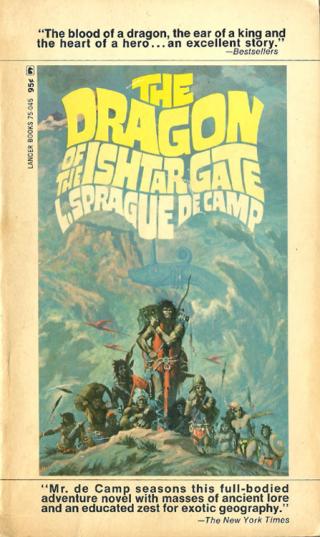
The Dragon of the Ishtar Gate
- Автор: Де Камп Лайон Спрэг
- Год: 1968
- Язык: английский
- Год: Lancer Books
- Жанр: Научная фантастика

Электронная книга - «The Dragon of the Ishtar Gate». Краткое содержание книги:
Dragon is probably closest in mood to de Camp's fantasy novels, while Bronze God and Arrows are closer to his science fiction, with their description of engineering problems, and personality clashes among researchers and engineers. Dragon also reflects de Camp's then-recent acquaintance with the Conan stories and other works of Robert E. Howard. Bessas, the huge Persian nobleman, is not only a close match for Conan in physique, but his mood swings, fixation on his mother, and tendency to toss of verses, seems a reflection of Howard himself. (Fortunately, his poems reflect de Camp's verbal dexterity and wit, not Howard's melancholy.)
"You said we might do with her as we liked!" cried Skhâ hotly.
"Shut up, you bloody little swine! O Shaykh, why did you not put a stop to this?"
"But, my lord, she is only a woman, a slave, and a black! What is the fate of such a contemptible creature to me?"
"How about you, Kothar?"
"I did protest, sir, but they paid me no heed."
"A fine pack of murderers," snorted Bessas. "Kothar, ask her whether, if we free her now, she can find her way home."
Katimar dried her tears and burst into an eager smile. "She says she can easily do so, if given a little food to take with her."
Bessas gave Katimar not only some food, but also a good knife and a fistful of trade copper. The last Myron saw of her, she was limping up the Astapous towards the land of the Megabarri, scores of leagues to the east. And for many days Skhâ sulked, refusing to speak either to Bessas or to Myron save in line of duty.
The ferry at Soba was a rickety little boat of sycamore planks sewn together with cords of palm fiber, holding three including the boatman. Half a day was spent in taking travelers and baggage across and towing beasts of burden by their bridles.
South of Soba the vegetation thickened. A forest of towering gum trees lined the banks of the Astasobas. The sausage tree, the soap tree, and the tamarind appeared. In the shallows of the river grew clumps of papyrus, lifting its feathery fronds eight or ten cubits above the flood.
This gallery forest hid the river from the travelers, save when they stamped and hacked a way through the tangle to reach the water. Their coming disturbed the crocodiles and the herds of hippopotami, which floated with only their eyes, ears, and nostrils showing. Although the greenery was a relief after so many leagues of desert, the insects became annoying.
Outside the forested strips along the river, the land stretched away in a grassy steppe. This plain, rarely interrupted by low hills, was dotted with squat, flat-topped, thorny acacias and deep-red termite hills. Across the river, sand dunes formed the skyline. Antelopes, wild asses, and giraffes appeared in the distance. At night, lions roared, leopards snarled, bushbucks barked, reed-bucks whistled, and hyenas uttered their mirthful yells.
Once a great slate-colored rhinoceros lumbered out from behind a thicket, blinking and twitching its ears. It uttered a volcanic snort, lowered its head, and took a few menacing steps towards the travelers. The horses began to neigh, the asses to bray, and the camels to roar, while all the animals danced with terror. Bessas unsheathed his bow, but Merqetek rode up, shouting in Kushite and Egyptian. Kothar translated:
"He says not to shoot; it will but enrage the brute! He says for all of us to shout and scream!"
The travelers howled and hallooed, while Merqetek, producing a pair of wooden billets, beat them together with a valiant clatter. The rhinoceros snorted, turned, and trotted off across the plain, with its little cloud of tick birds fluttering after it.
The days and the river crept past. The monotonous plain stretched weary leagues to the flat horizon. As they proceeded south, the grass of the prairie lengthened and the thorny trees of the scrub grew larger.
Myron found himself a little disillusioned with Phyllis. Tiring of her gentle but never-ending talk of life in Aineia and her noble ancestry, he tried to educate her by lectures on the world and the theories of priests and philosophers about it. But he quit when he saw that such talk bored her as much as her chatter of home and pedigree bored him.
So Phyllis spent more time with Salimat. Bessas often joined them when they were resting or eating, sending them into gales of giggles with his chaff and beguiling them with tales of his adventurous past.
"Sit down and join us, old man," said Bessas genially to Myron one day. "I was telling the lassies about the time my half brother Moccus and I journeyed across Hind. This country is so stocked with gods that it is easier to meet a god than a man, and Mithra knows the land has a plenty of men.
"After we left mighty Pataliputra, we beat our way to Supara, near the western coast. On the way we fell in with another wanderer, named Shunga, from the Persian provinces of Hind. Gods, but he was a rascal! He dyed his whiskers blue and put on an air of the gravest piety, but he'd steal a bowl of porridge from a puppy dog.
"If a man tell you that the streets of India are paved with pearls, cast the lie back in his teeth. Nor do pigs run about the streets ready roasted. To be sure, the kings and priests are rich, but that is the case in other lands, and the vulgus has as much ado to keep ahead of hunger as elsewhere.
"It is hard for the traveler in Hind to earn an honest living, because all occupations are regulated by ancestry. Every man must follow his father's trade, according to the class into which he is born, and there is nothing left for the stranger to do. Nor will they ever change their ways. When an Indian says, 'This is not according to custom,' that ends the matter.
"Hence we reached Supara nigh to starving, having run out of gold and silver and failing to find a way to get our hands on more. We were reduced to filching melons in the market place when Shunga told us of a great cave temple near Supara. This temple was, he said, full of gold and jewels to be had for the taking.
"Now, I am not uncommonly pious, but I like not to meddle with gods, especially strange gods on whose mercy I have no claim. But Shunga talked us round. He was worse than you Greeks at finding fancy reasons for doing things one wants but ought not to do.
"This temple was quarried out of the side of a mountain. Behind an ornamental stone gateway lay a short corridor, which widened out into a series of chambers: first the hall of offerings, then the dancing hall, then the hall of assembly, and lastly the shrine, a small room wherein stood the statue of the god Vishnu.
"Shunga had a scheme for getting into the shrine, namely: to make friends with the guard on duty at the entrance, ply him with rice wine laced with a decoction of poppy seeds, and thus put him to sleep. Shunga assured us that on this particular night there would be no ceremony, so all we had to do was to wait until the priests were asleep, pry loose a few kings' ransoms' worth of jewels from the statue, and flit out again.
"Getting in proved easy. With my heart beating like a blacksmith's hammer, I followed Shunga through the halls and into the shrine, where rose the great four-armed statue of the god, with a shawl of cloth of gold draped over his shoulders. Shunga lit a tiny lamp, set it in a corner, and covered it with a cone of oiled sheepskin, so that enough light came through to keep us from stumbling over our own feet.
"We were prowling around the statue, trying to decide which of the glorious rubies and emeralds and sapphires and opals and sardonyxes and topazes and other baubles to pry out first, when Moccus gave a little yelp and whispered: 'Ye gods, what is that?'
" 'That is only the sacred python,' said Shunga. 'Pay it no heed; it is probably drugged. Boost me up so that I can get at the jewels on the statue's girdle.'
"We had begun to do this when light and sound from the outer chambers warned us that something was toward. And there we were, trapped at the bottom of a bag, just as Myron and I were in that damned Egyptian tomb.
"Shunga put out his light, and we clustered behind the statue. Soon the audience hall was lit by torches, brightly enough to read by. Peering around the legs of the god, we saw a gallant procession coming towards us. Shunga whispered: 'The gods have mercy on us, but that fat fellow with the fancy feathers in his turban is the king of Supara. He has come to ask the god some question.'