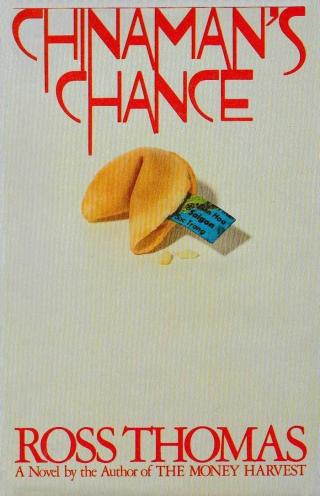
Chinaman’s Chance
- Автор: Томас Росс
- Серия: Arthur Case Wu #1
- Год: 1978
- Язык: английский
- Год: Simon & Schuster
- ISBN: 978-0-671-24070-7
- Жанр: Политические детективы

Электронная книга - «Chinaman’s Chance». Краткое содержание книги:
“And what does the man want?” Durant said.
Ploughman decided it was time to check out the ocean again. He turned in his chair. “A little industry, maybe a new post office, maybe a state headquarters located here. Maybe a couple of Federal programs. A slice of the pie, really; that’s all.” He turned back again, a large, yellow smile on his face. “Like it?”
“The Ploughman Machine,” Artie Wu said.
A look of pure delight spread across Ploughman’s face. He tried the new name out, almost breathing it. “The Ploughman Machine. Now, by God, that’s got a ring to it, I must say. You like it, huh?”
“What?” Durant said.
“What I just told you.”
“Oh, sure,” Durant said. “You run the cops and the cops run the city and you’ve got it wired. Maybe a little touch of fascism here and there, but what the hell, who’s to notice?”
“I can think of some people,” Artie Wu said.
“Them, you mean?” Ploughman said.
“Yeah, them,” Wu said. “Are you going to deal them in or out?”
“Well, now, that sort of brings us up to where we are right now, doesn’t it?”
“Where’s that?” Durant said.
“Well, they’ve kind of got some plans for this town — plans that maybe I don’t necessarily go along with on account of they would sort of have me running errands. Well, these plans they’ve got, they’re sort of secret, and Congressman Ranshaw was kind of poking around in them before he got himself killed. In fact, I had a few lines out to the Congressman to see if he and I couldn’t work something out together. But then he went and got himself killed before anything came of it.”
“You keep saying ‘sort of,’ ‘kind of,’ ” Wu said. “Does that mean you’re on the outside looking in?”
Ploughman grinned. “Sort of. Kind of.”
“But you’ve got some pretty good ideas of what they’re up to?”
“Yeah, I do. And so when somebody like Mr. Simms suggests that maybe I oughta keep an eye out for you two, I get a little bit curious. I wonder just what Mr. Simms has in mind. I mean, maybe you two guys are gonna upset his honey wagon and get shit all over his face, which would be too bad.”
“Yeah, wouldn’t it?” Artie Wu said.
“But I went and did what he told me to, of course. I threw you in down there with the animals, although I hear they didn’t give you too much trouble. But I can tell Mr. Simms I did my duty — just in case he asks. But you know something?”
“What?” Durant said.
“Mr. Simms, he’s still sort of worried about Congressman Ranshaw.”
“Oh?”
“Yeah, it seems that the Congressman had a girl friend who he was awful tight with. And this girl friend maybe knew everything that the Congressman knew before he got himself killed. Now, guess who this girl friend was?”
“Who?”
“You guys don’t know?”
Durant shook his head. “We didn’t say that.”
Ploughman picked up the bottle of gin and poured another drink into each of the three glasses. He then held his up and looked into it as if perhaps its contents would explain life’s mystery.
“You wanta know when this country started going bad?”
“When?” Wu said, and tried some of the warm gin.
“When the fucking Beatles came on the scene, that’s when. First the Beatles and then Kennedy got shot, or maybe it was the other way around, and then the war got going pretty good and then the whole damn country went to hell and there the Beatles were like some smart-ass chorus in the background. I never bought any of their records. You know whose records I used to buy?”
“Whose?”
“The Armitage Sisters, that’s who. Ivory, Lace, and Silk. Now, those girls knew how to sing. I mean, they might’ve been kind of loud, but by God, you gotta admit they could belt out a song. And the words made sense and rhymed and didn’t make you wanta go jump off a bridge, although they could make you a little sad, too, sometimes.”
Ploughman finished his gin in a gulp. “Silk Armitage was Congressman Ranshaw’s girl friend.”
“We know,” Durant said.
“Mr. Simms would sort of like to find her. Before anybody else does.”
Artie Wu blew a smoke ring. The three men watched it rise toward the ceiling, disintegrating along the way. “So would we,” Wu said.
“So that’s it, huh?” Ploughman said.
“That’s it,” Durant said.
“I’m sort of walking a tightrope, you know.”
Durant nodded. “Yeah, we know.”
“What would happen to Simms and all those nice fellas he’s fronting for if you found Silk Armitage before they did?”
“Nothing good,” Wu said.
“That a fact?”
“That’s a fact.”
Ploughman nodded and spun around for a quick look at the ocean. “Why don’tcha give me a ring Monday? Maybe Monday morning, and I might tell you where you oughta look.”
“Will it be a race?” Durant asked. “Between us and them?”
Ploughman turned back around. “Maybe.”
Durant and Wu rose and moved toward the door. Ploughman watched them. “Monday morning,” Durant said. “We can count on it?”
Ploughman grinned, much the way that old wolves sometimes grin. “You’ve got the word of the Ploughman Machine.” He shook his head with pleasure. “By God, I do like the way that sounds.”
Chapter 26
In the kitchen of the fortune-teller’s house on Breadstone Avenue the four young persons, two men and two women, watched silently as Silk Armitage wrote out the last check for $5,000. The tip of Silk’s tongue peeked out from one corner of her mouth as she signed her name, tore the check out, and handed it to Cindy Morrane, a pretty woman of twenty-six with glasses, a deadly earnest expression, and thick blond hair that she kept cut short.
The five of them were seated around the big table in the kitchen. The table was covered with worn oilcloth. Cindy looked at the check for a moment and then placed it on the table before her. The three other young persons had done the same with their checks.
One of the men, John Butler, a lawyer who was twenty-five and very tall with a rather ugly, horse-sense face, cleared his throat and said, “You don’t have to do this, Silk.”
“You all’ve done all you can,” Silk said. “I want you out of the way, somewhere safe. Saint Thomas is nice. Really it is.”
“And you?” Cindy Morrane said.
“I don’t want you to know where I’ll be. If somehow something goes wrong — well, I just don’t want you to know where I am. It’s better for you.”
The other young woman seated at the table picked up her check and placed it in her purse. She was Joan Abend, at twenty-seven the oldest of the four young persons and an economist who had earned her doctorate at Berkeley. She had a round, pleasant face, streaked brown hair, and calm, wise, hazel eyes. Like everyone else at the table, she had built her faith on the slippery rock of socialism, and there was nothing she liked better than baiting Maoists, assorted Communists, and old-line Trotskyites with her biting logic. Conservatives weren’t nearly so much fun, because they usually got mad before they got to the point. As for liberals, well, liberals were the kind who worked for Exxon during the day and then snuck off to stuff envelopes for Common Cause at night. Liberals, in Joan Abend’s opinion, would file docilely into the corporate concentration camps wearing buttons that read, WE MEANT WELL.
After she placed the check in her purse, Joan Abend snapped it closed with an air of finality and said, “Silk’s right. As usual. We’ve gone nearly as far as we can go.”