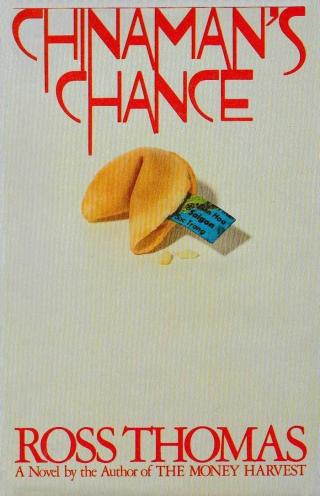
Chinaman’s Chance
- Автор: Томас Росс
- Серия: Arthur Case Wu #1
- Год: 1978
- Язык: английский
- Год: Simon & Schuster
- ISBN: 978-0-671-24070-7
- Жанр: Политические детективы

Электронная книга - «Chinaman’s Chance». Краткое содержание книги:
“The Turk, he’s still in,” Lake said.
“What about Jimbo?”
Lake nodded. “Yeah, he’s still there.”
Ploughman looked at Durant. “Like you say, animals. Real animals.” He shifted his gaze back to Lake. “Lieutenant, I think you can take Mr. Durant and Mr. Wu down now so they can get a little rest. And maybe when they’ve sobered up, well, maybe they can come back up here and we’ll go on with our little talk. I don’t know about you two,” he said, looking at Durant and Wu again, “but I’m finding it real interesting. Are you?”
“Extremely,” Artie Wu said.
Chapter 24
At approximately the same moment that Wu and Durant were being pulled over to the curb in Pelican Bay, Reginald Simms was turning his light brown, three-month-old leased Jaguar sedan right off Sunset into Bel Air’s west gate entrance.
Simms didn’t care much for Bel Air, finding it a bit gauche and showy, although certainly not so much so as Beverly Hills. At least in Bel Air the thick shrubbery afforded some vestige of privacy. In Beverly Hills, of course, it was simply naked wealth screaming to be envied.
Simms felt that power and wealth needn’t be advertised — indeed, shouldn’t be. His idea of city living was the quieter reaches of the East Sixties and Seventies in New York or Georgetown in Washington. And London, of course — almost anywhere in Mayfair.
But this, however, was California — Southern California, at that — and here, Simms felt, you were what you appeared to be. It was a section of the country that put a very high premium on face value.
Simms was on his way to a meeting with his former college roommate and present business associate, Vincent Imperlino, whom he always thought of as Imp. Simms was fairly sure that he was the only person in the country who still called Imperlino by that diminutive; doubtless the only one who dared to. Both men had traveled a far distance since their days at Bowdoin, but Simms was not at all surprised by their joint destination, which, when he thought about it, seemed somehow almost inevitable. During the years he had spent in Southeast Asia, Simms had acquired a hard streak of fatalism, which he now found comforting.
He and Imperlino had several matters to discuss, but the principal one would be how best to go about killing Silk Armitage. Simms made his mind form the word “murder” and derived a trace of sardonic amusement from the fact that the word made him experience no discernible revulsion. It had been a long time since the word or its concept had made him feel anything at all, and he promised himself that during the discussion with Imp he would use the word itself rather than some euphemism. He decided that Imp’s reaction — if any, of course — might prove amusing.
The turn that Simms was looking for was about two miles up into the hills. It was a narrow, twisting road with a sharp grade, and at the top of it were the huge iron gates that had come from France, and in front of them was the guard, one of the three who kept a constant twenty-four-hour vigil.
The guard wore no uniform — unless, of course, you thought that a Shetland tweed jacket and gray flannel trousers were a uniform: a kind of preppy one that somehow smacked of the 1950s and lost innocence. However, there was nothing innocent about the guard or his too careful eyes that stared down at Simms from a thirty-year-old face as dubious as a question mark.
“Mr. Simms?” the guard said, nothing but doubt in his voice.
“Yes,” Simms said.
“Would you mind?” the guard said, and held out his hand.
Simms produced his driver’s license and handed it to the guard, who looked back and forth several times from the color photo on the license to Simms. He had seen Simms before and knew who he was. But in this job you didn’t make mistakes. If you made a mistake, you got buried. Or worse.
The guard, Simms’s license still in his hand, moved over to the gate and used a house telephone to call somebody. As he talked into the phone, he kept his eyes on Simms. Finally, he hung up the phone, went back to the Jaguar, and grudgingly handed Simms back his license.
“Okay, Mr. Simms,” the guard said, and returned to the massive stone gatepost, pressing a button that swung the iron gates open. Simms drove through slowly, the carefully combed gravel of the drive crunching loudly under his tires. But that was what the gravel was there for — to make a noise. A loud one.
The nearly ten acres of grounds that formed Imperlino’s estate were carefully landscaped, but all Simms saw was green trees and shrubs and bushes with flowers that were either yellow or red or orange or blue or purple. Simms had never been interested in vegetation and knew the names of hardly any flowers other than roses and tulips. But he didn’t pride himself on his ignorance. It was simply that green, growing things had never interested him.
Simms preferred things that were built and made by man. That was why it was with some anticipation that he approached the crest of the hill, for on the other side of it, down in a kind of knell, was Imperlino’s dream, the childhood fantasy that he had made come true: the house that was, Simms knew, an extremely private joke.
Reginald Simms was probably one of the four or five persons in the United States who knew that Imperlino had handed his architect a forty-year-old volume of fairy tales, smeared with old chocolate and Crayolas, turned to a page, pointed to a picture, and said, “Make it look like that.”
“Exactly?” the architect had asked.
“Exactly like that,” Imperlino is supposed to have said. “But bigger.”
Simms didn’t stop his car when he reached the crest of the hill. That would have been unwise. But he slowed down enough so that he could enjoy the view.
The house was really too big to nestle, but that was what it seemed to do. Perhaps it was because of the trees that surrounded it down there in the knell, big tall pines and eucalyptus that were almost as high as the south tower where, in the fairy story, the good old witch had lived.
The roof, although made out of thick shake cedar shingles, somehow looked as though it were thatched, perhaps because of the way that the shingles curved back in under the eaves. The windows were all mullioned and irregularly, almost haphazardly, placed, and the brickwork seemed to be at least two hundred years old, which most of it was, having been salvaged from old houses in Boston and Richmond.
The house was two stories high in spots, one and three stories in others, and almost four stories where the tower was. It was the house where the good witch had lived a long time ago somewhere in England, and it was a triumph of practicality over whimsy and God knew how much it had cost. A lot, Simms thought. A whole hell of a lot.
After Simms parked his Jaguar behind a dark green Lincoln Continental, he got out and started toward the heavy oak door with its curious carvings and its heavy iron straps. The carvings were supposedly the cabalistic signs of magic, but no one was really sure of this because they too had been copied from the book of fairy tales.
The door opened before Simms reached it. The opener was a medium-sized man of about fifty-five with a hard, lined face, gray hair, and sure moves. He wore a black suit, a white shirt, and a dark tie. He was called Mark, although his name was Marcello Balboni, and he seldom spoke, if ever, because someone had forced most of a can of Drano down his throat in 1946 during a dispute on the Hoboken docks. He had been given to Imperlino as a college graduation present in 1952 and he did whatever Imperlino told him to.
Balboni nodded at Simms and then beckoned to him to follow with another kind of nod. Balboni had an extensive repertoire of nods and shrugs and gestures, which he used instead of words because his voice sounded very much like a parrot’s speech.