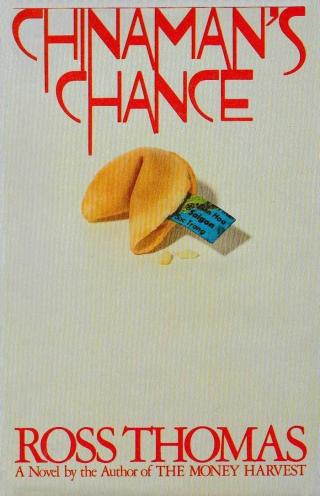
Chinaman’s Chance
- Автор: Томас Росс
- Серия: Arthur Case Wu #1
- Год: 1978
- Язык: английский
- Год: Simon & Schuster
- ISBN: 978-0-671-24070-7
- Жанр: Политические детективы

Электронная книга - «Chinaman’s Chance». Краткое содержание книги:
Simms followed Balboni down a hall of dark slate slabs. The hall, paneled in some kind of old, very dark, almost purplish wood, angled and twisted this way and that: Hung on the paneling at carefully spaced intervals was a series of old portraits of long-dead, thin-nosed people dressed in the clothing of the fifteenth and sixteenth centuries who all looked as if they might be kin to either Machiavelli or the Borgias.
After another confusing turn, the hall went up three steps. A few paces beyond the steps Balboni stopped, knocked once on a door, then opened it and with a jerk of his head indicated that Simms should go in.
Simms entered a large, book-lined room with leaded windows that looked out over a small, pretty English garden. It was a strongly masculine room with an ancient, trestlelike table that served as a desk. The rest of the furniture was mostly heavy stuff made out of dark leather and even darker wood. An Oriental rug, very old and very thin, covered most of the polished oaken floor.
Vincent Imperlino stood by the blazing fireplace beneath the oil portrait of a woman. He held a book in his hand, his place marked by a finger. It was difficult for Simms to remember when he had seen Imp at home without a book in his hand.
Imperlino smiled at Simms as they shook hands. He had an engaging smile, very white, very confident — an interesting contrast to Simms’s own warm but strangely shy one.
“It’s good to see you, Reg,” Imperlino said, and Simms said something equally polite and then watched as his former roommate turned and stared up at the portrait of the woman whom Simms now recognized as Ivory Armitage.
Imperlino stared at the portrait for several moments. He was a tall man, almost as tall as Simms, and sturdily built, but not yet heavy, although he might get that way in a few more years. He had one of those thin, handsome noses that saved his face from being brutal, although his eyes helped too. The eyes had the color and sheen of melted milk chocolate, and they were too soft and too gentle for the rest of his face with its heavy, thrusting chin and wide, nearly lipless mouth that, unless it was smiling, looked cruel and unforgiving.
Imperlino’s hair was nearly all of the same length, graying at the roots and it hung down over his head like some medieval cap. It seemed to have been carelessly combed with his fingers, but it went well with the book in his hand and the dark green cashmere slipover sweater, the white open shirt, and the dark gray trousers. He could have been some professor of comparative literature at a large California college — a ruthlessly ambitious professor perhaps, with designs on the chairmanship of his department.
Still staring at the portrait of the late Ivory Armitage, Imperlino said, “What do you think?”
“It’s quite good.”
“Yes, it is, isn’t it? I had it done by the same chap who painted one of her sister Lace — the one who’s the actress now. He had to do it from photographs, of course, but he had met Ivory once or twice, so he was able to draw on that too. I’m really quite pleased with it.”
Imperlino turned from the portrait. “Well, a drink? I have some sherry that you might like.”
“Good.”
Imperlino seemed to remember the book that he held in his hand. He looked at it and smiled fondly. “Rilke. I’ve been trying to read him in German with the help of a dictionary and the English pony that’s printed on the facing page. But my German is almost lost, and I tend to cheat. Do you read Rilke much anymore?”
“No.”
Imperlino put the book down and moved over to a nearby tray that held some cut-glass decanters and several glasses. “You should,” he said, pouring two drinks. “He improves with age. My age, I mean. I tried reading Rupert Brooke the other day, for no very good reason, and found him unbearably young; but then, of course, he was.”
He turned and handed Simms his drink. “How are you finding your middle years, Reg? I don’t think I’ve ever asked.”
Simms smiled. “Tolerable. And you?”
Imperlino shrugged. “I live in this rather splendid isolation which I more and more prefer, but I’ve been thinking about you and your new and rather romantic role as the disillusioned patriot turned renegade. Do you find it comfortable?”
“Both comfortable and profitable.”
“And you don’t miss the other — all that derring-do and arcanum and hugger-muggery?”
“Most of it was dull,” Simms said. “Dull and often pointless. What I do now I find amusing, even intriguing. Plus there’s a comforting absence of personal risk. I don’t miss that at all, which must be a sign of some sort of maturity.”
“And the fate of the republic?” Imperlino’s tone was more amused than sarcastic.
If it was bait, Simms refused to rise to it. Instead he smiled and said, “That weight seems to have been shifted to other, surprisingly sturdy shoulders.”
“You know,” Imperlino said, gesturing Simms to one of the wing-backed chairs that were drawn up before the fireplace, “you should have come in with me right after college.”
“Your hindsight is almost as good as mine.”
Now seated in one of the chairs, Imperlino crossed his legs and examined Simms in a rather speculative manner. His chocolate eyes seemed to harden and cool. “So,” he said, “no regrets?”
“None.”
“And your former colleagues?”
“Fuck the fuckers, as a number of my new associates seem fond of saying.”
Imperlino smiled slightly. “Yes, some of them are a bit awful, aren’t they? Particularly that little man, the one who runs the gymnasium in Venice — uh—” Imperlino snapped his fingers as if trying to recall the name.
“Gesini,” Simms said. “Solly Gesini.”
“Yes. What happened there?”
“I have to assume,” Simms said, “that he’s incompetent. I offered him twenty thousand to murder young McBride, and his people apparently botched the job.” Simms watched carefully to see whether Imperlino would react to the word and was amused when he didn’t.
“No problem with the police, though?”
Simms shook his head. “None.”
“But McBride could still be embarrassing, couldn’t he? But nothing more than that.”
“No, nothing more.”
“Then I suggest that you have Gesini himself kill McBride.”
“Is he capable?”
“Killing is his trade — or perhaps I should say murder.” A small smile ran about Imperlino’s thin lips — more of a twitch than a smile, really — and Simms realized with some small, odd pleasure that he had been caught out.
Imperlino sipped his sherry and went on. “Surprised? Well, back in the ’50s and early ’60s our little fat friend was the top assassin on the West Coast. I don’t think he’s demented enough to enjoy it, but he kills absolutely without compunction.”
“Then I’ll put him on it again,” Simms said.
“You might invoke my dread name. He’s frightened to death of me for some reason.”
“I can imagine.”
“Now, then,” Imperlino said, “we seem to have a couple of other visitors from your past, the ones you mentioned over the phone.”
“Durant and Wu.”
“Yes. Should they concern us?”
“I’m not sure,” Simms said. “They might want to repay me for something that arose a few years back out of a misunderstanding — carelessness on my part, really. But they’re not exactly the ‘don’t get mad, get even’ types — unless they could make a dollar or two out of it.”
“They’ve learned to cut their losses, I take it?”
“A long time ago,” Simms said. “But anyway, I’ve heard that they’ve been in touch with young McBride, although, knowing them, they must have found his scheme rather ridiculous.”
“So what do they want?”