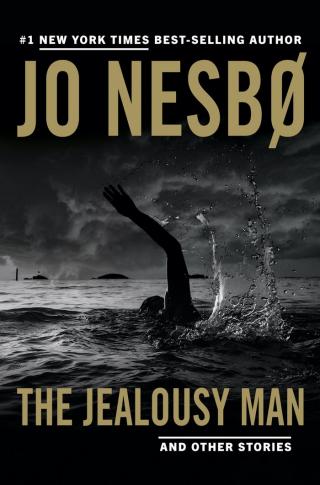
The Jealousy Man and Other Stories
- Автор: Несбё Ю
- Год: 2021
- Язык: английский
- Год: Alfred A. Knopf
- ISBN: 978-0-593-32100-3
- Переводчик: Robert Ferguson
- Жанр: Криминальные детективы

Электронная книга - «The Jealousy Man and Other Stories». Краткое содержание книги:
A detective with a nose for jealousy is on the trail of a man suspected of murdering his twin; a bereaved father must decide whether vengeance has a place in the new world order after a pandemic brings about the collapse of society; a garbage man fresh off a bender tries to piece together what happened the night before; a hired assassin matches wits against his greatest adversary in a dangerous game for survival; and an instantly electric connection between passengers on a flight to London may spell romance, or something more sinister.
With Nesbø’s characteristic gift for outstanding atmosphere and gut-wrenching revelations, The Jealousy Man confirms that he is at the peak of his abilities.
It didn’t take long from the discovery of the virus to the outbreak of the pandemic and the sudden dissolution of everything. People dropped like flies. In the first instance from the disease, then as a result of the collapse of the economy and the social and political institutions. Naturally, the poor were hardest hit by the pandemic; bad news always operates that way. But it was not until food shortages occurred that the situation changed from being something societies tried to tackle together into a struggle between the haves and the have-nots. First pitting the poor against the rich, and then the poor against the poor, until finally the only ones who weren’t enemies were family and friends. The food shops were empty, and in due course the gun shops too, although the production of guns and rifles was about the last to stop. The forces of law and order, already breaking down, collapsed. The richest barricaded themselves in behind the walls of their farms and country mansions, preferably on elevated sites which were easier to defend. A few of the very richest, such as Colin Lowe, who had seen the coming of the collapse long before the pandemic, had taken the precaution of acquiring private estates and islands that were self-sufficient and guarded by private militia equipped with the latest in weapons technology. Paradoxically the virus helped them in their struggle against those who posed the greatest threat to them: hordes of the poor and the desperate. Because the virus spread out of control in and around households where people lived in crowded conditions without health insurance and unable to afford to follow the government’s quarantine rules. But once the pandemic had levelled off and become less of a threat than the plundering I think the hardest hit were those stuck in the middle. Those with something that could be taken from them but without the means to protect and defend it. And once they had lost everything these people also turned into plunderers. Poverty, desperation, violence, all were contagious.
When the pandemic started I was head of the legal department of Colin’s IT company. The virus came from the east, from the other end of the country, but it swept over us — the majority, the safe middle class — before we had time to react.
When Colin first showed me Rat Island five years earlier, a tiny prison island of no more than a hundred hectares not far from the airport, I’d teased him about being a doomsday prepper, one of those paranoid wackos who spends all their time preparing for the worst, for the day when they have no one but themselves to rely on. The reason there are so many of them in our country probably has something to do with the culture of individual liberty here. You make your own luck and no one’ll stop you, but no one’ll help you either.
‘It’s just common sense,’ was his reply when I suggested that it was bordering on the paranoid. ‘I’m an engineer and a programmer, and people like us aren’t hysterics who go around thinking the end is nigh. We just reckon on the likelihood of something unlikely happening, same as we do in our work. Because there’s one thing you can be sure of, and that is that, given enough time, everything — but absolutely everything — that can happen will happen. The likelihood of the breakdown of society in my lifetime isn’t great, but then it isn’t negligible either. When I multiply that likelihood by what it would cost me, financially and in terms of quality of life, what that gives me is the price I should be willing to pay for my insurance. This—’ he gestured with his hand in the direction of the barren and rocky island with the empty concrete buildings that had once been built to keep killers in, not out — ‘is a small price to pay if I want to sleep better at night.’
At that time I was not aware that he already had cabinets full of weapons there. Nor that the reason he and several of his director friends had undergone laser surgery to correct near-sightedness had not been cosmetic but from the knowledge that in a world without law and order it would be difficult to get hold of either spectacles or contact lenses, and that clear eyesight would be critical in a struggle to survive that would have brought us a step closer to the Stone Age.
‘No reason not to be prepared, Will. If only for your family’s sake.’
But I had not been prepared.
It is not the case that the looting started when the authorities decided to open the prisons which had, in effect, become chambers of death in which isolation was impossible and the virus spread unhindered. The numbers of prisoners released in this way was not sufficient in itself to account for the chaos. It was the feeling it created. A feeling that the authorities were losing control, that law and order were suspended, that soon we would have to grab whatever we could before others grabbed it first. Nor was it that we failed to see or understand what was happening. It was not an irrational fear. We knew that if we could just put this pandemic behind us — and in some countries it was already on the wane — we would be able to return to our normal lives. But we also saw that fear had grown stronger than the common sense of the herd. It wasn’t mass hysteria but the lack of a shared common sense. So people made individual choices that were rational and sensible for themselves and those they loved, but catastrophic for the rest of society.
Some became looters and turned to violence out of sheer necessity.
Others — like Colin’s son Brad — did so because they wanted to.
Brad Lowe’s relationship with his father was complicated. As his firstborn, Brad was the one Colin expected to take over the business after him. But it wasn’t something Brad was cut out for. He lacked his father’s intellect and his capacity for work, had neither his vision nor his desire to change the world, and none of his charm or his ability to enthuse others. What he had inherited from his father was an egotism that was at times infinite, and a willingness to sacrifice everything and everyone in pursuit of his goal. It might involve Brad using his father’s money to bribe the trainer to pick him for the college football team ahead of others with more talent. Or persuading his father to give him money for a project he and his friends had started to help less fortunate students but which, as it turned out, went towards drugs, women and wild parties in the off-campus house they rented. The final straw that made Colin remove his son from college was when the dean informed him that Brad had physically threatened him after it was discovered he had forged documents to make it look as though he had passed certain exams he had not even taken.
Brad came back home the ultimate loser that summer. And I couldn’t help but feel sorry for him. For years our families used to spend mountain holidays in an enormous two-storey cabin we rented together until Colin bought the place. The bad relationship between father and son made it hard for the rest of us to be around Brad. Because he wasn’t a boy without feelings. Quite the contrary, in fact; he had way too many of them. He loved and admired his father. It had always been that way and was something people could see clearly. A lot more clearly than the fact that the father loved his son. Now Brad’s emotions veered wildly between despair, anger, an apathetic indifference and an aggression directed against everyone who didn’t do what he wanted them to, whether one of his family, one of ours, or one of the employees at the cabin. And that was when I discovered the other Colin inside Brad. The one who appeared when Colin’s seductive intelligence and contagious enthusiasm failed to persuade people: the threatening person. The Colin who could almost on a whim buy up some troublesome little competitor, strip its assets and put the workers out of a job. On the couple of occasions when I had trashed Colin’s plan on legal grounds he had become so angry that I know he was within a whisker of firing me. I know because I recognised from childhood the black look that came into his eyes when he didn’t get his way.