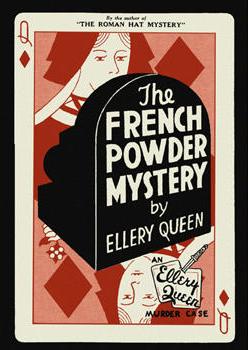
The French Powder Mystery
- Автор: Куин (Квин) Эллери
- Серия: Ellery Queen #2
- Год: 1930
- Язык: английский
- Год: Frederick A. Stokes
- Жанр: Классические детективы

Электронная книга - «The French Powder Mystery». Краткое содержание книги:
“Then,” said Ellery, “you took a duplicate of the book and the book was Fourteenth Century Trade and Commerce, by a gentleman named Stani Wedjowski.”
“Correct,” said Weaver. “On that third occasion, it came to me that the addresses were of vital importance. What that importance was I had no idea. But I realized that the books were there for some purpose, and I decided to try a little experiment. In the case of the Wedjowski book, after Springer had gone I got another copy of the book, marked the date in the back for reference, made a private note of the new address, and took the duplicate book back upstairs with me to study. Perhaps, I thought, there’s something about this book that will enlighten me. I left the original exactly where Springer had placed it, naturally.
“I studied that book until I was blue in the face. I couldn’t make a thing of it. And I repeated my tactics for the next four weeks — Springer did his mysterious little job every eight days, I noticed — and studied my duplicate books very assiduously. They didn’t make sense, and I was getting desperate. I might add that all this time I had been keeping tabs on Springer’s records, and I was just beginning to see light. Springer was taking advantage of the one flaw in the departmental system, and was falsifying his accounts in a devilishly clever manner. And then I knew that the books must have some significance — whether connected with my own investigation or not I didn’t know. But I had no doubt now that they signified something crooked.
“At any rate, by the sixth week I was quite desperate. This was Monday evening — the night of the murder, although I had no idea of what was going to happen within a few hours. I watched Springer as usual, saw him go through the customary ritual, and leave. But this time I meant to do a daring thing. I took the original book.”
“Good for you!” cried Ellery. He lit a cigaret with unsteady fingers. “Brilliant, in fact. Go on, Wes; this is tremendously exciting.” The Inspector said nothing; Crouther regarded Weaver with a new respect.
“I duplicated the markings in another book exactly and placed it where Springer had left the original, which I took away with me. I had to do these things in a hurry, because I meant to follow Springer that night to see if I could get any clue from his movements. I was in luck, because he had stopped to chat with O’Flaherty. As I dashed out of the building, Springer’s latest book under my arm, I was just in time to see him turn the corner on Fifth Avenue.”
“Regular detective,” remarked Crouther admiringly.
“Well, hardly,” laughed Weaver. “At any rate I followed Springer’s wandering trail all evening. He had dinner alone in a Broadway restaurant and then went to a movie. I stuck to his trail like the fool I am, I suppose, because he did nothing at all suspicious, telephoned no one, spoke to no one, all evening. Finally, about midnight, he got home — he lives in the Bronx in an apartment house. I watched that house for an hour — even pussyfooted up to the floor on which his apartment is. But Springer stayed in. And so I finally went home, still carrying Springer’s book, but no wiser when I left him than when I’d begun to follow.”
“Nevertheless,” said the Inspector, “you showed good judgment in sticking to him.”
“What’s the title of that sixth book and where is it? How does it happen that I didn’t find it among the five others in French’s apartment? You put the five books there, of course?” asked Ellery rapidly.
“One at a time,” pleaded Weaver, smiling. “The book is Modern Trends in Interior Decoration, by Lucian Tucker...” Ellery and the Inspector exchanged glances at Weaver’s mention of the author’s name. “You didn’t find it among the other five because I didn’t leave it there. I took it home with me. You see, I felt all along that the duplicates weren’t important. It was evidently the originals that counted. Perhaps I was wrong, but I certainly figured that the sixth, being an original, was more precious than the other five. So I put it in a safe place Monday night when I got home — my own bedroom. As for the five, the reason I kept them at the store was that I was studying them at odd moments and wanted them handy. I didn’t want to bother the Old Man about them and the whole business, because he was having his hands full negotiating this new merger with Whitney, and he always leaves details to me anyway. So I merely slipped each book, as I got it, between the book ends on the Old Man’s desk. I also took away one of the Old Man’s books to keep the count similar, and merely hid them in the bookcase, behind odd volumes there. In this way, by the end of five weeks the Old Man’s five books had entirely disappeared into the bookcase, and the duplicates of Springer’s books were between the book-ends. I meant to explain if the Old Man noticed the new volumes on his desk, but he didn’t, so I didn’t bother. Those ‘favorites’ of his are mere atmosphere, anyway; he’d got so accustomed to seeing them there on his desk that he sort of took it for granted they were still there, even though he was up and about that desk every day for weeks. It often happens that way... As for Springer noticing the strange books on the desk, that was impossible. Springer never had occasion to come to Mr. French’s apartment.”
“Then I take it,” demanded Ellery, with a creeping light of animation in his eyes, “that you put the five books between the book-ends week for week? In other words, that the first book, the Wedjowski thing, was on that desk six weeks ago?”
“Exactly.”
“That’s most interesting,” said Ellery, and subsided in his chair.
The Inspector stirred into action. “Here, Weaver, let’s have a look at those addresses. You have them on you, I think you said?”
For answer, Weaver took a small notebook from his breast-pocket and extracted a slip of paper. The Inspector, Ellery and Crouther bent curiously over to read the seven addresses.
“Well, I’ll be—” The Inspector’s voice was hushed, quietly throbbing. “Ellery, do you know what these are? Here are two addresses that Fiorelli’s boys have had under suspicion for weeks as depots for the distribution of dope!”
Ellery dropped back thoughtfully, while Crouther and Weaver stared at each other. “I’m not particularly surprised,” said Ellery. “Two, eh? That means all seven are probably dope-distributing headquarters... changed from week to week... clever, no doubt about it!” Suddenly he started forward. “Wes!” he almost shouted, “the sixth address! Where is it? Quickly!”
Weaver hastily produced another memorandum, The address was a number on East 98th Street.
“Dad,” said Ellery at once, “this is remarkable luck. Do you realize what we’ve in our hands? Yesterday’s dope depot! The date — May twenty-fourth — Tuesday — the trail is so hot it sparks!”
“By the lord Harry,” muttered the Inspector, “you’re right. If that 98th Street place should still be tenanted — I can’t see why not—” He sprang to his feet and reached for the telephone. He gave the number of Police Headquarters and in a moment was speaking to Sergeant Velie. He spoke rapidly, had his call switched to the office of the Narcotic Squad. He spoke tersely to Fiorelli, head of the Squad, and hung up.
“I’ve just tipped off Fiorelli and they’re going to raid that 98th Street address immediately,” he said briskly, taking a pinch of snuff with practiced fingers. “They’re taking Thomas with them, and they’ll stop here to pick us up. I want to be in on this one!” His jaw stiffened grimly.
“Raid, hey?” Crouther rose and tightened his muscles. “Mind if I go along, Inspector? Be a picnic for me — that’s a fact!”