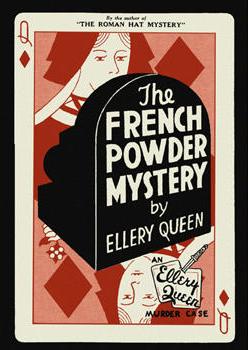
The French Powder Mystery
- Автор: Куин (Квин) Эллери
- Серия: Ellery Queen #2
- Год: 1930
- Язык: английский
- Год: Frederick A. Stokes
- Жанр: Классические детективы

Электронная книга - «The French Powder Mystery». Краткое содержание книги:
But Ellery was suddenly plunged in thought. His eyes had spied the five books from French’s desk, which now lay on an end-table nearby. With an indistinct murmur of sympathy, he rose and sauntered over to the table, fingering the books affectionately. The old man’s eyes narrowed.
“Out with it!” he said. “You’ve discovered something in those books!” He hopped out of his chair suspiciously.
“Yes, I think I have,” replied Ellery slowly. He picked up the five books and carried them to the breakfast-table. “Sit down, dad. My work last night wasn’t entirely wasted.”
They sat down. The Inspector’s eyes were bright and curious as he chose one of the books at random and riffled its pages aimlessly. Ellery watched him.
“Suppose, dad,” said Ellery, “you take up these five books and go through them. Here’s the situation. You have five volumes, the only fact to go on being that they’re queer books for a certain person to possess. You’re looking for a reason to explain why those five books are where they are. Go to it.”
He lit a cigaret thoughtfully and leaned back in his chair, blowing smoke at the paneled ceiling. The Inspector seized on the volumes and attacked them singly. When he had finished with one, he took up the next, and so on until he had examined all five. The wrinkles on his forehead deepened. He looked up at Ellery out of very puzzled eyes.
“Danged if I can see anything remarkable in these books, Ellery. There doesn’t seem to be a point of similarity among them.”
Ellery smiled, drew his body forward abruptly. He tapped the books with a long forefinger for emphasis. “That’s exactly why they are remarkable,” he said. “There doesn’t seem to be a point of similarity. And in fact, except for one little link, they haven’t any points of similarity.”
“You’re talking Greek,” said the Inspector. “Elucidate.”
For answer Ellery rose and disappeared into the bedroom. He reappeared in a moment with a long slip of paper on which were copiously inscribed in a weird series of scrawled characters a body of notes.
“This,” he announced, reseating himself at the table, “is the result of last night’s séance with the ghosts of five authors’ brain-children... Lend ear, Father Queen.
“The books, by title and author, are as follows — just to make the analysis entirely clear: New Developments in Philately, by Hugo Salisbury. Fourteenth Century Trade and Commerce, by Stani Wedjowski. A Child’s History of Music, by Ramon Freyberg. An Outline of Paleontology, by John Morrison. And finally, Nonsense Anthology, by A. I. Throckmorton.
“Let’s analyze these five books.
“Number one. The titles have not the slightest connection with each other. Because of this fact, we can discard any thought that the subject matter of the books is relevant to our investigation.
“Number two. The dissimilarity is further heightened by a number of small points. For example, all the covers are of different colors. True, there are two blues, but they are of distinct hues. The sizes are different: three of the books are oversize, and all of these oversizes have differing dimensions: one of the books is a pocket edition; the last book is of average size. The bindings are different: three of them are of cloth, but of different grain; one of them is a de luxe leather binding; one of them is bound in linen. The inner format is different. In two cases the paper is light India in shade; in the other three white is used. Of the white different weights are apparent. The type-style, on examination, although I know little enough about such technical matters, is in each instance different. The number of pages differs also — and their actual enumeration elicits no intelligible message. They mean nothing... Even in price they show dissimilarity. The leather-covered book is listed at ten dollars; two others are five; the fourth is three-fifty, and the pocket edition is a dollar and a half. The publishers are different. The dates of issue and number of editions are different...”
“But Ellery — of course — they’re more or less obvious...” objected the Inspector. “Where does this lead you?”
“In an analysis,” returned Ellery, “nothing is too trivial to be overlooked. They may mean nothing and they may mean a heap. In any case, they are definite facts about these five books. And if they point to nothing else, they certainly indicate that physically the books differ in practically every respect.
“Number three — and this is the first exciting development — the right-hand top corner of the back inside leaf — let me repeat that: the right-hand top corner of the back inside leaf — has the notation in hard pencil of a date!”
“A date?” The Inspector snatched one of the books from the table and turned to the back inside leaf. There, in the upper right-hand corner, was a tiny penciled date. He examined the other four books and they exhibited in exactly the same places similar penciled dates.
“If,” continued Ellery calmly, “you arrange these dates arbitrarily in their chronological order this is the result:
4/13/19—
4/21/19—
4/29/19—
5/ 7/19—
5/16/19—
“By consulting the calendar I discovered that these dates represent, progressively as I have given them: Wednesday, Thursday, Friday, Saturday, and Monday.”
“That’s interesting,” muttered the Inspector. “Why is Sunday omitted?”
“A valuable little point,” said Ellery. “In four cases we have consecutive days of the week, one week apart. In one case a day — Sunday — is skipped. That this is an oversight on the part of the dater is not likely; that a book is missing is impossible, because the number of days between the first four dates is eight, and the fifth is increased only to nine. Plainly, then, Sunday was omitted for the reason that Sunday is generally omitted — it is a non-working day. What the work is I haven’t at the moment an answer for. But we may take the irregularity in the case of the Sunday omission as a logical irregularity which you will find in any part of the business world.”
“Follows,” commented the Inspector.
“Very well. We now come to point number four. And this is of considerable interest. Dad, take up the five books and read the titles in the chronological order of their dates.”
The old man obeyed. “Fourteenth Century Trade and Commerce, by Stani Wedjowski. The—”
“One moment,” interrupted Ellery. “What’s the date on the back inside leaf?”
“April thirteenth.”
“What day is April thirteenth?”
“Wednesday.”
Ellery’s face lit up triumphantly. “Well?” he cried. “Don’t you see the connection?”
The Inspector looked slightly nettled. “Darned if I do... The second one is Nonsense Anthology, by A. I. Throckmorton.”
“Date and day?”
“Thursday, April twenty-first... The next is A Child’s History of Music, by Ramon Freyberg — Friday, April twenty— By jinks, Ellery! Friday, April twenty-ninth!”
“Yes, go on,” said Ellery approvingly.
The Inspector concluded rapidly. “New Developments in Philately, by Hugo Salisbury — and that’s Saturday, May seventh... And the last one is An Outline of Paleontology, by John Morrison — Monday, of course... Ellery, this is really amazing! In every case the day coincides with the first two letters of the author’s last name!”