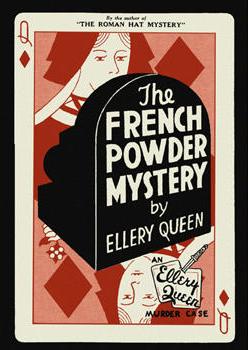
The French Powder Mystery
- Автор: Куин (Квин) Эллери
- Серия: Ellery Queen #2
- Год: 1930
- Язык: английский
- Год: Frederick A. Stokes
- Жанр: Классические детективы

Электронная книга - «The French Powder Mystery». Краткое содержание книги:
“But why,” asked Weaver, “that period of eight days? Why not merely every week on the same day?”
“A good question, and it has, I think, a simple answer,” replied Ellery. “These people were taking not the slightest chance of a slip-up. If a certain person came into the Book Department at nine o’clock every Monday, he might after a time be noticed and remarked on. But coming in on a Monday, then a Tuesday, then a Wednesday, all a week and a day apart, there was little likelihood that he would be remembered.”
“My God, what a racket!” muttered Crouther. “No wonder we never got wind of it!”
“Clever’s no name for it,” sighed the Inspector. “Then you think, Ellery, that the addresses are all local ‘joints’ for the selling of the dope?”
“No question about it,” said Ellery, lighting another cigaret. “And while we’re remarking about cleverness, how does this strike you? The ring never uses the same address twice! That’s patent from the different address each week. And it’s apparent, too, that their system of distribution makes it a methodical weekly affair. Your Narcotic Squad has a chance to ferret out a drug depot if it’s used week after week; people notice suspicious activity, perhaps; the address and the word go around through the grapevine of the underworld. But how can your Squad ever get on the track of a gang which uses a different depot every week? Why, the scheme is amazing. As it is, Fiorelli did get wind of two of the addresses through informers or stool-pigeons; the fact that he didn’t get any other shows how holeproof the plot really is. And of course, when he raided the places, he found the ring gone — cleared out. They probably have an afternoon soirée week after week and dismantle the place immediately after the last customer’s gone.
“Now consider how safe the ring really is. They must have a regular channel of communication with their customers — and I suspect it’s a limited list. Too many would be dangerous by their very numbers. That means, then, that the customers are wealthy, probably society people, who get a weekly tipoff by telephone, we’ll say — just an address. They know the rest. And what can the customer do? What does he want to do? We all know the desperate uncontrollable craving of the addict for his drug. Here he has a safe source of supply, and what’s more important, a regular source of supply. No — the customers aren’t blabbing. What could be sweeter?”
“It staggers the imagination,” muttered the Inspector. “What a plan! But if we clean them up this time—!”
“I need only refer to the well-known cup and the better-known lip,” laughed Ellery. “However, we’ll see.
“Some questions arise, as I began to say a few moments ago, more directly applicable to the murder. We may certainly presume that Bernice is — or was — one of the ring’s customers. And I do believe that shady, mysterious motive of which we haven’t been able to grasp the merest shadow, is beginning to emerge into daylight. Winifred French was not an addict. She carried in her bag a lipstick belonging to Bernice and filled with heroin... And carried it to her death. A strong line of incident, dad! Very, very strong... Interesting, isn’t it, especially since we haven’t been able to discover any other motive for the crime? But motive won’t mean much in the unraveling of this case, I’m afraid; the big job is to corral the murderer and also to round up the drug ring. A dual task which presents to my deduction-weary mind a suggestion of difficulty...
“Another question. Is Springer pawn or king in this drug game? My guess is — he’s on the inside, knows all the facts, but is not top man. And the question naturally arises, too — did Mr. Springer fire the lethal weapon aimed at Mrs. French’s heart? I’d rather not go into that at the moment.
“And finally, doesn’t this business of the drug ring indicate that Winifred’s murder — and Bernice’s disappearance — are integral parts of the same crime, rather than two unrelated crimes? I think it does, but I cannot see how we shall ever get to the truth of the matter unless a certain eventuality occurs. Deponent being temporarily out of wind, deponent will sit down and think of the case in toto.”
And Ellery, without another word, seated himself and worried his pince-nez in a thoroughly absent manner.
The Inspector, Weaver and Crouther sighed all at once.
They were sitting that way, silently, looking at each other, when a short siren blast from the street below announced the arrival of Fiorelli, Velie and the raiding party.
29
— Raid!
The police van, crammed with detectives and officers, rushed through the West Side, headed uptown. Traffic opened magically before its wailing siren. Hundreds of eyes followed its reckless course wonderingly.
The Inspector shouted to a grim and chagrined Velie, above the roar of the exhaust, Crouther’s story of the lone taxicab driver and the mysterious automobile with the Massachusetts license-plate. The sergeant gloomily promised an immediate check-up on the chauffeur’s story and dissemination of the new information to all his operatives on the trail of the vanished girl. Crouther sat chuckling by his side as Velie took from the Inspector’s hand the name and address of the cab-driver.
Weaver had been excused, and with the arrival of the van had left to return to the French store.
Fiorelli sat quietly chewing his fingernails. His face was haggard and feverish as he pulled the Inspector to one side.
“Had a bunch of boys beat it up to the 98th Street address beforehand to surround the house,” he boomed hoarsely. “Not taking any chances on their doing a fade-away. The boys are keeping under cover, but they won’t let a rat slip through the net!”
Ellery sat calmly in the van, watching the crowds jump into view and disappear. His fingers thrummed a rhythmic tattoo on the iron mesh obscuring the view.
The powerful truck turned into 98th Street and dashed eastward. The neighborhood thickened, grew squalid. As the van plunged farther toward the East River the onrushing scene became one of ramshackle buildings and ramshackle humanity...
At last the police car ground to a stop. A man in plain clothes had stepped suddenly from a doorway into the middle of the street, pointing meaningly toward a low, two-story building of rotten wood and peeled paint, leaning crazily over the sidewalk as if the slightest convulsion of nature would topple it, a brittle wreck, into the gutter. The front door was closed. The windows were heavily shaded. The house looked tenantless, lifeless.
With the first grinding of the van’s brakes, a dozen men in plain clothes ran into view from odd corners and doorways. Several in the dilapidated backyard of the house drew guns and advanced on the rear of the building. An avalanche of policemen and detectives poured out of the truck, headed by Fiorelli, Velie and the Inspector, Crouther close behind, and ran up the crumbling wooden steps to the front door.
Fiorelli pounded fiercely on the cracked panels. There was not a whisper of audible response. At a sign from Inspector Queen, Velie and Fiorelli put their formidable shoulders to the door and shoved. The wood splintered and the door cracked back, revealing a dim, musty interior, a broken old chandelier, and a flight of uncarpeted steps leading up to a second floor.
The police streamed into the building, investing both floors simultaneously, opening doors, pushing into corners, guns ready.
And Ellery, sauntering leisurely behind, openly amused at the psychology of the gaping mob which had miraculously gathered outside the house, kept back by the clubs of several bluecoats, saw at once that the raid was a failure.