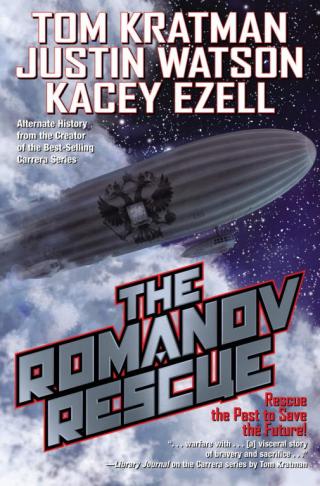
The Romanov Rescue
- Автор: Кратман Том, Watson Justin
- Год: 2021
- Язык: английский
- Год: Baen
- ISBN: 978-1-9821-2570-7
- Жанр: Альтернативная история

Электронная книга - «The Romanov Rescue». Краткое содержание книги:
As WWI comes to a close a German general, an escaped prisoner of war, and the crew of an airship converge to effect THE ROMANOV RESCUE. Can there be a world without communism?
Mankind’s history is bound up in the fabric of fate, a strong cloth, tough and closely woven.
It is the beginning of 1918, the last year of the greatest war in human history, to date. All the belligerents stagger on their feet. Starvation is an ever present reality, while disease waits in the wings. In Russia, no longer a belligerent but, instead, rapidly descending into civil war and chaos, a lone family—Father, Mother, four beautiful young girls, and a brave but sickly boy—await their own fate, shivering and hungry in the dark, hoping and praying for salvation.
Their relatives in England have turned their backs. The guards set over them do little but torment them. They look Heavenward, but God doesn’t answer. They know they’re a threat to the new regime, a threat that will, in time, be eliminated.
But even the strongest fabric has flaws. An escaped prisoner of war, caught, injured, and punished, but still highly capable, might be one. An airship, returned and at loose ends after a failed mission to Africa might be another. A German general, taking a wrong turn on his nightly walk and suddenly coming face to face with the reality of the monster rising in the east, would be a third.
Follow, then, as the general gives the orders, the prisoner of war raises the men from among his fellows, and the airship launches itself forward, to contest fate, to tear the fabric of time, and to effect The Romanov Rescue.
About the Carrera series:
“Thank you, Captain,” Kostyshakov said with a slight inclination of his head. “I promise that we will take good care of the young man.”
“Mueller, what are your thoughts?”
Wilhelm had been looking up at the underside of the L59 as his friends and crewmates lowered barrel after barrel out through the deck of the forward part of the cargo bay. The airship currently hovered ten meters above the ground, secured by her mooring lines as the crew practiced offloading cargo as they would do if they could not find a landing zone big enough to set down on the ground. Lieutenant Colonel Kostyshakov, to whom he’d been temporarily assigned for the duration of this mission, approached him, hands behind his back and that slight smile on his clean-shaven face.
“Sir?”
“How goes the rehearsal? If you’re to be my liaison, you must be ready to explain the nuances that I might not immediately catch.” Kostyshakov came to a stop beside Wilhelm and craned his neck upward to see what Wilhelm had been watching. “Is it going well?”
“This part is, sir. Our crew is very well trained with supply drops of this type. The hard part will be the animals.” Wilhelm instinctively drew his spine up straight, then belatedly realized that the Russian officer was several inches shorter. Would he see that as an insult?
Not that Kostyshakov had time to notice. A deafening scream rent the air, causing both men to spin aft toward the stern of the zeppelin. There, a mule dangled, suspended in a canvas sling that wrapped under its belly and hung from chains that led to the zeppelin’s winch. Wilhelm knew that the machinists, his friend Gustav among them, had been working all morning to move and reconfigure the winch to try to attempt this maneuver.
As Wilhelm and Kostyshakov—along with everyone else observing the unloading rehearsal—watched, the mule let out another scream of protest as the winch started to lower the sling. The animal kicked out with its hind legs, making its situation worse, as the sling began to lurch from side to side in response.
“Oh no,” Wilhelm murmured. “This is bad.”
“Bad? Why?” Kostyshakov asked.
“That oscillation is very hard on the winching gears. If the crew cannot get it under control, it could tear the winch right out of the support strut—or worse, cause it to grind itself up and start a fire. These ships are big, yes, but everything is very delicate.” Wilhelm breathed in sharply as the animal kicked again and showed no sign of ceasing to struggle.
The swaying got worse, until Wilhelm found himself biting his lower lip in fear for his friends overhead. A loud pop echoed across the field, and the mule in the sling jerked, and then plummeted to the ground with another scream of terror.
A sickening thud echoed across the suddenly otherwise silent field. A tall figure that Wilhelm instantly recognized as Captain Bockholt stepped toward the crumpled animal and drew a Luger P08. The captain fired, and the mule finally fell silent, freed from its misery.
“They had to cut the load,” Wilhelm said, hearing the sickness in his own voice. “Otherwise, it would have jeopardized the ship and everyone on her.”
“Hmmm. Sergeant Kaledin is going to be very upset about the loss of his mule. But, yes, I can see that. What do you suggest?”
“Me, sir?”
“Yes, you. You’re my liaison. Your captain wouldn’t have assigned you to me if he didn’t intend you to advise.” Kostyshakov’s tone was kind, but Wilhelm could hear the edge of impatience under the words. He took a deep breath, steeled his nerve, and opened his mouth.
“I suggest that your strategic recon team find a place where we can fully land, at least for the first lift, if not two. If panicking animals don’t cause damage to the ship, they will almost certainly injure themselves and then they’re no use to your forces, sir.” Wilhelm kept his tone respectful, but he told the bald truth.
Kostyshakov turned to look up at Wilhelm, his tiny smile returning. “There,” he said. “See? That wasn’t so hard. As it happens, I agree with you, but we may not have a choice in the matter. And if the animals die, they can always be eaten.”
“And so we will continue to rehearse,” Wilhelm said. “Perhaps we can get the animals used to the procedure. Maybe if they try a blindfold?”
“That should be interesting,” Kostyshakov said.
“Yes, sir,” Wilhelm agreed. Privately, he had a bet with Gustav that at least three of the horses didn’t make it to the actual day of the mission. But he wasn’t about to tell the Russian that. Not after watching the horrible demise of one of the poor animals.
Perhaps later, after the mission was complete. Still, poor “Lydia.”
Interlude
Tatiana: Alexei and his bodyguard
Alexei’s violent coughing had led to hemorrhaging in his groin. He lay in bed, in excruciating pain, and there was nothing anyone, including the doctors, could do.
As he moaned and cried, Mama sat with him, never leaving his bedside.
It had been almost six years since he’d had a bout this bad.
Deverenko was beside himself. The man who had been responsible for getting Alexei to wear all the various encasements he’d needed throughout his life wore a look of such utter despair that Papa gently suggested he leave. Most of the encasements, made of leather and canvas, to support Alexei’s legs, arms, and body, were now too small for his growing body.
Alexei had always fought them, insisting that they didn’t help, but we all knew that was just his stubbornness coming out. Like Anastasia, he had always had a mind of his own, and for days, I had expected that willfulness to surface.
But it hadn’t.
Once Deverenko and Papa left, it was just Mama and I, sitting at his side. A basin of melted ice rested in my lap, along with strips of cloth, freshly torn from our most threadbare clothes.
Mama pulled one of the rags off Alexei’s feverish face and set it aside. She rested her fingers atop his forehead, sweeping the strands of sweat-soaked hair aside.
I dipped a fresh strip of cloth into the chill water, gave it a squeeze, and handed it to Mama.
“I would like to die, Mama,” Alexei said, his voice barely a whisper. “I’m not afraid of death.”
Mama’s hands froze mid-motion. Mama’s hands, unfailingly steady through years of Alexei’s illness, trembled now. She set the rag atop his forehead as she shushed him.
His eyes had become enormous in his head as his fever had thinned him and turned his skin yellow. He blinked his eyes open, holding her gaze with his own.
“Mama, I’m so afraid of what they may do to us.”
Chapter Eleven
Governor’s House, Tobolsk
As winter settled over Tobolsk, Dostovalov and Chekov were reassigned to day shift. Kobylinsky informed them of the change himself in his office, across the street from Freedom House.
“Aside from the minor incident with that samogon,” he said. “You lads have done excellent work, and the Romanovs seem comfortable with you, so I’m transferring you to day shift. No need to freeze your asses off.”
This was, perhaps, optimistic of the colonel, as it was perfectly possible to freeze one’s ass off, in Siberia, in the winter, in broad daylight.
As he spoke, Kobylinsky’s eyes shifted to the window and his fingers drummed on the table. He was in a dark brown suit and coat. After an incident in which one of the men had torn off his epaulets, and the soldiers’ committee had demanded the abolition of rank insignia, Kobylinsky had taken to wearing mufti, even during duty hours.