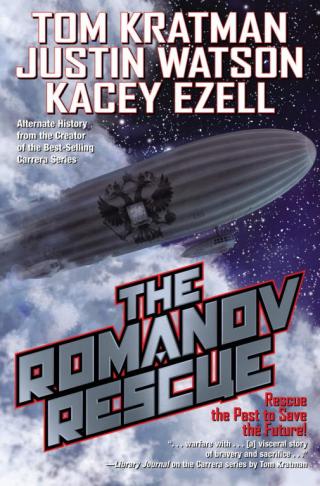
The Romanov Rescue
- Автор: Кратман Том, Watson Justin
- Год: 2021
- Язык: английский
- Год: Baen
- ISBN: 978-1-9821-2570-7
- Жанр: Альтернативная история

Электронная книга - «The Romanov Rescue». Краткое содержание книги:
As WWI comes to a close a German general, an escaped prisoner of war, and the crew of an airship converge to effect THE ROMANOV RESCUE. Can there be a world without communism?
Mankind’s history is bound up in the fabric of fate, a strong cloth, tough and closely woven.
It is the beginning of 1918, the last year of the greatest war in human history, to date. All the belligerents stagger on their feet. Starvation is an ever present reality, while disease waits in the wings. In Russia, no longer a belligerent but, instead, rapidly descending into civil war and chaos, a lone family—Father, Mother, four beautiful young girls, and a brave but sickly boy—await their own fate, shivering and hungry in the dark, hoping and praying for salvation.
Their relatives in England have turned their backs. The guards set over them do little but torment them. They look Heavenward, but God doesn’t answer. They know they’re a threat to the new regime, a threat that will, in time, be eliminated.
But even the strongest fabric has flaws. An escaped prisoner of war, caught, injured, and punished, but still highly capable, might be one. An airship, returned and at loose ends after a failed mission to Africa might be another. A German general, taking a wrong turn on his nightly walk and suddenly coming face to face with the reality of the monster rising in the east, would be a third.
Follow, then, as the general gives the orders, the prisoner of war raises the men from among his fellows, and the airship launches itself forward, to contest fate, to tear the fabric of time, and to effect The Romanov Rescue.
About the Carrera series:
“I hope so, otherwise we’re going to deliver fewer men than we promised. Not to mention the godforsaken horses.” He let out a sigh.
“Aye, sir, the horses are the trickiest part. The best plan we can figure is to construct half a dozen stalls in the aft-most portion of the bay.”
“Stalls?” Ludwig felt his eyebrows go up. “You’re going to turn my cargo hold into a stable?”
“Temporarily, yes, sir. We’ll use the same support struts as anchors for lightweight wooden walls suspended from ceiling and deck using the same tarred ropes. Then we’ll have a cradle of hay for each animal, to keep it docile and occupied during transit. We’ll lay duckboards across the floor struts in between the stall walls to create a solid surface for the horses and mules to stand or lie upon.”
Heinrich gestured enthusiastically as he pointed out where each of these things would go, and despite himself, Ludwig was amused. The idea of carrying horses and mules aboard his ship was a ghastly one, but then, this entire enterprise was equal parts ridiculous and incredibly ambitious. Perhaps diving in with enthusiasm and imagination was the only way to actually accomplish it.
“Fine,” Ludwig said. “Though I will make it clear to Kostyshakov and Brinkmann that it will be their men, not mine, who are responsible for cleaning the horseshit out of my cargo hold. Now, let us discuss unloading.”
After his walkthrough with Heinrich, Ludwig was mostly satisfied with the load plan. As he’d suspected, however, the logistics of unloading were still murky at best. Chief among issues was that no one had briefed him on the specific destination—General Hoffmann’s orders had just mentioned “somewhere east of the Volga, and probably east of the Urals”—and so neither Ludwig nor his crew knew exactly what type of situation they’d be flying into.
That was something he needed to rectify posthaste. So he headed to his office to pen a note to ask Brinkmann to come and see him.
“Ah! Captain Bockholt! I was hoping to find you. Do you have a moment?”
Lieutenant Colonel—or whatever the Russian imperial guards equivalent was—Kostyshakov stood outside his office door, a small smile on his face. Ludwig couldn’t decide if he liked the man or not, but he couldn’t deny that he was ambitious and aggressive… and he seemed fanatically dedicated to the success of his mission.
“What can I do for you?” Ludwig asked.
“How is your planning coming?” Kostyshakov asked, which surprised Ludwig and put him on his guard. Was the man doubting him and his crew?
“Rather well, actually,” Ludwig said, trying to keep all hint of stiffness out of his tone. “Although I was headed to pen a note to Major Brinkmann. I’m afraid we can go no further with our plans until I have more concrete details about our exact destination.”
“Ah, I don’t have much more information on that, but I will tell you what I know,” Kostyshakov said, his smile changing to a rueful grimace. “You have maps in your office?”
“I do,” Ludwig said, and reached out to turn the handle of the door leading from the hangar. “But there are more and better in the planning room. First right past my office. After you, please.”
Ludwig followed Kostyshakov into the large room that he and his officers used to plan their flights. Maps and charts hung on three of the four walls, with the fourth dedicated to large windows to let in sunlight. In the center of the room, a long table with an angled top held a large, detailed map of eastern Europe from the Mediterranean to the Baltic, and including most of Western Siberia. Kostyshakov made a beeline for this map.
“This is good quality,” he said, admiration in his voice. “You Germans always did pay attention to the details.”
“It is how we are taught, sir,” Ludwig said. “The destination? Major General Hoffmann said east of the Volga?”
“Hmm, yes. So we don’t actually know the exact location. Yekaterinburg, Tyumen, or Tobolsk, those are our best guesses right now. The latter is the last we’ve heard of, but they may have been moved to one of the others. The strategic recon team will find a place to land but it will depend on where the royal family is.”
Ludwig leaned in to peer at the map where Kostyshakov pointed at the three cities in succession.
“Does your Strat Recon team know what to look for?” Ludwig asked. “What makes a good landing zone for a zeppelin?”
“I gave them some guidance. Describe the ideal to me.”
Ludwig pointed at a spot on the map where the topographical contour lines curved away from each other with wide separation.
What he recited sounded much like what Kostyshakov had told Turgenev. “If we are to land, it must be a large area, flat with little to no vegetation. Some kind of water feature—a lake or wide river would be best—so that we can refill our ballast tanks. And most importantly, it must be secure. I am sure I don’t need to remind you that our hydrogen lifting gasses are quite flammable. One enemy tracer round into our envelope and we are done. As a well-roasted beef haunch is done.”
Kostyshakov snorted a soft laugh at Ludwig’s dark humor. “There will be only a small force on the ground to receive the first shipment. However, we will do our best to ensure you have a secure landing area. Once the first lift is complete, of course, it will be simpler, for we will have the grenadier company on the ground. However, what other options do you have, if we cannot find this perfect meadow of yours?”
“We can land to a tower, like a steeple perhaps, though it will make unloading more difficult, at least for the horses. Supplies can be thrown out or lowered via rope slings, as can men. Or men could use a ladder. But the horses and mules will present a problem, as will the heavy weapons.”
“How long will you need on the ground?”
“We will do a rehearsal in a day or so to practice onloading and offloading the cargo, so my men should be able to get it down to about thirty minutes. No longer than it will take to top up the ballast tanks. But I must tell you that approaching to land to the ground takes much more time than landing to a tower, and we will be quite vulnerable the whole time.”
“Well, as I said,” Kostyshakov shrugged, “we will do what we can. Let us hope your crew can keep from being spotted from the air while in transit.”
“I do not like to risk my crew and my ship on the basis of hope, sir,” Ludwig said tartly. Kostyshakov looked up at him with one raised eyebrow.
“Captain, is that not what we are all doing here?”
Ludwig said nothing, merely met the other man’s eyes for a long moment, and then turned back to the map.
“On another topic, I do have a small request for you,” Kostyshakov said, straightening and stepping back from the map table. “I appreciate that there are nuances to this business of mobility by air with which I am unfamiliar. I would like to have you appoint a liaison to my staff, if you wouldn’t mind. Someone who can inform me and my staff of things we do not know.”
“I am desperately short of officers, sir,” Ludwig said with real regret. A liaison was a fantastic idea, and it spoke well of Kostyshakov that he would ask for one. “I am sorry that I have none to spare.”
“I know, Brinkmann told me that you have only the one lieutenant as your XO. I thought perhaps an NCO might do the trick. What about that one young man… Wilhelm…?”
“Signalman Mueller?” Ludwig pursed his lips and considered. “He is a good man and indispensable as our wireless operator… but as you know, this mission is so covert that we have literally no one with whom we can communicate. Your ground forces will be on the move too much to make a wireless practical… yes. That might do nicely, sir. I will speak with my senior noncom and have him release Wilhelm to your staff effective immediately.”