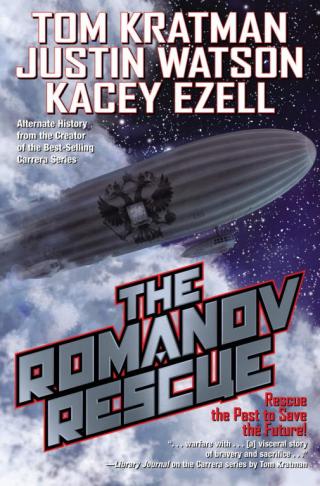
The Romanov Rescue
- Автор: Кратман Том, Watson Justin
- Год: 2021
- Язык: английский
- Год: Baen
- ISBN: 978-1-9821-2570-7
- Жанр: Альтернативная история

Электронная книга - «The Romanov Rescue». Краткое содержание книги:
As WWI comes to a close a German general, an escaped prisoner of war, and the crew of an airship converge to effect THE ROMANOV RESCUE. Can there be a world without communism?
Mankind’s history is bound up in the fabric of fate, a strong cloth, tough and closely woven.
It is the beginning of 1918, the last year of the greatest war in human history, to date. All the belligerents stagger on their feet. Starvation is an ever present reality, while disease waits in the wings. In Russia, no longer a belligerent but, instead, rapidly descending into civil war and chaos, a lone family—Father, Mother, four beautiful young girls, and a brave but sickly boy—await their own fate, shivering and hungry in the dark, hoping and praying for salvation.
Their relatives in England have turned their backs. The guards set over them do little but torment them. They look Heavenward, but God doesn’t answer. They know they’re a threat to the new regime, a threat that will, in time, be eliminated.
But even the strongest fabric has flaws. An escaped prisoner of war, caught, injured, and punished, but still highly capable, might be one. An airship, returned and at loose ends after a failed mission to Africa might be another. A German general, taking a wrong turn on his nightly walk and suddenly coming face to face with the reality of the monster rising in the east, would be a third.
Follow, then, as the general gives the orders, the prisoner of war raises the men from among his fellows, and the airship launches itself forward, to contest fate, to tear the fabric of time, and to effect The Romanov Rescue.
About the Carrera series:
Still, Wilhelm thought. Surely she has plenty of room for a few men and horses!
“Gentlemen,” he said as he started up the ramp. “Please follow me and stay to the foot traffic walkway. Some of the other areas are designed to hold cargo, but are not necessarily safe for walking.”
The captain gave him a slight nod of approval, and Wilhelm allowed himself a small smile when he turned back and began leading them into the relative dimness of the bay.
“You call this a weld? Herr welder? Your time would clearly be better spent elsewhere. Go to the cafeteria und fressen!”
This furious tirade echoed through the metal struts and after a brief moment, a red-faced Bulgarian stomped past them, clearly upset at the dressing-down he’d just received. Wilhelm drew a deep breath and took a calculated risk.
“Obermaschinistenmaat Engelke!” he called out, “The captain and a delegation of officers are here to see you!”
Wilhelm thought he heard another muttered epithet, but his supervisor and the L59’s senior NCO walked toward them with his spine straight and his working uniform looking sharp. No trace of the irritation he must have felt for the bumbling welder remained on his face.
“Captain,” the senior noncom said, coming to attention and rendering a salute once he was within speaking distance of the group.
“Obermaschinistenmaat,” Captain Bockholt replied, returning the salute with a tiny smile on his face. The captain then stepped forward, and dropped his voice to a whisper that Wilhelm could barely hear, “These Bulgarians are butter-fingered oafs, aren’t they? Well done, but you must continue to keep a close watch on them.”
“Aye, sir,” the senior mate said, a tiny growl entering his tone. “The Bulgarian ‘expert’ was a ham-handed fool. Some are better. I will have one of our machinists break his weld and start over. It will not delay our progress.”
“That is good to hear. This is Lieutenant Colonel Kostyshakov, of the Russian Guards, plus Major Brinkmann, of Ober Ost, and Feldwebel Weber. We have been given orders from General Hoffmann.”
The senior machinist’s spine got even straighter, which Wilhelm didn’t think was possible.
The captain went on. “Perhaps you and Feldwebel Weber can go over the cargo requirements and begin to work on some loading solutions. This is to be a major movement, not quite like anything we have done before.”
“Yes, sir,” Engelke said. Feldwebel Weber stepped away from the group, and the two NCOs greeted each other and shook hands. Wilhelm took a step to follow them as they began walking back farther into the cargo bay.
“Wilhelm, wait a moment. Lieutenant Colonel Kostyshakov, Major Brinkmann, I think there is something else we must discuss,” Bockholt said, beckoning to the two officers to come closer. Wilhelm, too, found himself being drawn into a circle of confidence, and he felt intensely uncomfortable at being in such company. What could the captain want me for?
“There is another matter we must consider,” Bockholt said. “The matter of getting past the Russian lines. Armistice or no armistice, I do not think the Bolshevik army is likely to simply let a warship of a recent enemy fly overhead with impunity. And they do have aircraft.”
“What do you suggest?” Kostyshakov asked.
“In his orders, General Hoffmann said that we will have whatever we need. Major Brinkmann, what we need is a fighter escort. Two planes. Four would be better, but two will work, just to see us past the most dangerous part of the crossing, the front.”
The two visiting officers looked at each other for a brief moment, and then Brinkmann nodded.
“I will send a message,” he said. “The general gives this mission his top priority, so it is likely that he will respond quickly.”
“Thank you,” Bockholt said. “Now, Wilhelm here will be able to answer any questions you have about the ship and her capabilities. I must speak with my officers and begin the planning cycle. I will have a basic plan for you in twenty-four hours, pending any changes due to the general’s answer about the escort.”
“Yes, of course,” Kostyshakov said. “Thank you very much, Captain. I am pleased to be working with you.”
“And I, you, sir. We shall make history together, no?”
Again, thought Wilhelm, with more than a little bit of pride. We shall make history together again.
Ludwig looked down the length of the cargo bay and squinted his eyes, imagining it filled with men, equipment and—heaven help them all—even horses.
“It will be tight, sir, but we can make it work,” Heinrich, his recently promoted XO said. After the Africa mission, Ludwig’s previous XO had been given command of his own ship. The navy hadn’t been able to provide a backfill, however, and so his young lieutenant navigator had been forced to step into the role. Overall, Ludwig was pleased with his performance and growth, but this coming mission would certainly put him to the test.
It would put them all to the test.
“Tell me how, Lieutenant,” Ludwig said as he started walking aft. He beckoned to Heinrich to follow and then clasped his hands behind his back. “Tell me what you and the chief-machinist’s mate figured out. I need to see it in my mind’s eye.”
“Very good, sir,” Heinrich said as he stretched his long legs to catch up. “In the first place, the new aluminum cargo racks here in the forward area are significantly lighter than the previous versions. We will use those for standard sized cargo, food barrels, ammunition, et cetera.”
“And how much weight?”
“Four and a half tons for food and water, and about eleven tons for the men and equipment for the first lift.”
“The grenadier company?” Ludwig asked, knowing that they had been Kostyshakov’s choice for the first lift.
“And about twenty-four men from headquarters company. Plus their heavy weapons.”
“And where have you planned to put these men for the duration of the trip? We obviously can’t have them moving around the cargo bay.”
“No, sir. The plan is to cordon off this area where they will stay for the duration of the trip. As long as they don’t leave that portion of the cargo bay, the loading balance should be stable. We’ll have them hang hammocks from support struts to the ends of the racks starting at that stanchion there,” Heinrich said, pointing. “To there. It’s not a large area, but it will be enough that they can stretch their legs from time to time—and a few at a time—and keep their blood moving.”
Ludwig nodded. It wasn’t ideal—but then, what was? It would work, though he didn’t envy those men the cold, miserable transport that awaited them.
“What else?” he asked, continuing down the length of the cargo bay. “How will we secure the heavy weapons?”
“The weight and balance calculations we ran suggest that they’re best located dead center of the cargo bay, sir,” Heinrich said, walking to that point. “The plan is to use horses to haul them in their rigs up onto the deck, and then immobilize the wheels in place and tie the entire apparatus down to our support struts, using our standard cargo eyelets. We’ll use hempen rope, stiffened with tar for the tiedowns.”
“With a lot of redundancy, one would hope,” Ludwig said dryly.
“Of course, sir. I give you my word that the guns will remain immobile for the entirety of the trip.”