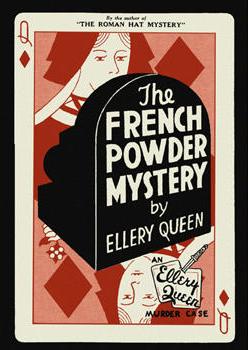
The French Powder Mystery
- Автор: Куин (Квин) Эллери
- Серия: Ellery Queen #2
- Год: 1930
- Язык: английский
- Год: Frederick A. Stokes
- Жанр: Классические детективы

Электронная книга - «The French Powder Mystery». Краткое содержание книги:
“You’ve proved it to my satisfaction,” said the Inspector. “Go on.”
“Alors! I examine the book-ends. They are of solid onyx. Furthermore, the only change in their composition is the removal of the original felt from one of them. I conclude therefore that the book-end was not repaired in order to hide something inside or because something was extracted from its interior. There is no interior. Everything is on the surface.
“With this in mind, I ask myself: What other reason could have caused the repair of the onyx piece, if it was not to hide traces of a secretion or a removal? Well, there’s the crime itself. Can we tie the crime and the fixing of the book-ends into one knot?
“Yes, we can! Why should a felt be removed and another substituted? Because something happened to that felt which, if the felt were left as it was, would have betrayed traces of a crime. Remember that the murderer’s most pressing need was to keep knowledge of the murder from every one until he had delivered the all-important message during the morning. And he knew that that library would be tenanted at nine o’clock in the morning, that if anything were wrong with the book-end it would be noticed in all probability.”
“Blood!” exclaimed the Inspector.
“You’ve hit on it,” replied Ellery. “It could scarcely be anything else but bloodstains. It would have to be something of a directly suspicious nature, or the murderer would not have taken all the trouble he did. The cards, the other things — these in themselves would never suggest a murder before the body was found or foul play even suspected. But blood! That’s the water-mark of violence.
“So I reasoned that in some way blood soaked the felt, and the murderer was compelled to change the felt and dispose of the tell-tale bloody one.”
They walked on in silence for a long time. The Inspector was buried in thought. Then Ellery spoke once more.
“You see,” he said, “I was progressing with commendable rapidity in the reconstruction of the physical elements of the crime. And, when I had reached the conclusion about the blood-soaked felt, immediately another isolated fact leaped into my mind... You remember Prouty’s suspicions in connection with the lack of blood on the corpse? And our instant deduction that the murder must have been committed somewhere else? Here was the missing link.”
“Good, good,” murmured the Inspector, reaching excitedly for his snuff-box.
“The book-ends,” went on Ellery rapidly, “were obviously of no importance in the crime until they became blood-soaked. After that, of course, the whole chain of incident was a logical outgrowth — changing the felt, handling the book-ends, and then applying the powder to efface prints made necessary by the handling...
“Then, I reasoned, the staining of the book-end was an accident. It was standing innocently on the glass-topped desk. How could the blood have got on it? There are two possibilities. The first is that the book-end was used as a weapon. But this is indefensible, because the wounds were the result of revolver-shots, and there are no signs of a striking blow with such a bludgeon as the book-end might have made. Then the only remaining possibility is that the blood got on it inadvertently. How might this have occurred?
“Easily. The book-end is on the glass-topped desk. The only way blood could get on the bottom of the book-end, where the blood would show ineffaceably, would be by its trickling across the glass and soaking into the material. But you see what this gives us.”
“Mrs. French was at the desk when she was shot,” announced the old man gloomily. “She was shot below the heart. She fell into the chair and got another in the heart itself. The blood from the first wound gushed out before she fell. The blood from the second wound trickled out as she lay across the table — and soaked into the felt.”
“And that,” said Ellery, smiling, “is a perfect recitation. Remember that Prouty is sure that the precordial type of wound particularly would bleed profusely. That’s probably what happened... Now we can further reconstruct the crime. If Mrs. French was at the desk and was shot in the heart, then her murderer was in front of her and shot across the desk. It must have been at a distance of several feet, because there are no powder marks on the woman’s clothes. We can perhaps compute the approximate height of the murderer by determining the angle at which the bullets entered the body. But I have little faith in this, because there is no exact way of judging just how far the bullets traveled, or in other words how far from Mrs. French the murderer stood when he fired. And an error of inches would throw off all our calculations as to his height, considerably. You might get your firearms expert, Kenneth Knowles, on the job, but I don’t think much will come of it.”
“Neither do I,” sighed the Inspector. “Nevertheless, it’s comforting to be able to place the crime so precisely. It all hangs together, Ellery — a nice bit of reasoning. I’ll get Knowles to work immediately. Is there anything else, son?”
Ellery said nothing for an appreciable moment. They turned into West 87th Street. Half-way up the block stood the brownstone old house in which they lived. They quickened their steps.
“There’s a heap more, dad that I haven’t gone into, because of this and that,” Ellery said absently. “The signs were all there, for the world to see. They needed intelligent assembly, however. You’re probably the only one on the scene who has the mental potentiality for piecing them together. The others... And you’re exceptionally dulled by care.” He smiled as they reached the brownstone steps of their dwelling.
“Dad,” he said, one foot on the lowest step, “on one phase of this investigation I am entirely at sea. And that—” he tapped the package under his arm, “is the five books I plucked from old French’s desk. It seems silly to suppose that they can have anything to do with the murder, and yet — I have the queerest feeling that they can explain so much if we worm out their secret.”
“You’ve gone slightly daffy with concentration,” growled the Inspector, laboriously ascending the stairs.
“Nevertheless,” remarked Ellery, inserting a key into the lock of the big carved old-fashioned door, “this night is dedicated to a sedulous analysis of the books.”
The Fourth Episode
Oriental police set far smaller store by the criminal alibi than do Occidentals... We know only too well what warped cunning is capable of... and prefer to probe emotions and instincts rather than crack down highly glazed stories. This is undoubtedly explained by the difference in psychology of the two racial strains... The Oriental is notoriously more suspicious than the Occidental, dealing with fundamentals rather than superficials... Where the Western world is inclined to shout a lusty BANZAI! in acclamation of its more successful rogues, we cut off their ears, or put them in stocks for milder crimes, or behead them for major ones — but always pointing out by example (with true Japanese subtlety, perhaps?) the overwhelming ignominy of the punishment...”
— From the Preface to the English edition of A THOUSAND LEAVES,