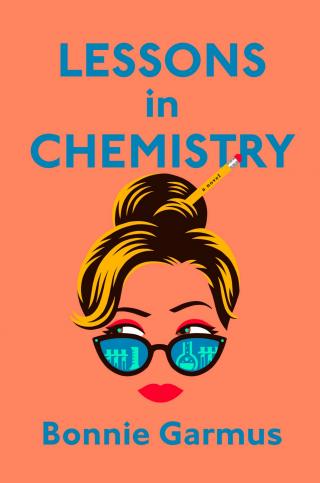
Lessons in Chemistry
- Автор: Garmus Bonnie
- Год: 2022
- Язык: английский
- Год: Doubleday Canada
- Жанр: Современная русская и зарубежная проза

Электронная книга - «Lessons in Chemistry». Краткое содержание книги:
“I guess we can always add the Bunsen burner later. It’s quite useful.”
“I bet.”
“What about the work surfaces?”
“The stainless steel you requested was unaffordable.”
“Well that’s odd,” she said. “Nonreactive surfaces are usually quite inexpensive.”
Walter nodded as if he were surprised too, but he wasn’t. He’d picked out the Formica countertops himself: a fun-filled laminate flecked with shiny gold confetti.
“Look,” he said. “I know our goal is about making food that matters — good-tasting, nutritious food. But we want to be careful not to alienate people. We have to make cooking look inviting. You know. Fun.”
“Fun?”
“Because otherwise people won’t watch us.”
“But cooking isn’t fun,” she explained. “It’s serious business.”
“Right,” he said. “But it could be a little fun, couldn’t it?”
Elizabeth frowned. “Not really.”
“Right,” he said, “but maybe just a little fun. A smidge fun,” he said, holding up his forefinger and squeezing it next to his thumb to show just how little. “The thing is, Elizabeth, and you probably already know this, TV is governed by three hard and fast rules.”
“You mean rules of decency,” she said. “Standards.”
“Decency? Standards?” He thought of Lebensmal. “No. I meant actual rules.” He used his fingers to count. “Rule one: entertain. Rule two: entertain. Rule three: entertain.”
“But I’m not an entertainer. I’m a chemist.”
“Right,” he said, “but on TV, we need you to be an entertaining chemist. And do you know why? I can sum it up in one word. Afternoon.”
“Afternoon.”
“Afternoon. Just saying the word makes me sleepy. Does it make you sleepy?”
“No.”
“Well, maybe that’s because you’re a scientist. You already know about circadian rhythms.”
“Everyone knows about circadian rhythms, Walter. My four-year-old knows about circadian—”
“You mean your five-year-old,” he interrupted. “Madeline has to be at least five to be in kindergarten.”
Elizabeth waved her hand as if to move on. “You were saying about circadian rhythms.”
“Right,” he said, “As you well know, humans are biologically programmed to sleep twice a day— a siesta in the afternoon, then eight hours of sleep at night.”
She nodded.
“Except most of us skip the siesta because our jobs demand it. And when I say most of us, I really just mean Americans. Mexico doesn’t have this problem, nor does France or Italy or any of those other countries that drink even more than we do at lunch. Still, the fact remains: human productivity naturally drops in the afternoon. In TV, this is referred to as the Afternoon Depression Zone. Too late to get anything meaningful done; too early to go home. Doesn’t matter if you’re a homemaker, a fourth grader, a bricklayer, a businessman — no one is immune. Between the hours of one thirty-one and four forty-four p.m., productive life as we know it ceases to exist. It’s a virtual death zone.”
Elizabeth raised an eyebrow.
“And although I said it affects everyone,” he continued, “it’s an especially dangerous time for the homemaker. Because unlike a fourth grader who can put off her homework, or a businessman who can pretend to be listening, the homemaker must force herself to keep going. She has to get the kids down for a nap because if she doesn’t, the evening will be hell. She has to mop the floor because if she doesn’t, someone could slip on the spilled milk. She has to run to the store because if she doesn’t, there will be nothing to eat. By the way,” he said, pausing, “have you ever noticed how women always say they need to run to the store? Not walk, not go, not stop by. Run. That’s what I mean. The homemaker is operating at an insane level of hyperproductivity. And even though she’s in way over her head, she still has to make dinner. It’s not sustainable, Elizabeth. She’s going to have a heart attack or a stroke, or at the very least be in a foul mood. And it’s all because she can’t procrastinate like her fourth grader or pretend to be doing something like her husband. She’s forced to be productive despite the fact that she’s in a potentially fatal time zone — the Afternoon Depression Zone.”
“It’s classic neurogenic deprivation,” Elizabeth said, nodding. “The brain doesn’t get the rest it needs, resulting in a drop in executive function and accompanied by an increase in corticosterone levels. Fascinating. But what does this have to do with TV?”
“Everything,” he said. “Because the cure for this neuro, uh, deprivation as you call it, is afternoon programming. Unlike morning or evening programming, afternoon programming is designed to let the brain rest. Study the lineup and you’ll see it’s true: from one thirty p.m. to five p.m., TV is stuffed with kid shows, soap operas, and game shows. Nothing that requires actual brain activity. And it’s all by design: because TV executives recognize that between these hours, people are half dead.”
Elizabeth envisioned her ex-colleagues at Hastings. They were half dead.
“In a way,” Walter continued, “what we’re offering is a public service. We’re giving people — specifically the overworked housewife — the rest she needs. The children’s shows are key here: they’re designed to electronically babysit children so the mother has a chance to recuperate before her next act.”
“And by act you mean—”
“Making dinner,” he said, “which is where you come in. Your program will air at four thirty — exactly the time your audience will be emerging from the Afternoon Depression Zone. It’s a tricky time slot. Studies show that most housewives feel the greatest amount of pressure at this time of day. They have much to accomplish in a very short window of time: make dinner, set the table, locate their children — the list is long. But they’re still groggy and depressed. That is why this particular time slot comes with such great responsibility. Because whoever speaks to them now must energize them. That’s why when I tell you that your job is to entertain, I mean it sincerely. You must bring these people back to life, Elizabeth. You must wake them back up.”
“But—”
“Remember that day you stormed into my office? It was afternoon. And yet despite the fact that I was in the Afternoon Depression Zone, you woke me up, and I can assure you that is nearly statistically impossible because all I do is afternoon programming. But that’s how I knew: if you had the power to make me sit up and listen, there is no doubt you can do the same for others. I believe in you, Elizabeth Zott, and I believe in your mission of food that matters — but that’s not just making dinner. Understand this: you must make it look at least a little fun. If I wanted you to put viewers to sleep, I would have slotted you and your hot pads in at two thirty.”
Elizabeth thought for a moment. “I guess I hadn’t really thought of it that way.”
“It’s TV science,” Walter said. “Hardly anyone knows about it.”
She stood silently, weighing his words. “But I’m not entertaining,” she said after a few moments. “I’m a scientist.”
“Scientists can be entertaining.”
“Name one.”
“Einstein,” Walter shot back. “Who doesn’t love Einstein?”
Elizabeth considered his example. “Well. His theory of relativity is riveting.”
“See? Exactly!”
“Although it’s also true that his wife, who was also a physicist, was never given credit for—”
“There you go, nailing our audience again. Wives! And how would you wake up these Einsteinian wives? Using TV’s time-tested waker-uppers: jokes, clothes, authority — and, of course, food. For instance, when you throw a dinner party, I bet everyone wants to come.”