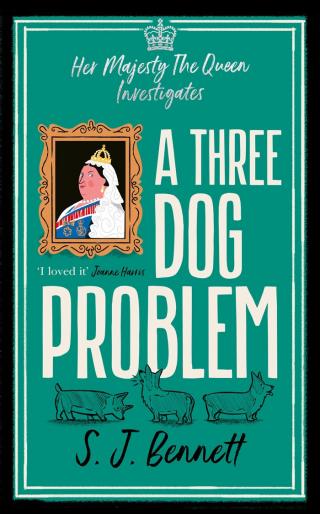
A Three Dog Problem
- Автор: Беннет Си Джей
- Серия: Her Majesty the Queen Investigates #2
- Год: 2021
- Язык: английский
- Год: Zaffre - Bonnier Publishing Fiction
- ISBN: 978-1-83877-485-1
- Жанр: Другие детективы

Электронная книга - «A Three Dog Problem». Краткое содержание книги:
When a body is found in the Palace swimming pool, she finds herself once again in the middle of an investigation which has more twists and turns than she could ever have suspected. With her trusted secretary Rozie by her side, the Queen is determined to solve the case. But will she be able to do it before the murderer strikes again?
MacLachlan looked sympathetic. ‘But I gather from the way you say it that it didn’t turn out that way?’
‘Nope.’ Stephen took a morose gulp of Cabernet. ‘Copies,’ he sniffed. ‘Poor Queen. I mean, not poor Queen, obviously, but you know what I mean. Poor all of us who cared.’
‘They were fakes, then, the paintings?’ MacLachlan suggested.
‘Not exactly. It’s only a fake if you pass it off as the original. When they were cleaned up, these looked like copies that were probably made by someone at court, soon after the originals were painted,’ Stephen explained. ‘Almost like prints, if you like. But by someone not particularly talented, from what I heard. I never saw them.’ He paused for more wine. ‘I did see a couple of the originals, though,’ he added quietly.
MacLachlan, who had already heard this on the art grapevine in London, but wanted to hear it from the horse’s mouth, looked suitably fascinated.
‘What? How?’
‘At auction about two or three years later.’ Stephen had a faraway look in his eye. ‘The first one was found round here, and I was working in this area by then. Apparently, the owners had heard the royal story, gone hunting about in their attic and . . . whaddaya know? They discovered an original Artemisia Gentileschi painting of Thalia, the muse of comedy. The second one of Erato, I think – the muse of love poetry – showed up in America, but I saw the catalogue. Same story. They were examined by the experts and they were genuine. Amazing how those portraits had lain undiscovered for centuries and then . . . poop! Suddenly up they pop.’
MacLachlan adopted the slightly fuzzy look of a man who scents scandal but is also a little bit out of his depth. ‘What are you suggesting, Stephen?’
Stephen shrugged. ‘I’m just saying. A bit coincidental. A bit neat. Not many people knew the local scene like me, I suppose. It all seemed above board, but the dealer who’d come into the auction house with the first painting? Well, he was someone I wouldn’t recommend to clients, put it that way. And I happened to know the second dealer too, in America, because he’d bought a couple of things from a friend. Same story.’
‘Dodgy dealers, dodgy paintings? Is that it?’
Stephen shook his head. ‘No, Charlie, it isn’t what I’m saying. What I’m saying,’ he spoke slowly, to make himself understood, ‘is that the dealers were dodgy, but the paintings were real.’
‘Charlie’ looked confused.
Stephen managed to lower his voice and sound emphatic. The wine and the rapt attention of his companion had loosened his tongue. ‘I’m saying that quite possibly someone stole the Queen’s paintings, replaced them with copies, and sold one of the originals at auction about three miles from here, and another the following year, in Texas. That’s what I think. I mentioned it to a couple of people. They said I was mad, but d’you know what’s interesting? After that, no more Gentileschis. There had been four portraits altogether. What happened to the other two? I think the man behind it all got scared. Scared of me. When I set up the gallery there were a few clients who’d never work with me. Bigwigs, you know, people who knew my reputation, knew the quality of my pieces. I think he set them against me. Petty revenge.’
‘Fascinating. So the copies were fakes. Tada!’ ‘Charlie’ said.
Stephen looked as if he was about to contradict him, but ‘Charlie’ had just about summed it up. If Stephen was right, the four ‘copies’ now in the Royal Collection had been passed off as paintings made in the seventeenth century, when in fact they’d been recently faked to enable the scam. He nodded. ‘I s’pose so. You could say that.’
MacLachlan offered to get them both a digestif from the bar, and Stephen wasn’t one to say no.
‘Why didn’t you say? To the police, I mean?’ MacLachlan asked when he came back, plonking two cognacs on the table between them.
‘Nah, I couldn’t prove anything,’ Stephen shrugged. ‘It was a feeling I had, that’s all.’
‘Did he get a lot for them?’ MacLachlan asked. ‘The two originals that found their way to auction, I mean.’
‘Depends what you call “a lot”,’ Stephen said. ‘He’d have had to give the dealers their cut, and the people who claimed to be the original owners, I guess, and the forger, of course.’ He stared into his cognac glass. ‘If the paintings had been found at a royal palace . . . who knows what they’d have gone for? As it was, the provenance was shaky. If it wasn’t for the brilliance of the brushwork, they might not have been accepted as genuine. The two I know about sold for five figures each. Even so, that was back in the eighties, when you could get a decent house for thirty grand. If he’d sold all four, he’d have raked it in. I like to think my little feeling cost him the price of a couple of houses. He got too greedy, that was the problem. He should’ve waited longer. But perhaps he sold the others privately. It’s possible. But I kept an eye out. I think I’d know.’
He waited for ‘Charlie’ to ask him who this art world Machiavelli was, who’d stolen art from under the nose of Queen Elizabeth II, but his companion was looking tired by now. The barman called time and ‘Charlie’ rose to his feet unsteadily to settle the bill. As they said goodnight, Stephen was fairly sure he’d remember less than half of the story in the morning.
Back in his comfortable room in a small hotel near the Market House, MacLachlan unpacked his notebook and wrote down their conversation almost word for word.
Chapter 33
Upstairs at the Palace, Sir Simon sat back with his feet up on his desk, on his second call to a colleague in the Cabinet Office, smoothing the way. He was tired, and put every effort not to let it show in his voice. Calm, affable, on top of things . . . that’s what was needed, and indeed expected, from the Private Office. You were supposed to know everything, anticipate the impossible, offend no one, and charm your way out of every awkward situation. He had learned many of these skills in the navy and others in the Foreign Office, but most had come much earlier, when his parents were planning to divorce.
Simon was at prep school then, a little boy of eight, already slightly lost in a big country house full of iron beds and bells, the ever-present smell of cabbage and masters who could slipper you if you misunderstood a rule or stepped on an untied shoelace. For a term and a half, he had longed for nothing but to be back with his mother and his sisters, their menagerie of animals and the gruff sound of his father arriving home after a long day in the City and an ‘infernal’ commute from Waterloo. At home for the Lent half-term, he had heard his parents arguing late at night. His sister Beatty wrote afterwards to tell him his father had moved out. She thought he might be living above a pub in the village, but she wasn’t sure.
For the next eighteen months, every fibre of his being had been dedicated to bringing his parents back together. At school, young Simon put on a brave face, denying the circulating rumours and making sure that – when it all turned out all right in the end – it would seem as if it had always been that way. During holidays and exeat weekends, he and his sisters went to work on their mother, reminding her of happy holidays and helping out with whatever housework they could understand.