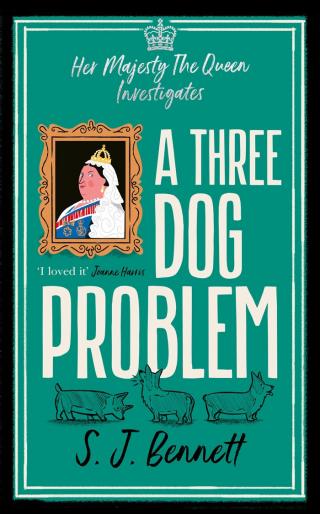
A Three Dog Problem
- Автор: Беннет Си Джей
- Серия: Her Majesty the Queen Investigates #2
- Год: 2021
- Язык: английский
- Год: Zaffre - Bonnier Publishing Fiction
- ISBN: 978-1-83877-485-1
- Жанр: Другие детективы

Электронная книга - «A Three Dog Problem». Краткое содержание книги:
When a body is found in the Palace swimming pool, she finds herself once again in the middle of an investigation which has more twists and turns than she could ever have suspected. With her trusted secretary Rozie by her side, the Queen is determined to solve the case. But will she be able to do it before the murderer strikes again?
The torchlight caught something bright and golden, glimmering on the ground a few feet further on. Rozie was stepping forward to inspect it just as a distant thud made the air reverberate behind her. Jerking up in shock, she banged her head, hard, on the tunnel roof. Dazed, she tried to catch her balance as her mouth filled with the ferrous taste of blood.
Chapter 32
Billy MacLachlan had had worse jobs. Sitting in a pub in Tetbury, pint of ale on the table in front of him, he looked approvingly at the logs that crackled gently in an open fire, the decent list of beers, the decent-looking barmaid and the chalked-up menus of posh pub grub. Once upon a time he and the lads had been pretty scathing about ‘triple-cooked chips’ and half-baked steaks, everything resting on rocket leaves and costing a week’s wages. But you got used to it. The food these days was good. He was very fond of a triple-cooked chip, especially if somebody else was buying. Today he was on expenses from Her Majesty.
‘Now, the pictures. I’m keen to know what happened afterwards.’
The man coming back from the Gents had the look of someone who knew his way around beer and chips, posh or otherwise. His hacking jacket and smart jeans were carefully tailored to accommodate his waistline. He reminded MacLachlan a bit of Humpty Dumpty. The rosy face and receding hairline added to the impression. MacLachlan made a mental note to stick at one pint tonight, even if Her Maj was paying.
‘Have you decided what to order?’ the man asked. His name was Stephen Rochester and he was a Tetbury local and a regular at the pub. He ran a gallery-cum-antique shop in the high street. He’d come highly recommended and, so far, he wasn’t proving a disappointment.
‘Cod and chips and mushy peas,’ MacLachlan said, glancing at the nearest menu. ‘If it’s on, that’s what I’ll have.’
‘Not the duck? It’s very good,’ Rochester suggested.
‘Not the duck.’
‘Or the lamb shank?’
‘You have the lamb shank, Stephen.’ They were on first-name terms by now, although in this case MacLachlan’s name was Charlie. ‘And let me get you some wine. What do we think? The Merlot or the Cabernet Sauvignon?’
They chose a bottle, one of the more expensive on the list, and MacLachlan neglected to mention that he didn’t drink wine any more. It didn’t agree with him – gave him a headache. But if he was entertaining, for whatever reason, he liked to keep his interlocutors loquacious, expansive and well oiled. A good Cabernet could do that. Stephen was on his second glass before he noticed that ‘Charlie’ had stuck to his pale ale.
They were talking about Stephen’s business. ‘Charlie’ had wandered into the shop not long before closing and explained he’d come into some money and he’d need some paintings and the odd stick of furniture to go in his new country home, once he found the right one. ‘To make it look lived-in. You know.’
Stephen Rochester did indeed know and was very happy to oblige. Unlike the rich city-dwellers who were flooding into the Cotswolds – with money to burn, but no love for ‘brown furniture’, such as the Regency mahogany tallboy that ‘Charlie’ had admired as soon as he walked into Stephen’s shop – ‘Charlie’ turned out to be a man who knew his Georgian from his Victorian and asked so many questions about the local area that they’d ended up agreeing to go out for dinner at the pub.
Comfortably installed at a little table by the fire, they chatted about the different Cotswolds towns and villages: which ones were dominated by yoga bunnies in designer leggings, which ones were mostly Airbnbs by now, and which were just about holding onto their character. Stephen was happy to share his expertise. They talked about art, too. ‘Charlie’ was interested – ‘very much as an amateur, you understand. I don’t really know anything. My aunt was keen, mind you. The one I inherited from, God rest her. She had this Renaissance painting – at least, she said it was. She was convinced it was by Caravaggio. Is that how you say it?’
‘It is,’ Stephen acknowledged. ‘That would be very exciting, but unlikely. Caravaggio isn’t Renaissance, by the way.’
‘Oh?’
‘No, he’s the height of Baroque, but don’t let me bore you.’
‘You’re not boring me at all, Stephen,’ ‘Charlie’ assured him. ‘Not at all.’
They finished their dinner and ordered dessert, although MacLachlan picked at his Madagascan Vanilla Panna Cotta with Chocolate Soil and Fresh Basil like a bird. ‘So, if it wasn’t a Caravaggio, how would I know?’
Stephen Rochester happened to be a bit of an expert on the period, which was no surprise because MacLachlan had done his research. Stephen had worked in the local auction houses for years before he set up the gallery, and the Baroque was his specialist subject. He explained about Caravaggio and MacLachlan, who didn’t really care, was impressed with his scholarship.
‘Amazing. You could write a book about it,’ he said, grinning appreciatively.
‘Perhaps I will.’ Stephen was enjoying himself.
MacLachlan topped up Stephen’s glass. ‘What was the most interesting painting you’ve come across, then?’
‘Well, there was one . . .’
Stephen launched into the story of a Peter Lely miniature, followed, when pressed, by another about a Mary Beale portrait of a young girl that had caused quite a stir when it was discovered behind badly installed panelling in a Victorian rectory near Stroud.
At last, MacLachlan felt one step closer to his quarry. ‘Mary Beale, you say? I didn’t know women painted back then. I didn’t think they were allowed to.’
‘Not many did. But Mary was prolific. Her husband was her studio assistant, you know. She was quite the portrait factory.’
‘A woman painter, eh? Back in the – what? Seventeenth century?’
‘Oh, you remind me,’ Stephen said, leaning back in his seat, happy in a well-fed, well-watered haze, ‘about the Gentileschis. I’d almost forgotten.’
‘Oh?’ Bingo. MacLachlan looked politely intrigued.
‘Honestly, tell me to stop if I’m boring on about art, Charlie. All this was twenty years ago. No – thirty!’
‘Not boring at all,’ MacLachlan assured him. ‘Tell me about the gentle-what-was-its.’
Stephen had to pause for a bit to marshal his facts. He explained how there had been a potentially huge discovery of works by a highly respected artist called Artemisia Gentileschi, who was a few years older than Mary Beale, but the same sort of period. Unlike Mary, she was a Continental artist, an Italian. A bit of a genius.
‘There were four paintings. Oils. Dirty and badly varnished but otherwise OK. They’d been hanging in rooms used by one of the old ladies who lived at Hampton Court Palace at the time. Anyway, one of the Royal Collection people finally got permission to see around the place and discovered these priceless pieces dotted about. Well, not priceless, exactly, but Gentileschi is one of the greats and the paintings were possibly the only surviving portraits of her daughter Prudentia, posing as various classical muses. I am boring you.’
‘You’re not, I promise.’
‘It’s not as if the world went mad,’ Stephen admitted, ‘like they’d found a Leonardo or something. Although I wouldn’t put it past them. Artemisia Gentileschi hasn’t got the recognition she deserves, but still, those of us who were working in London at the time, who heard about this on the grapevine, we were agog, you know? Given the time frame, it was possible that the paintings were a royal commission for Queen Henrietta Maria, the wife of Charles I. It would fit with the way the queen’s private apartments in Greenwich were supposed to be decorated. All those interiors are lost. It’s a big gap in the art history of the times, but apparently they were designed on classical themes of art and desire, like these paintings of the muses. It was perfect. If someone could prove the link, once they were cleaned up, it would have been . . . extraordinary.’