Esperanto and Its Rivals: The Struggle for an International Language
- Автор: Garvía Roberto
- Год: 2015
- Язык: русский
- Жанр: Культурология

Электронная книга - «Esperanto and Its Rivals: The Struggle for an International Language». Краткое содержание книги:
Even before the Ido movement's decline looked irreversible, the Espe- rantists were claiming victory, a victory that, according to contemporary Esperantist sources, was practically foreordained. Compared to Ido and its offspring, Esperantists had long been asserting to whoever was in- clined to listen that their language was superior: the easiest to learn, the most beautiful, the closest to natural languages, and so on. Hence their fi nal triumph.
But was this true? Did Esperanto crowd out its rivals because it was a bet- ter language? Similarly, is it possible to claim, for example, that Novial is worse than Occidental, or that Esperanto is better than Idiom Neutral?
In late nineteenth- and early twentieth-century linguistic theory, the idea that languages could be ranked by their level of complexity and perfection had much currency. It was claimed that primitive cultures spoke primitive languages, and advanced societies had more logical, precise, and beautiful languages. Current linguistics, however, has rejected this idea and maintains that all natural languages, be they languages of hunting and gathering soci- eties or of advanced, post-industrial societies, are equally complex. For mod- ern linguistics, ranking languages by their degree of complexity, or claiming that language A is simpler, easier to learn, or better suited for human com- munication than language B, does not make sense. There are no better or worse
Ido — — — Esperanto Volapuk
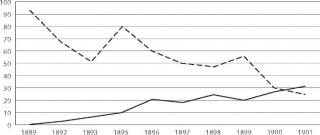
Figure 3. Number of Volapuk, Esperanto, and Ido journals, 1880-1928. Source: Petr E. Stojan, Bibliografio de Internacia Lingvo (New York: Georg Olms, 1973 [1929]), 305-54, 483, and 502-5.
languages: all of them are equally complex, as well as equally efficient when it comes to serving the communication needs of their speakers.1
A similar claim can be made about artificial languages. Since they mir- ror the essential characteristics of natural languages, it is equally difficult to rank them by complexity or learnability. Rather than their complexity or learnability, the proof of the pudding of artificial languages is their feasi- bility, their actual "languagehood," which can only be positively tested by their natural evolution.2 In existence for over 100 years, Esperanto has passed this test. Very much like other languages, it has evolved, absorbing the irregularities, ambiguities, and modifications that its speakers have been infiltrating into Zamenhof's original Esperanto for decades. But the argu- ment that Esperanto has passed the languagehood test because it was better than its rivals is unpersuasive. A more plausible argument is precisely the opposite: Esperanto was able to maintain over time a relatively large com- munity of speakers so that it could evolve and eventually pass the language- hood test.
Zamenhof himself candidly conceded as much. In 1889 he claimed that because of its deficiencies, especially its vocabulary and unpleasant sounds, Volapuk was doomed to fail. In the 1911 Congress of Esperantists, however, when Volapuk was already dead, he volunteered a more balanced view. Volapuk, he claimed, did not die "because of its strange sounds or any other similar reason, since everybody can get used to anything; and what might sound strange today, it will look completely natural and beautiful to- morrow." Volapuk died because, constantly quarrelling, the Volapukists did not give it a chance to evolve. Had Volapukists behaved differently and agreed on the final shape of their language, it could have naturally evolved, and "we all would be probably speaking Volapuk now."3 Russian Esperantist Lev Zhirkov made a similar point in 1931. According to him, Esperanto did not triumph because of its superior qualities on paper. "After the emergence of Esperanto," he argued, "other, much better planned languages, more con- sistent and detailed in their linguistic qualities, made their appearance."4 Esperanto defeated its rivals because it was already a living language, be- cause it had a community of speakers who, whether pacifists, language afi- cionados, or stamp collectors, were using the language to communicate with kindred spirits, either through necessity or choice, unburdened by the quar- rels unfolding at the margins of the community.5
This takes us to one of the main arguments of path dependence litera- ture. Rarely are the potential applications and presumed benefits of compet- ing technologies known in advance, and the same is true with artificial languages. We know retrospectively that Esperanto was good enough to be- come a serious contender or even the eventual winner, but contemporaries could not know for sure, particularly when supporters of rival languages were making exactly the same claims. Everybody was guessing, both regarding the relative superiority of this or that language and the eventual outcome of the battle.6 In other words, extra-linguistic considerations rather than linguistic qualities better explain Esperanto's success.
A similar argument applies to English and to former lingua francas. English has attained that status not because of its syntax and morphology, but as the result of a historical contingency: the economic and political power of English-speaking peoples. But in the case of Esperanto, the historical contingency was different. Their supporters, as well as those of Ido or Volapuk, operated in a power vacuum. They volunteered to create a public good, a lingua franca, without much support from governments and the general public. They had to stand by themselves, increase their numbers as best they could, and strive for the recognition of an outside and not very sympathetic world.
The battle of artificial languages was similar to other standardization con- tests, such as the battle between QWERTY and alternative keyboards, or the contest between VHS and Betamax. A standardization battle of this kind ends when the accumulated decisions of adopters ultimately tip the balance to one technology, but not necessarily the best or most suitable one, and crowd out competing alternatives. Some particularly intuitive contemporaries perceived the battle of artificial languages in exactly these terms. For example, this was the case of the linguist Hugo Schuchardt: "Even when [the artificial lan- guages] are really fighting to win the place, it does not mean that the survi- vor will be the best. On the one hand, because, very much like the stenographic systems, they do not differ substantially. . . . On the other hand, because their diffusion is not primarily determined by their own qualities, but by those of their supporters, their insight, and social influence."7
Neither Schleyer nor Zamenhof nor Couturat were aware that they were fighting in a scenario of positive feedback mechanisms. They simply used dif- ferent organizational strategies. On the surface, the three language movements look very much alike. Established around the same time, shaped by a simi- lar economic and technological context, their organizational contour did not differ much. They all provided themselves with an academy, official jour- nals, address books of speakers and supporters, and annual international meetings. But there were substantial differences in their organizational strategies, which can be explained by the mental models and well-established predilections of their leaders. Schleyer's original plan incorporated the authoritarian and highly formalized organizational blueprint of the Catho- lic Church; Zamenhof had taken from his experience in the proto-Zionist movement his conviction about the relevance of participation and commit- ment for the survival of a social movement; Couturat took from his aca- demic milieu the idea of enforcing a division of labor between scientists and lay people in the Ido movement.