Esperanto and Its Rivals: The Struggle for an International Language
- Автор: Garvía Roberto
- Год: 2015
- Язык: русский
- Жанр: Культурология

Электронная книга - «Esperanto and Its Rivals: The Struggle for an International Language». Краткое содержание книги:
But if many were rightly concerned about the growing importance of En- glish, few anticipated that it was going to enter the battle as another artificial language as well, in the form of a simplified "Basic English." In 1930 the Brit- ish Charles K. Ogden (1889-1957) published his Basic English: A General In- troduction with Rules and Grammar. Ogden had already obtained some notoriety with his book The Meaning of Meaning (1923), which he co-authored with Ivor A. Richards. But unlike Richards, who would later become a re- nowned Harvard literary critic, Ogden preferred to make a living at the mar- gins of academia, working as an editor for the Kegan Paul publishing group. While a Cambridge student, he had been the editor-in-chief of the Cambridge Magazine, which he transformed into an influential journal in political and academic circles. He was also president of the Heretics Society, an informal club that invited leading intellectuals, such as Chesterton, Russell, or Frank Ramsey, to discuss their ideas.17
As he conceived it, Basic English had only 850 words, which, combined in paraphrases and circumlocutions, would satisfy all practical communi- cation purposes. Although he was not a pacifist, Ogden was convinced that the dissemination of English would put a definitive end to the threat of war and that a simplified version would be more suitable to realize this possibility.
To promote his new language, he founded the Orthological Institute in 1927, "orthology" meaning a new discipline wherein philosophy, linguistics, and psychology converged. But beyond those already involved in the artificial language movement, Ogdens Basic English did not attract much attention. He was able to publish some textbooks and collect the support of luminaries such as George Bernard Shaw, Julian Huxley, and H. G. Wells (Russell had had enough of language inventors), but that was all, and the outbreak of World War II only made his dream look more fanciful. Thus, it came as a surprise when in a public speech at Harvard University, the British prime minister Winston Churchill devoted a sizeable part of his discourse to Ogden's Basic English. This was in September 1943, when the Allies were more confident about their eventual victory. As Churchill said:
I do not see why we [British and Americans] should not try to spread our common language even more widely throughout the world. . . . Here you have a plan [Basic English]. . . . Might it not be also an advantage to many races and an aid to the building-up of our new structure for preserving peace? . . . Such plans offer far better prizes than taking away other's peoples provinces or land, or grinding them down in exploitation. The empires of the future are the empires of the
mind.18
Those more closely associated with Churchill were not surprised. Some months before his Harvard speech, he had established a cabinet committee to eval- uate Basic English as an international auxiliary language. By December 1943, the committee, composed of the secretaries of state of the colonies and India, the minister of information, the undersecretary of state for foreign affairs, and other officials, released its conclusion. It strongly supported the development and use of Basic English by the British Council, the colonial office, diplomats, official representatives, and even the BBC. It also recom- mended that Ogden's Orthological Institute be provided with generous funding. To operationalize this scheme an interdepartmental committee, led by the Foreign Office, was established in 1944, but in the following year, and as a consequence of Churchill's defeat in the July elections, the whole plan was gradually phased out. Even so, Ogdens institute, renamed the Ba- sic English Foundation, obtained a Ј18,600 grant in 1947 from the Ministry of Education (around $870,000 at current values). But by the early 1950s public officials had lost interest and the state coffers were sealed for Churchill's linguistic ambitions.19
It is important to note, however, that even before Basic English captured Churchill's imagination, the British government was already moving in the same direction. In 1938, and anticipating the international Esperanto con- gress scheduled to take place in London, the Foreign Office sent a warning note that "it is undesirable to support organizations which have as their ob- ject the encouragement of artificial languages, when we are seeking to secure the adoption of English as the second language in all foreign countries."20 That the British government decided to pursue this goal by means of either real English or a simplified version did not matter much to artificial language supporters.
As Sapir put it, be it Full or Basic, the real thing or a Trojan horse, the promotion of English or any other ethnic language could only kindle resent- ment.21 Similarly, for the Stanford professor and IALA associate Albert L. Gue- rard, Basic English was another example of the all-too-common "linguistic imperialism" of the time, explained in this case by "the magnificent insular- ity which is the pride of the Anglo-Saxon mind."22 No less critical, but more biased, was the ex-Idist and Occidentalist Alphonse Matejka. Probably with earlier discussions in Germany about the creation of a simplified German for use in the German colonies still in his mind, he thought that Basic English would serve the same purpose and "reduce us to the linguistic level of black Africans."23
Notwithstanding the travails of IALA, Jespersens and de Wahl's decisions to take the plunge and launch new languages, and Ogdens Basic English, the fact was that Esperanto had long before won the battle. It reached its heyday in the 1920s, when, weary of World War I and its consequences, many saw in Esperanto a suitable instrument to promote international cooperation among people of different languages. In 1926, attendance at the international Esperanto congress was the highest ever, with almost 5,000 participants, and the Universala Esperanto Asocio reached its membership peak in 1935 with 16,000 affiliated Esperantists. Similarly, in the early 1920s, Esperanto was taught as an elective or compulsory subject in some primary and secondary schools in France, Belgium, the United Kingdom, the United States, the Neth- erlands, Spain, Hungary, Czechoslovakia, and some German states such as Hesse, Saxony, and Brunswick, among other places. It was also taught on the premises of the Chambers of Commerce of Paris and London. The 1920 World
Congress of International Associations recommended its use, as well as other associations such as the Red Cross, the YMCA, the International Catholic League, the International Bibliographic Institute, the International Women's Suffrage Alliance, and the International Peace Bureau. Even the League of Nations, as we see below, seriously considered Esperanto as an auxiliary language.24
Although Esperanto prevailed among the crowded and fractious field of artificial languages, it failed to become the international auxiliary language that many expected. The movement reached its peak in the mid-1920s, but only ten years later Esperanto's prospects were rather bleak. It had defeated rival artificial languages but lost the war against natural languages—in par- ticular, English—to become the world's lingua franca.
How this did happen? What factors combined against the final adoption of Esperanto as the international language?
Conclusion
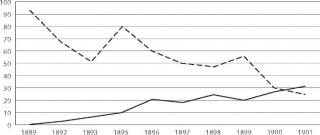
Figure 3 illustrates the number of Volapuk, Esperanto, and Ido journals from 1880 to 1928. This is probably the best measure of each language movement's strength. As the figure shows, by the time Ido entered the scene, Volapuk had already exited, defeated by Esperanto and its own internal divisions. For its part, Esperanto had a very difficult time during its first decade of existence, only taking off at the turn of the century. When Zamenhof published his Unua Libro, Volapuk was still thriving and about to reach its peak. The Volapuk movement was certainly experiencing some difficulties, but its inability to overcome them would only become visible a couple of years later.