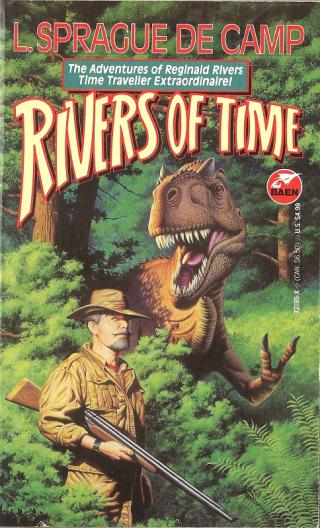
Rivers of Time
- Автор: Де Камп Лайон Спрэг
- Год: 1993
- Язык: английский
- Год: Baen Books
- ISBN: 9781555940232
- Жанр: Научная фантастика

Электронная книга - «Rivers of Time». Краткое содержание книги:
Includes:
• Faunas (1968)
• A Gun for Dinosaur (1956)
• The Cayuse
• Crocamander Quest
• Miocene Romance
• The Synthetic Barbarian
• The Satanic Illusion
• The Big Splash
• The Mislaid Mastodon
• The Honeymoon Dragon
These game ranches did well for a while, with the disappearance of all the real wild lands except for parks and preserves, where the beasts are protected. The technique of breeding animals has got to the point where you need only a few of any species and you can keep your breeding group furnishing more specimens indefinitely.
Once Professor Prochaska got his transition chamber working, all the real hunting sahibs wanted to go back in time, shoot some local fauna—especially mammoth and dinosaur—and bring back heads and hides to prove it. So the game ranches had been going broke, and they hired a lobbyist to stop time safaris.
The lobbyist for the Game Ranch Association was a bloody shrewd lawyer named Jason Eckler. He made a pitch against importing fossil fauna to the Present.
The Raja and I had brought a couple of stenonychosaurs back from the late Cretaceous. These are man-sized theropods—flesh-eating dinosaurs. That Wildlife Park in San Diego reports that they have bred successfully. The Park people are all of a twitter over a half-dozen little stenos running around and snatching each other's meat rations.
Now there was talk of fetching something more ambitious. Each year the Raja and I find that fewer of our clients want to kill anything and more who prefer just to study, photograph, or watch the beasts, or wish to bring them back to Present alive, as we were trying to do.
This bloke Eckler spoke of the dangers of importing exotic fauna, of which a pair might get loose and fill the country with their descendants. He cited the starling, the walking catfish, the Mediterranean fruit fly, the kudzu vine, and so forth. He pictured America overrun with tyrannosaurs stalking and gobbling citizens.
In my turn, I pointed out that the same objection applied to bringing in any exotic species, as for zoos and circuses. In fact, some game ranches had imported Asian deer, which had got loose and out-competed the native deer. Australia well knows these dangers, as witness our troubles with imported rabbits and foxes.
Then another cove whom I knew took the stand. He was a big bloke with a ruddy complexion, conventionally dressed except for long black hair hanging down his back. He was Norman Blackelk, a Native American of the Crow or Absaroka tribe. He, a lawyer, headed the Redintegration Society, which was footing the bill for our mastodon hunt. On the stand, he explained that it was a matter of conscience with him to try to restore as much as possible of the North American Pleistocene climax fauna. The theory is that Blackelk's ancestors had come over from Siberia twenty or thirty thousand years ago. Finding the continent swarming with mammoths, mastodons, ground sloths, camels, horses, and other big, edible creatures that had never learned to cope with men, they killed and ate the lot. When the big mammals—the mega-fauna, my scientific friends call it—were nearly all gone, along with the lions and sabertooths that preyed on them, the invaders starved until they learned to grow maize and beans and to trap smaller beasts like marmots—woodchucks, I think you call them.
Another witness was Horace Dunbar, a lean, weather-beaten bloke with a potbelly overhanging his belt and a Texan accent. He owned a game ranch, and he told a pitiful tale of how he had worked long and hard to put his children through college, and now these foreign coves were going to bankrupt him with their devilish time-travel contraption. Had a couple in the audience shedding a tear.
After the hearing, the Raja and I—that dark chap you met when you came in was my partner, Chandra Aiyar. I call him "Raja" because by descent he actually is one, if anybody paid attention to that sort of thing nowadays. We went down with Blackelk to unwind, taking a table for four. Presently Eckler, finding all the stools along the bar taken, asked if he might sit at our table. I said certainly.
"No hard feelings?" he said. "I'm just an advocate, doing what the Game Ranch Association pays me to do."
"I understand," I said. We talked of lightweight matters while our drinks were coming. Then the Raja, who is a near-teetotaler, excused himself and went away to meet his wife. Eckler said:
"May I offer a small piece of advice, Mr. Rivers?"
"Sure, if you like," I said. I looked sharply at him, wondering if the next remark would lead up to a threat or a bribe offer. "Is your meter turned off?"
He laughed. "Oh, I'm not charging for this. I was going to say, next time you're on the witness stand, speak a little more slowly and distinctly than normal. As it is, that Australian accent causes some Americans to miss an occasional word."
"Thanks; I'll try," I said.
Then Eckler, looking round, spotted Dunbar, searching for a place to sit. He called: "Hey, Horace!"
Soon Dunbar, after apologies, occupied our fourth chair. After a bit of persiflage, Dunbar looked at me through narrowed eyes.
"Mr. Rivers," he said, "do I understand rightly that your next Safari won't be for hunting, but to bring back one of them mammoths or mastodons to the present world?"
"That's right," I said. "Mr. Blackelk hopes to get enough of these Pleistocene animals to establish breeding herds."
"We aim," said the Native American, "to start with Mastodon americanus, a once very common, successful species. It will have to be young, because the transition chamber isn't large enough for a full-grown specimen; likewise with the three species of mammoth of the North American Pleistocene."
Dunbar gulped his third drink—he was a two-fisted drinker—and said: "I've got a client who'll pay a hefty five-figure sum to shoot one of them mastodons."
"Well then, send him to Rivers and Aiyar, Tame Safaris," I said.
"No, that won't work. This guy's got a phobia, I guess you'd call it, about your time machine. He's mortal afraid it'll get him back to some ancient time and then break down, leaving him stranded millions of years back. He's had a couple of experiences with machines that make him leery—an airplane forced to land in a cow pasture, or a train that ran off the rails, or a ship that went aground. And he figures time travel's the trickiest of all."
"It's always worked for us," I said. "We've made dozens of time trips in it, and it's never failed to fetch us home to Present."
"That don't make no difference. This client's got his mind set and wouldn't listen to you. How about if you was to bring your mastodon back to now and then sell him to us?"
"Hey!" said Blackelk. "You mean so you can stake it out for your client to walk up and shoot?"
"Sure. This guy's crazy mad to kill an elephant, irregardless of how he does it. Only nowadays there ain't no elephants for shooting. The few that still live are all numbered and watched over like so many prize chickens, both the African and the Asiatic kinds. There's no place you're allowed to shoot one. One of my customers tried poaching, and the rangers shot him dead. Well, Mr. Rivers, how about it?"
"I'm not interested in that kind of 'sport,' " I said. "Anyway, the animal will be the property of Mr. Blackelk and his Redintegration Society."
"And you can be damn sure we wouldn't consider any such deal," said Blackelk. "We're trying to restore the species, not exterminate it a second time over."
Dunbar by now had had four or five drinks. He growled: "All right, you snotty sons of bitches! I'll show you! Gonna put me out of business, eh? After I've spent half my life trying to build up an honest sporting establishment—"
Eckler grabbed Dunbar's arm and squeezed hard, saying: "Shut up, Horace! This is your lawyer speaking!"