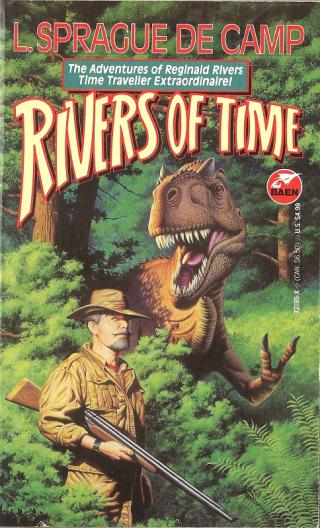
Rivers of Time
- Автор: Де Камп Лайон Спрэг
- Год: 1993
- Язык: английский
- Год: Baen Books
- ISBN: 9781555940232
- Жанр: Научная фантастика

Электронная книга - «Rivers of Time». Краткое содержание книги:
Includes:
• Faunas (1968)
• A Gun for Dinosaur (1956)
• The Cayuse
• Crocamander Quest
• Miocene Romance
• The Synthetic Barbarian
• The Satanic Illusion
• The Big Splash
• The Mislaid Mastodon
• The Honeymoon Dragon
Then, to one side, the Raja's gun went off. The mammoth staggered as if from a tremendous blow. It regained its balance and shuffled away, shaking its head.
"I shot him through that bump on top of his skull," said the Raja. "Knowing you didn't want him killed. The bullet just went through that spongy mass of bony cavities. He may have a headache for a while, but the holes should soon heal up." That dome atop the heads of mammoths provides anchorage for the huge neck muscles, which have to be bloody powerful to support those tusks.
"You should have killed him," said Delarue. "I could have gotten a paper out of a study of its head, or even my thesis."
"You didn't speak up," said the Raja.
"But I should think anyone with brains—" began Delarue.
My own temper was getting frazzled, and I did my lolly: "Look, God damn it, you almost got us into serious trouble by going close to the mammoth when I told you not to, and then falling over your own stupid feet in the animal's path. The next stunt of that kind you pull, we'll hogtie you, put you in the chamber, and tell Cohen to drop you off at Present."
"I—I'm sorry," he mumbled.
More days passed without a sign of mastodon, although all the paleontological finds indicated that at this time the place should swarm with them. The Raja and I began to worry, since the charges for keeping the chamber back in the Pleistocene were mounting up. Norman Blackelk worried, too, saying:
"I don't know, Reggie, how much more money the directors of the Redintegration Society are willing to sink in this trip. Perhaps we ought to shift camp after all."
"That would run the charges up pretty fast, too," I said. "We should have to go back to Present and round up some extra crew and our train of asses—burros, if you prefer—to help with the move."
Hockersmith said: "Why don't we try to catch one of the smaller mammals: say, a Pleistocene horse or beaver; or even that ground sloth."
Blackelk looked dubious. "We may come to that; but first I'd have to consult the exec committee of the Society. They were pretty definite that they wanted a young mastodon. They already have a breeding stock of several other Pleistocene species, and they want to spend their money where it'll do the most good."
"Hey, Norm!" said Hockersmith. "Just had an idea. You're a real Native American, aren't you?"
"So they tell me," said Blackelk. "Less than one-quarter white genes."
"Well, the Indians used to put on ceremonies, with dances, to encourage animals of the kinds they hunted to come around and let themselves be killed. I seem to recall that the Ghost Dance, which got poor old Sitting Bull killed, was supposed to bring back the buffalo. It didn't, of course, since by then the whites had shot most of the buffalo with repeating rifles."
Delarue cleared his throat. "Don't you mean 'bring back the bison'?"
"No; I said 'buffalo* and I meant 'buffalo.' That's what the animal was always called in that time and place. A 'bison' is something an Aussie like Reggie here uses to wash his hands in."
"Oh, bulsh!" I said. "A dinkum Aussie does not pronounce 'basin' and "bison' alike. Unless you're hearing-impaired, you can hear the difference: 'basin,' 'bison,' 'basin,' 'bison.'"
"I see," said Delarue. "You move "basin' halfway to 'bison,' and 'bison' halfway to 'boyson.' "
Blackelk asked: "Is there such a word as 'boyson'?"
Delarue shrugged. "I once knew a Mr. Boysen." He turned to Blackelk. "What did the Crows call it, Norm?"
Blackelk spread his hands. "Don't know. I learned Absaroka in school, although all the tribe are Anglophones now. The theory was that the language mustn't be allowed to die out, because it was a priceless cultural heritage or something. I never became fluent in it. Actually, 'bison' and 'buffalo' are both names for several kinds of Old World wild cattle. The white invaders carelessly applied both Old World names to the one American species, since they couldn't pronounce the Native American words for the animal."
Hockersmith said: "We're getting away from the subject. Norm, we want you to do a ghost dance to bring back the mastodon. It may not work, but what have we got to lose?"
"Don't know that I could do that," said Blackelk. "Even if I could remember enough Absaroka, the language has no word for 'mastodon.' Maybe it did once, but if so it must have been forgotten soon after the animal went extinct."
"Well then, simply call it 'mastodon.' Your Native American gods would understand."
"I'll see what I can think up—"
"Don't do it, Norm!" said Delarue. "It's just pandering to primitive superstition. The world will never be able to manage its affairs in a rational manner as long as people go in for irrational, unscientific cults and sects, with gods and other spooks."
Delarue's cocksureness even got under the skin of Joe Hockersmith, usually an even-tempered, self-controlled man. "Look, squirt," he said. "We'll make it a sporting proposition. If Norman comes up with a ghost dance, what'll you bet the mastodon don't appear in a reasonable time, say ten days? How about ten bucks?"
"Make it fifty," said Delarue. "I don't ordinarily bet, but against a silly superstition it's a sure thing."
They shook hands. Blackelk said: "The first thing I need is a drum. Too bad we didn't bring one."
After much yabber, we decided to convert Hockersmith's barrel of apples into a drum. We dumped the apples out in the chamber, took a sheet of plastic used as a tarpaulin, and with much tugging and grunting got it pulled tight over the empty barrel and dogged down. It gave a satisfactory boom when Blackelk slapped it. He said:
"Now I need some dancers. Reggie, you and Joe ought to do."
"Me, dance?" said Hockersmith. "Never have in my life. My wife's been after me for years to take lessons—"
"You thought up this project," said Blackelk, "so you can damn well play your part in it."
"What steps have we got to learn?" asked Hockersmith.
"I'll show you." The steps proved simple enough, with much stamping and raising the knees, as in that British parade step the Commonwealth armies used to practice.
After tucker that night, when full dark came, we cleared a space and went to work. Blackelk sat on a camp chair with the barrel between his knees. Stripped to the waist, he had a necktie knotted around his forehead for a headband and some feathers, which Ming supplied from a fresh turkey in our commissariat, stuck in the band. He began a chant in Absaroka. I can't reproduce any of it. It had a rather monotonous little tune with about three notes, while Blackelk slapped his drum. Hockersmith and I hopped and stamped around him in circles, as Blackelk had taught us. The rest of the crew, standing about in the firelight, kept time by clapping. After a while the rhythm and the pounding got into our blood, as they got into mine when I once took part in a corroboree with some Native Australians in the outback.
When Blackelk ran out of song and Hockersmith and I out of wind, we paused. From the dark woods came a squeal, and then another. Then several proboscidean throats let loose with that sound called 'trumpeting,' because it does sound like some sort of trumpet, only a horn with spit in it.
Everybody turned to look while the Raja and I got our guns. Presently an animal hove into view, near enough so that we could dimly make it out by firelight. It stared at us and turned away; the light showed it to be an American mastodon. I guessed it to be a female from its slender tusks. I had read that elephant herds are commonly bossed by the oldest cow; they have alpha females instead of alpha males.
After this first mastodon came another, then a couple of little ones no more than waist high; then another big one, following the track of the first. More went by until at least a dozen had passed. All, as nearly as I could judge, were cows and young. At the tail of the procession, a big bull ambled along. This one looked our way, hoisted his trunk to sniff, and flapped his ears. Then we heard a loud toot, which seemed to come from the head of the line. The bull turned away and single-footed it after the herd like a Bondi tram. It must, I thought, have been the big cow who headed the line, the matriarch, telling the bulclass="underline"