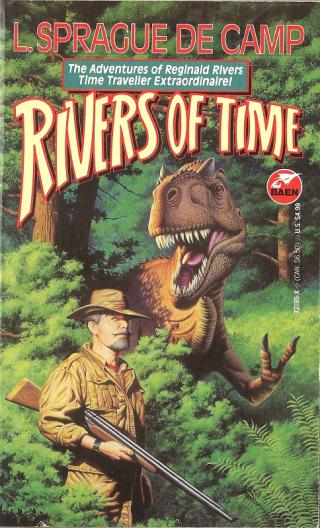
Rivers of Time
- Автор: Де Камп Лайон Спрэг
- Год: 1993
- Язык: английский
- Год: Baen Books
- ISBN: 9781555940232
- Жанр: Научная фантастика

Электронная книга - «Rivers of Time». Краткое содержание книги:
Includes:
• Faunas (1968)
• A Gun for Dinosaur (1956)
• The Cayuse
• Crocamander Quest
• Miocene Romance
• The Synthetic Barbarian
• The Satanic Illusion
• The Big Splash
• The Mislaid Mastodon
• The Honeymoon Dragon
"He said something, half an hour ago, about taking a little walk to watch the local fauna undisturbed by our presence. I'm sure he hasn't gone far."
The Raja saw I was about to blow my top over the matter. He said: "Calm down, Reggie; I'll go hunting for—"
Then a disturbance interrupted. Around the bend of the hill came George Romero, doing a fair turn of speed in spite of being short and middle-aged. Right behind him ran a steno, trying to get close enough to flesh its fangs in his back.
A steno? That's short for Stenonychosaurus, one of the saurornithoids of his period. We call them "stenos" because people find Stenonychosaurus hard to remember. They're smaller flesh-eaters. One weighs around fifty kilos—in other words, as much as a smallish human being. They have a slim running shape, and when moving they come up about to your navel, with the head and tail sticking out horizontally. When they rear up, they can look you in the eye. They're normally harmless, since their prey is little things like lizards, birds, and the mammals of those times, all of which looked much like rats and mice.
But here this bloke was chasing our scientist with obvious hostile intent. Romero ran through the camp and headed for the time chamber, which stood on a slight rise on the edge with its doors open.
I jumped for the Raja's and my tent and came out with my heavy rifle, in time to see Romero dive in the doors of the chamber. Cohen was in the chamber, making adjustments, and I heard a startled yell from him. Then the doors slammed shut in the steno's face.
The reptile went splat against the steel doors and backed off, shaking its head as if in wonder at human technology. It looked about, seeming to realize for the first time that it had blundered into territory off-limits to dinosaurs.
I hesitated to shoot, lest I hit somebody or something in the camp. The Raja came out with his gun, but he paused likewise. Then the steno set off at a dead run, out of the camp and around the curve of the hill where it had chased Romero. In a few seconds it was out of sight.
By banging on the chamber door, we persuaded Cohen to open up. Romero, still breathing hard, came out looking like a lad caught with his hand in the lolly jar. He apologized all over the place: I had seemed too busy to bother, and he took only a little stroll, etcetera. Meanwhile Cohen locked the chamber doors behind him in a marked manner.
"But," I said to Romero, "what on earth did you do to rile up that steno? Normally they leave us alone, since we're much too big to serve as their normal prey."
"It was this way," he said. "I walked quietly around the hill till the camp was just out of sight. There was a pair of these stenos on a little flat place, doing a kind of dance. So I watched. One just stood, while the other went through what looked like the calisthenics I do when I get up in the morning. It did deep-knee bends, squatting down and rising up again; then it stayed up but bowed down and touched its head to the ground, over and over. Then it went back to squatting and rising.
"I figured out that this was a mating dance, and the one doing the setting-up exercises was the male, hoping to get the female into a receptive mood. It seemed to be working, because the male extruded that great long hook-shaped hemipenis—or rather, he extruded the half of it on the side toward the female. Then he grabbed the female with his foreclaws, hoisted one leg over her hindquarters, and started feeling around her underside with this organ to find the point of entry.
"I couldn't resist the temptation to shoot a few frames on my camera. Whether the tiny click of the shutter aroused the male, or the motion of my arm, I don't know. But he suddenly stared at me, let go the female, and withdrew his hook inside him. He uttered a kind of caw, like a crow, and started for me. Not being armed, I ran for it."
The Raja and I had the same thought, and we both burst out laughing. "Sport, he thought you were a rival, who wanted to screw his mate," I said. "Naturally, no right-thinking bull steno is going to stand for that!"
The whole camp had a good laugh over the incident. But then our spirits sank as the clouds formed huge anvils, with lightning and thunder. By the time for tucker, rain was coming down in buckets.
It kept up the whole night. Maybe theropods gathered again round the sauropod carcass to resume their feast; but the storm made so much noise we couldn't have heard them. The next day was more of the same, all day.
"Lousy luck," said Featherstone. "If we can't see the results of the impact from a distance, we don't dare hang around until it happens. The shock wave might catch us unawares and smear us."
Haupt said: "There may be enough light from Enyo to warn us as it makes its final plunge, even through the cloud cover."
"How about the big wave?" asked Romero. "If that Thing lands in water, it'll kick up the grandfather of all tsunamis. You know what they say: If you're at the beach and see a tsunami coming, it's already too late to save your life."
"Unless," said Featherstone, "you had a fast motor vehicle and floored the gas away from the beach."
"And if," said Romero, "the road wasn't jammed with other people trying to do the same thing. But how about this tsunami?"
"Don't worry," said Haupt. "One might wash inland over flat country for a few kilometers—maybe ten or twenty—but we're at least a hundred kilometers from any sea. The speed—"
"How do you know," interrupted Todd, "that we're a hundred kilometers from the sea, when we haven't a map of the area for this period?"
Haupt answered with the forced patience of a schoolma'am with a backward pupil. "Because if it were closer, we could see it plainly from this altitude. The speed of the wave would be only a fraction of that of sound, which is a little over 330 meters per second, and which is also the speed of the shock wave."
I held up a hand to quiet the argument and said: "Listen, please. We shall get up hours before the expected impact. Then we shall load into the chamber all the stuff we plan to take back with us and stand by the doors, ready to leap in the minute you blokes see a flash in the sky. We shan't wait for any shock wave but take off for Present instantly."
So it was decided; but as things turned out, that scenario did not prove necessary. During a day of rain, I had to listen to Todd's complaints over not getting a second hunt, and O'Connor's complaints over not being able to paint more pictures, as if I were somehow responsible for the weather.
The evening before the Event, the rain tapered off and the clouds broke up. We loaded into the chamber the stuff we were taking back, like Todd's sauropod head and O'Connor's pictures. Ming hauled a bag full of our new kitchen utensils; he wasn't going to sacrifice them if he could help it.
When we got up before dawn, we had a clear, deep-blue sky overhead, in which the stars were going out one by one as the glow of the coming sunrise brightened in the east.
"Where's Enyo?" I asked Haupt.
"She'll be up any minute," he said. "The Earth has to turn more towards her—ah, there she comes! Call your gang together!"
Rising from the southeastern horizon, which was still a pretty dark blue, came another spot of light, somewhat resembling the planet Venus at her maximum brightness. I stared at it but could not see any relative motion between Enyo and the few stars still visible.
"Is she going to make it?" I asked Haupt. "She doesn't seem to be getting anywhere."
"She's moving, but too slowly to make out with the bare eyeball," he said. After we had stood for a while, jittering and thinking—at least I was thinking—whether it wouldn't have been smarter to have used robot instruments instead of human observers, Haupt said: "Look carefully, now. She's visibly declining toward the horizon."