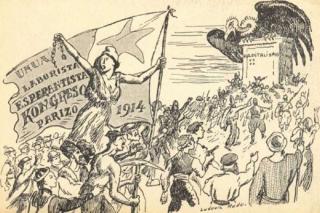
Esperanto Revolutionaries and Geeks: Language Politics, Digital Media and the Making of an International Community
- Автор: Fians Guilherme
- Год: 2022
- Язык: русский
- Жанр: Культурология

Электронная книга - «Esperanto Revolutionaries and Geeks: Language Politics, Digital Media and the Making of an International Community». Краткое содержание книги:
In a ground-breaking ethnographic study on political power and social organisation among indigenous peoples in South America, Pierre Clas- tres (1989) argues that several indigenous groups lack a state apparatus. Yet, this is so not because they are incapable of organising centralised power structures, but because they deliberately develop mechanisms against state formation. Along comparable lines, the language ideology that precedes, grounds and justifies Esperantos existence takes shape through practices that set the speech community against the language council, thus actively preventing the emergence of an incontestable and centralised authority. Therefore, despite the existence of dictionaries, prominent Esperanto users and the Akademio, there is still room for the continuous emergence of debates on which word to choose during a discussion about drones.
The three competing principles outlined here are what enable Esperanto to take shape, to the eyes and ears of its speakers, as an accessible, egalitarian, fairer and more inclusive language. As language is rendered consistently negotiable and open for grabs, Esperanto is constantly (re)politicised, which establishes a relatively democratic space open for linguistic controversies and conflicts to arise. By pursuing more horizontal forms of communication, Esperantos language ideology empowers users to continuously contribute to language development and gives them opportunities to suggest the use of one word instead of another, thus expressing themselves more freely, without neces- sarily being judged as 'bad language users'. In this sense, Esperanto (re)politicises intercultural communication, encouraging people to think about the role of language, mutual understanding and equality when using the language in both its written and spoken forms. However, instead of complementing each other, the three principles that enable this inclusive approach often compete with each other, which makes this speech community a linguistic battlefield for both supporters of the fundamental language and all kinds of reformers.
References
Achard, Pierre. 1980. History and the Politics of Language in France: A Review Essay. History Workshop Journal 10 (1): 175-183. https://doi.org/10.1093/ hwj/10.1.175.
Adelman, Michael. 2014. Constructed Languages and Copyright: A Brief History and Proposal for Divorce. Harvard Journal of Law & Technology 27 (2): 544-562.
Boulet, Paul. 1905. Unua Universala Kongreso de Esperanto en Boulogne-sur- Mer: Kongresa Libro. Boulogne: Hamain.
Candea, Matei. 2010. Corsican Fragments: Difference, Knowledge, and Field- work. Bloomington: Indiana University Press.
Clastres, Pierre. 1989. Society Against the State: Essays in Political Anthropology. New York: Zone Books.
Connor, Janet E. 2019. 'The Langue d'Oc Is Bringing People Together': Debating the Place of Regional Languages in France. Journal of Linguistic Anthropology 29 (2): 249-270. https://doi.org/10.1111/jola.12215.
Cramer, Marcos. 2021. Empirical Study on the Use of Gender-Neutral Pronouns in Esperanto. In The Intercultural Role of Esperanto, ed. Ilona Koutny, Ida Stria, and Michael Farris. Poznan Adam Mickiewicz University and Wydawnictwo Rys.
De Hoog, Hendrik A., Douglas B. Gregor, Kalman Kalocsay, Stefano La Colla, Ivo Lapenna, Teruo Nakamura, Tomaŝ Pumpr, Juan Regulo, Raymond Schwartz, Ernst Sonnenfeld, and Gaston Waringhien. 1961. La Zamenhofa Esperanto: Simpozio pri -atal-ita. La Laguna: J. Regulo.
Fiedler, Sabine. 2012. The Esperanto Denaskulo: The Status of the Native Speaker of Esperanto Within and Beyond the Planned Language Commu- nity. Language Problems and Language Planning 36 (1): 69-84. https://doi. org/10.1075/lplp.36.1.04fie.
Forster, Peter G. 1982. The Esperanto Movement: Contributions to the Sociology ofLanguage. The Hague: Mouton.
Garvia, Roberto. 2015. Esperanto andIts Rivals: The Struggle for an International Language. Philadelphia: University of Pennsylvania Press.
Heller, Monica. 2017. Dr. Esperanto, or Anthropology as Alternative Worlds. American Anthropologist 119 (1): 12-22. https://doi.org/10.1111/aman. 12824.
Jaffe, Alexandra. 1996. The Second Annual Corsican Spelling Contest: Orthog- raphy and Ideology. American Ethnologist 23 (4): 816—835. https://doi.org/ 10.1525/ae.1996.23.4.02a00080.
Lins, Ulrich. 1974. Akademio de Esperanto. In Esperanto en Perspektivo: Faktoj kaj Analizojpri la Internacia Lingvo, ed. Ivo Lapenna, Ulrich Lins, and Tazio Carlevaro. London and Rotterdam: Universala Esperanto-Asocio/Centro de Esploro kaj Dokumentado pri la Monda Lingvo-Problemo.
Macbeth, Douglas. 2004. The Relevance of Repair for Classroom Correction. Language in Society 33: 703-736. https://doi.org/10.1017/S00474045040 45038.
Marcus, George. 1995. Ethnography in/of the World System: The Emergency of Multi-sited Ethnography. Annual Review of Anthropology 24: 95-117. https://doi.org/10.1146/annurev.an.24.100195.000523.
McDonald, Maryon. 1989. 'We Are Not French!'Language, Culture and Identity in Brittany. London and New York: Routledge.
McDonald, Maryon. 1999. A Deadly Linguistics? Tales from the Celtic fringe. In Divided Europeans: Understanding Ethnicities in Conflict, ed. Tim Allen and John Eade. The Hague: Kluwer Law International.
Miner, Ken. 2011. The Impossibility of an Esperanto Linguistics. Inkoj, Interlingvistikaj Kajeroj 2 (1): 26-51. https://doi.org/10.13130/2037-455 0/838.
Netz, Hadar, Dafna Yitzhaki, and Adam Lefstein. 2018. Language Correc- tions and Language Ideologies in Israeli Hebrew-Speaking Classes. Language and Education 32 (4): 350-370. https://doi.org/10.1080/09500782.2018. 1435688.
Piron, Claude. 1989. La Bona Lingvo. Vienna: Pro Esperanto.
Schreyer, Christine. 2015. The Digital Fandom of Na'vi Speakers. Transforma- tive Works and Cultures 18. https://doi.org/10.3983/twc.2015.0610.
Silverstein, Michael. 1979. Language Structure and Linguistic Ideology. In The Elements: A Parasession on Linguistic Units and Levels, ed. Paul Clyne, William Hanks, and Carol Hofbauer. Chicago: Chicago Linguistic Society.
Silverstein, Michael. 1985. Language and the Culture of Gender: At the Intersection of Structure, Usage, and Ideology. In Semiotic Mediation: Sociocultural and Psychological Perspectives, ed. Elizabeth Merz and Richard Parmentier. Orlando: Academic Press.
Waringhien, Gaston. 2002 [1968]. Generala Antauparolo (1-a Eldono). In Plena Ilustrita Vortaro de Esperanto, ed. Gaston Waringhien. Paris: Sennacieca Asocio Tutmonda.
Weber, Max 2017 [1949]. Methodology of Social Sciences. London and New York: Routledge.
Wennergren, Bertilo. 2005. Plena Manlibro de Esperanta Gramatiko. El Cerrito: Esperanto League for North America.
Wennergren, Bertilo 2020. Bertilo ne intencas igi verda papo. Libera Folio, 28 September. Available online at: https://www.liberafolio.org/2020/09/28/ber tilo-ne-intencas-igi-verda-papo/?fbclid=IwAR1ptD1oWm3Vl6i9KO6_-Z9C 5ZK6FB_nFfX89WUzPc45FhQk2Kk5g-NotJw. Accessed 3 November 2020.