Esperanto Revolutionaries and Geeks: Language Politics, Digital Media and the Making of an International Community
- Автор: Fians Guilherme
- Год: 2022
- Язык: русский
- Жанр: Культурология

Электронная книга - «Esperanto Revolutionaries and Geeks: Language Politics, Digital Media and the Making of an International Community». Краткое содержание книги:
Woolard, Kathryn. 2016. Singular and Pluraclass="underline" Ideologies of Linguistic Authority in 21st Century Catalonia. Oxford: Oxford University Press.
Zamenhof, Ludwig Lazar. 1903. Fundamenta Krestomatio de la Lingvo Esperanto. Paris: Hachette.
Zamenhof, Ludwig Lazar. 1905. Fundamento de Esperanto. Paris: Hachette.
Zamenhof, Ludwig Lazar. 1910. Lingvaj Respondoj. Paris: Hachette.
®
Check for updates
6
On Moving and Standing Stilclass="underline" The Social Movement from the Standpoint of an Esperanto Association
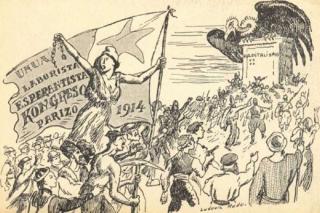
In the late 1930s, the Generalitat de Catalunya produced posters and other visual materials urging Esperantists from across the world to join the Catalans in their fight against fascism (Fig. 6.1). Moreover, in 1936, the organising committee of the Barcelona Popular Olympics prepared Esperanto signage and trained volunteers to communicate with visitors and guide them through the sports competition in Esperanto— before the Games were called off because of the Spanish Civil War. In the following decade, the 1949 Congress of the World Non-National Esperanto Association (SAT) would gather more than 1,000 left-wing activists in Paris to debate politics in Esperanto. In addition, in 1955, the association SAT-Amikaro designed one of the most emblematic portrayals of Esperanto as a left-wing political cause. Imprinted in a poster that gained the world, this depiction consolidated an image of Esperanto as a proposal to break communication barriers between workers of the world (Fig. 6.2).
In 2016, however, when I began my research on the connections between Esperanto and political activism, this vibrant scenario seemed to have changed. From the comfort of my armchair in Manchester, England, I found that the Facebook pages of the left-wing Esperanto
© The Editor(s) (if applicable) and The Author(s), under exclusive 151
licence to Springer Nature Switzerland AG 2021 G. Fians, Esperanto Revolutionaries and Geeks, https://doi.org/10.1007/978-3-030- 84230-7_6
Fig. 6.1 Poster saying, in Esperanto: 'What are you doing to stop this? Esper- antists of the world, put your strength against international fascism' (Source Comissariat de Propaganda de la Generalitat de Catalunya, c.1936. Available at the US Library of Congress, Washington D.C.)
Fig. 6.2 Poster in French, encouraging workers of the world to come together and break down the language barriers that keep them apart (Source SAT- Amikaro, c.1955. Available at the archives of SAT-Amikaro, Paris) associations SAT and SAT-Amikaro were not regularly updated and very few users interacted with their content. The associations' websites were likewise outdated and their mailing lists seemed rather inactive. In addi- tion, SAT-Amikaro's latest congress had taken place in 2013, despite their tradition of holding annual congresses since the association's foundation.
After over 130 years of existence, Esperanto is recurrently referred to as an unsuccessful utopian project or as a language with univer- salist claims that is no longer spoken. Esperanto nevertheless continues to count relentless and numerous supporters, who regard it as a living language that offers people an alternative way of communicating and engaging with progressive politics, enabling its speakers to build a better future through activism. Seen from this standpoint, Esperanto appears as a cause oriented towards the future. However, between a failed project circumscribed to the past and a future-oriented movement for more egal- itarian and fairer communication, what is the place of Esperanto in the present, where these conflicting notions of past and future materialise simultaneously?
Local and national Esperanto clubs and associations are, historically, core places where people come across the language on a rather regular basis. Beyond the occasional and extraordinary Universal Congresses, associations reveal the ordinary, everyday use of the language. Analysing what Esperantists do with Esperanto when they are not materialising the short-lived 'real Esperantujo' in their encounters with national diversity, this chapter explores how members of the Esperanto community and activists for the Esperanto movement juggle perceptions of past, present and future in their engagements with the language.
This discussion revolves around how the Esperanto movement, in connection with other social movements, may both advance Esperanto and use the language as a tool to strategically promote other social and political causes. This chapter particularly examines Esperantists' expecta- tions about the success of their activism and their hopes for its future, as well as their counterparts: the fear of failure and despair when the outcomes they envisage seem to be frustratingly out of reach. To explore these issues ethnographically, I draw on the dynamics of the Esperanto association SAT-Amikaro, focusing on its headquarters in Paris, where activism for Esperanto is carried out in conjunction with wider stances of left-wing and progressive activism. By editing periodicals and organ- ising weekly debates about issues such as work and living conditions in the contemporary world, environmentalism, French elections and Euro- pean federalism, the activities held by SAT-Amikaro bring to the fore a number of questions: how to advance Esperanto alongside traditional left-wing politics, namely through stances related to party politics, trade unionism, anarchism and communism? How can the language play a role in supporting such political groups and causes in practice? Furthermore, what is the point of talking politics in an international language in a local context, among people who mostly share the same mother tongue?
Focusing on how volunteers and long-standing members of SAT- Amikaro engage with the seeming decline of Esperanto as a tool for political activism, this chapter analyses how Esperantists grapple to advance the language as a relevant cause at a time when traditional left- wing stances related to communism, pacifism and anarchism seem to lose ground in France. I argue that Esperantists' practices and discourses about the past and future enable us to grasp, through ethnography, how their yearnings for the success of Esperanto aim not at a farfetched future, but at everyday, ordinary accomplishments. In a dialogue with anthro- pological scholarship on social movements and temporal reasonings, this ethnographic material challenges the theoretical perception that conveys the present as a field of action, since here the present appears partially deprived of its potential to provoke changes, amidst activists who regard the language's apparent stability as a sign of stagnation of their cause.
6.1 MoveForward!
It was a Friday afternoon in late February 2016 when I first travelled from Manchester to Paris to visit the associations in which I was plan- ning to conduct my field research. Among the Esperanto associations headquartered in Paris, I was especially interested in two of them: SAT and SAT-Amikaro. The former, the Sennacieca Asocio Tutmonda (World Non-National Esperanto Association), founded in 1921, is a working class-oriented association that uses Esperanto as its working language. SAT's main purpose is to create an international forum to enable debates on social and political issues from diverse viewpoints seen as progres- sive. SAT presents itself as kleriga ('educational', 'instructive') rather than action-oriented, promoting the exchange of ideas in a broadening, non- dogmatic way (Forster 1982: 192-193; Garvfa2015: 123-124). Created in 1945 and linked to SAT, SAT-Amikaro (Amikaro meaning 'Fellow- ship') aims to spread the word about the language and about SAT's international forum in milieus d'avant garde in francophone countries, working in both French and Esperanto.[23]