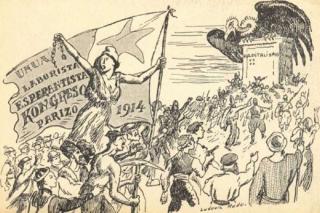
Esperanto Revolutionaries and Geeks: Language Politics, Digital Media and the Making of an International Community
- Автор: Fians Guilherme
- Год: 2022
- Язык: русский
- Жанр: Культурология

Электронная книга - «Esperanto Revolutionaries and Geeks: Language Politics, Digital Media and the Making of an International Community». Краткое содержание книги:
This metalinguistic exercise—when one uses language to debate language itself—is an ordinary activity, common among speakers of most languages. Nevertheless, what is remarkable in the case at stake is: why do Esperantists all too frequently attempt to create words, rather than looking for already existing ones? And why, subsequently, do they demo- cratically choose which word to use, instead of simply following the authority of the dictionary?
5.2 Determining Linguistic Authority Through Vocabulary Choice
Of course, corrections and uncertainty about vocabulary, as well as argu- ments about which word to use, are not exclusive features of Esperanto. Addressing concerns about linguistic imperialism, also users of other languages deploy neologisms to avoid the imposition of hegemonic languages on the concerned language. This matter gains prominence among speakers of regional languages in France. As a reaction against France's strong standard language ideologies—reinforced particularly since the seventeenth century, with the establishment of the Academie franijaise and the Port Royal grammar (Achard 1980; Connor 2019)— users of regional languages mobilise vocabulary as a resource to make their languages stand out from the hegemonic and standardising power of French.
Based on fieldwork on Corsica, Matei Candea (2010) describes how Corsican speakers strive to distinguish their language from French and Italian through the creation and dissemination of neologisms. Two of the examples Candea analyses are terms coined in the 1990s: the first is scagninu (derived from the Corsican scagnu, 'desk/drawer'), to refer to 'cassette tape' (metaphorically, as 'little drawer'). The second one is a word to rename 'television' as spichjafonu ('mirror-phone'). These two neologisms aimed to replace vocabulary that Corsicans had previously used in French, due to the lack of words to refer to these technologies in the Corsican language. Something similar takes place—not necessarily in a deliberate manner—regarding the French language. Terms such as cour- riel, atelier and en ligne, developed within the francophone community, occasionally replace Anglicisms like 'e-mail', 'workshop' and 'online'. To control the influence of foreign vocabulary, the Academie fran^aise formally recognises and gives preference to the French-inspired varieties of these terms. Additionally, as much as languages may be susceptible to intervention, they still develop organically, and some neologisms become more successful than others: while scagninu became widely used on Corsica, spichjafonu was not equally popular, which resulted in Corsicans continuing to use the French word television (Candea 2010: 124).
Neologism creation aimed at distinguishing a regional language from a hegemonic one also gains ground through names of places. In southern France, as Connor (2019) analyses, a major conflict arose between 2009 and 2011 regarding the bilingual signage identifying cities. When the council of Villeneuve-les-Maguelone installed a French-Occitan panel at the entrance of the town, a complaint was raised at the departmental administrative council against the mayor. Even though several places in Bretagne and Provence were installing bilingual signage since the 1980s, this case gained visibility because of claims that this town was originally named in French, never having had an Occitan name. This resulted in heated debates at the departmental court on whether the name Vilanova- de-Magalona, deemed not authentic, should stand alongside its French equivalent or not. As the debate unfolded, distinct language ideologies clashed: some in favour of French-only signage, others for bilingual signs only when the place had an 'original', 'authentic' name in the regional language and others backing the creation of an Occitan neol- ogism derived from French to strengthen the presence of Occitan in the region.
Conflicts over bilingual signage raise the issue of who has political rights and authority over a language, which also puts into question who can define what is authentic, right and wrong in language use. This becomes a core issue, for instance, in the Breton movement. As Maryon McDonald (1989, 1999) asserts, based on her field research in Bretagne in the 1980s, at least three groups regularly fought over who had authority over the Breton language. While most Breton native speakers were peasants who by and large had limited access to the French- medium education system, the Breton language movement was made up mostly of people who had been brought up and educated, often to university level, in French, having learned Breton as a second language (McDonald 1999). These Breton activists were primarily linguists from the universities of Rennes and Brest—which, in turn, held different perspectives about the language. In view of this, who had the right to decide what is right' or 'wrong' regarding language use, and who had the power to regulate neologisms? Ultimately, who were the key users of Breton entitled to speak on radio broadcasts and write dictionaries: its native speakers or its experts—and, if the latter, the ones from Rennes or Brest?
Returning to Corsica, the same issue of defining who holds linguistic authority becomes manifest via spelling contests, such as the one analysed by Jaffe (1996). Corsican spelling became systematically codified with the launch of the first Corsican spelling manual in 1971, which fostered language planning and standardisation. As spelling contests gained popu- larity and became broadcast on live TV in France, they became spaces where the competitors presented not only their contrasting views about norms and standards, but also their perceptions on language ideologies. While some language activists attempted to bring Corsican closer to French by showing how Corsican spelling could also be systematised, others wanted to keep Corsican away from French, evincing how the former is enriched by its varieties and lack of strict standards. In this way, competing over who is to make decisions on right and wrong spelling turns language into an arena of political negotiation.
From road signage and neologism creation to spelling contests, language ideologies play a role in shaping vocabulary, defining linguistic authority and developing a language over time. As Michael Silverstein (1979, 1985) argues regarding the evolution of the English language in the United States, the language ideologies that speakers exhibit mediate the variations that occur in language structure, eventually resulting in new standardisation processes. According to Silverstein's research on language and gender, the use of he as the gender-neutral pronoun in English became increasingly questioned in the late twentieth-century by feminist movements, which saw he as a linguistic symbol of patri- archalism and gender inequality. As a result, the growing rejection of the generic he in favour of 'he or she' and they brings about language change, more as a consequence of language ideologies than due to linguistic structural reasons. A similar phenomenon takes place in present-day Esperanto use, with the non-grammatical pronouns ri and sli emerging as gender-neutral alternatives to the gendered li (he) and si (she) (Cramer 2021).