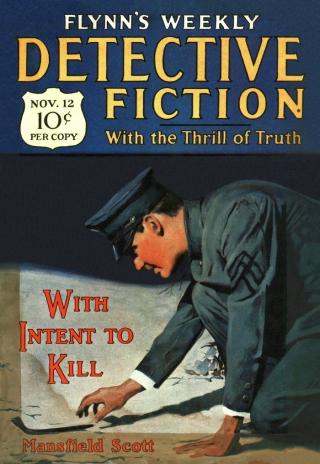
Flynn’s Weekly Detective Fiction. Vol. 28, No. 3, November 12, 1927
- Автор: Alexander R. W., Ames John
- Год: 1927
- Язык: английский
- Год: The Red Star News Company
- Жанр: Другие детективы

Электронная книга - «Flynn’s Weekly Detective Fiction. Vol. 28, No. 3, November 12, 1927». Краткое содержание книги:
“Referrin’ to the razor,” said Reggie. “He used a safety on his lawful occasions. It’s on the dressing table. An old friend. But he also had a case of razors handy. That’s very unusual. And the case is new, Bell.”
Bell took it up. “Looks pretty new. But it would be. If he used a safety, he’d have to buy another to kill himself.”
“Yes, that would have to be considered,” said Reggie in a dry, hard voice which startled Superintendent Bell.
“I don’t get what you mean about the razors being new, sir.” Bell came to the body and looked at the razor clasped in the dead hand. “Nothing unusual in a suicide buying a weapon. This is one of that set on the table.” He touched the dead fingers gingerly. “The hand’s stiff and hard grasping it.”
“I noticed that,” said Reggie meekly. “Anything else strike you, Bell?”
“No, sir. Clear case of suicide to my mind. I don’t know what else there is.”
“Blood’s rather dark, isn’t it?”
Bell stared at him. Bell looked down at the bed and drew back with something of horror on his solemn face. “Good Lord, Mr. Fortune, I couldn’t tell. It’s just blood to me. What’s wrong with it?”
“I don’t know,” Reggie said contemplating the body. He turned away. “Found an answer to everything, haven’t we, Bell? But there’s several curious things. Let’s see if Logan’s got any more.”
III
Inspector Logan had got nothing at all. The old walnut bureau contained no papers, not so much as a check book. Inspector Logan considered that Mr. Landomere had taken good care not to leave anything behind.
“Looks as if he had something pretty nasty to hide,” said Bell.
Reggie, wandering about the room, had come to a halt before a glass and a spirit decanter. Both were empty. Inspector Logan grinned. “He had a good drink before he went out, sir, didn’t he?”
“Yes. Yes. That is indicated,” Reggie murmured. He was smelling decanter and glass.
“It was whisky he used, sir,” Logan helped him.
“Thanks. I did recognize it.” He put down decanter and glass and still wandered about the room, looking closely at the prints, the furniture, stopped before an oak chest.
“Some rare old things he had. That’s sixteenth century.” He bent over it and rose with a sigh of respectful admiration. “Well, well. I shall have to do some work with the body. Have it removed, will you? I want the bed clothes, too. And that glass and decanter, Bell.”
“Very good, sir. Any points you want us to work on?”
“Oh, the obvious. Did anybody come to the flat last night? Who are Mr. Landomere’s friends, who’s his banker, who’s he been talking to on the telephone? You know all that. Better get hold of the discharged valet. He ought to be interesting.”
“There’s nothing else, sir?”
Reggie was looking at the few pieces of old silver on the bureau. “Oh, my aunt,” he said softly. He turned in his hands a small cubical box. “Look at that,” he held it out on his palm to Bell.
Bell poked at it, peered at it. “What is it, Mr. Fortune?”
“It’s a pouncet box.”
“That don’t help me. What’s it for?”
“It was made to hold Elizabethan smelling salts. That isn’t wholly relevant. But it’s engraved with a lion who has the body of a fish. See?”
“Yes, I see. But what about it?”
“Mr. Landomere was real after all,” said Reggie. “I’ll take this. Good-by.”
Inspector Logan gazed at his superintendent. “I don’t get what he means about Landomere being real,” he grumbled. “And a fish lion! What’s the sense of that? Sounds like he was being funny.”
“This case isn’t going to be funny, my lad,” said Bell. “Give me that phone.”
IV
It was late in the next day when Reggie came into the room of the chief of the criminal investigation department, who was being brisk with papers and a secretary. “Hullo, Lomas. Pressin’ on to closin’ time? Something attempted, something done has earned a night’s repose.”
“You’re aggressively cheerful, Reginald,” said Lomas. “I expect you to justify it,” and he got rid of the secretary. “Well?”
“Have you found Mrs. Akers?”
Lomas sighed and gave him a cigar. “No, Reginald, we have not found Mrs. Akers. We are rather busy with the Landomere case. Be relevant as soon as possible.”
“I always am. Have you found Landomere’s valet?”
“Not that I know of.” He took up his telephone and talked to Superintendent Bell. “No, not yet. Logan thinks he is on the track of the fellow.” He paused. “Why do you revert to the Akers case, Reginald?”
“Certain similarity. Hadn’t you noticed at? Two men die violent deaths. Care in each case to obliterate the reason, and in each case the person who might know something fades away.”
“And certain differences. A tout is kicked to death in a street row. A man of means cuts his throat in his flat.”
Bell came into the room. “But the police know nothing about either of them,” said Reggie cheerfully. “Or do you, Bell?”
Bell smiled. “I had to check Logan for saying you were being funny, sir. But were you pulling my leg about the lion fish?”
“Oh, my, Bell! Did I ever?” Reggie felt in his pockets and produced the pouncet box. “There you are. Beautiful piece, isn’t it, Lomas? Lion’s head on a fish’s body. Lion of the sea. Lion de mer. Landomere.”
“Landomere’s arms, eh?” Lomas said. “Well, what about it?”
“First inference: Mr. Landomere’s name is genuine and old. Lookin’ into the matter, we find that the Landomeres were an ancient family in Downshire, founded by an eminent pirate of the middle ages. Hence the name, Lion of the Sea.
“They did a little in the profession later and eked it out by smuggling. As times got quieter, they decayed. They’re supposed to have died out last century. I can’t trace this fellow, but he’d stuck to a few of the old family things.”
“All very interesting, Reginald,” Lomas yawned. “I’m not compiling a history of the family of Landomeres. If you’ll tell me how he died, we might get on.”
“Oh, he died in his sleep.”
“Good gad!” said Lomas.
“What, sir?” Bell cried. “Cut his throat in his sleep?”
“Yes. Yes. In a way. He didn’t really cut his own throat. It happened like this. Some time in his absence his flat was entered and a sleeping draft put into his whisky. He came back, had his drink and went to bed. While he lay in a drugged sleep, his flat was entered again by somebody, probably two men or more. They brought that case of razors, they brought the blackmailing letter.
“They put a razor in his hand and so cut his throat. They put the letter in his pocket. Then they took all his papers, switched off the light and quit Thus wiping out Mr. Landomere and all traces in the flat of how he’d been living and leaving quite good evidence that he destroyed his papers and committed suicide in fear of blackmail. Very thoughtful bit of crime. Like the extinction of George Akers.”
“Damme, Reginald, you surpass yourself,” Lomas smiled. “This is very ingenuous, but more than a little conjectural. Guessing isn’t evidence.”
“Thank you for those kind words.”
“My dear fellow, I’ve the greatest respect for your opinion. But after all, an opinion isn’t facts. You can’t possibly know all this. It’s a work of imagination constructed with very scanty and unreliable material.”
“You think so? I bet you the jury won’t.”
“Great heavens, you’re not going to tell this tale at the inquest?”
“I’m going to tell the jury that Superintendent Bell pointed out to me the man had died very quiet, that his blood was dark and his lungs congested as if he had been poisoned with chloral hydrate; that I found chloral hydrate in the empty glass and the empty decanter.