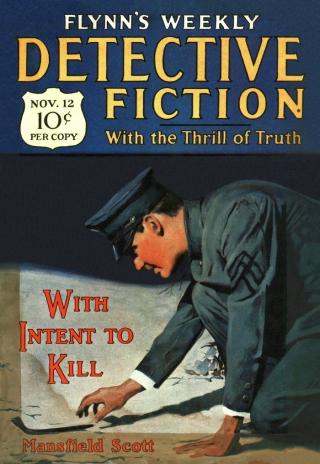
Flynn’s Weekly Detective Fiction. Vol. 28, No. 3, November 12, 1927
- Автор: Alexander R. W., Ames John
- Год: 1927
- Язык: английский
- Год: The Red Star News Company
- Жанр: Другие детективы

Электронная книга - «Flynn’s Weekly Detective Fiction. Vol. 28, No. 3, November 12, 1927». Краткое содержание книги:
Lomas lit another cigarette. “Poor devil,” he said.
“But what’s it all come to, sir?” Bell protested. “He’s quarreled with his gang and they’ve smashed him and got at his wife to hush it up. We do have these cases.”
“I wonder,” Mr. Fortune murmured. Bell looked at him, dubious, resigned, patient. “I was only hintin’ there’s some brains in this one, Bell.”
Bell made a mournful noise. “Some clever chap behind it all, sir?” he said wearily. He turned to Lomas. “Somebody in a large way of business, like you said, sir?” He shook his head at the two theorists. “It don’t happen much, does it? My way of thinking, all we can do is to work over Akers’s gang and see what we can make of his wife.”
Lomas nodded and the superintendent went his heavy way. Lomas looked at Mr. Fortune. “He’s right, you know, Reginald. It don’t happen. When did you meet an organizer of crime?”
“Well, it’s not much in my way,” said Mr. Fortune. “I suppose this dope business has a managing director or so. If Akers was in it.
“But I never studied crime as an industry. What I get is generally a work of art: individual enterprise and fancy. I don’t think I ever met a cooperative murder before. I don’t like it.” He looked plaintive, he wandered out.
II
Superintendent Bell’s labors discovered nothing more. George Akers’s gang was unanimously dumb. The widow came to the inquest, a waif of the streets in decent black, and, with tears, related that her man had gone to the races as usual — he got his living racing — and never came home again.
When she saw him in hospital he said he had been drinking and got into a scrap with some fellows; he didn’t know who they were; she didn’t know. George didn’t have no enemies she ever heard of; not George. She wept herself out of the box. She went unchallenged.
The police could offer no other evidence but Mr. Fortune’s, and on that the jury gave a verdict of willful murder against persons unknown. And George Akers was buried with his widow a lonely mourner, and before the week was out she had gone from the one room in Soho, which was her home, and was seen no more.
Superintendent Bell shook a sage head. “You can’t make anything of it, sir. I dare say she knew something. I dare say she didn’t. She’s the sort to pick up with another man before her husband was cold.
“Maybe we’ll come on the truth in a year or two, when we’re looking for something else. Maybe we won’t. We do get these cases.”
“I wonder what George thinks about it,” said Mr. Fortune.
But his attention was then distracted. Superintendent Bell’s telephone rang. Superintendent Bell listened to a long narrative. “Landomere?” said the superintendent. “Spell it. Landomere. Right. I’ll come round” He turned the pages of one book of reference and another “Do you know anything of Gerard Landomere, Mr. Fortune?”
“No. He doesn’t sound real. What’s he done?”
“Cut his throat.”
“That gives him a certain interest.”
“Would you like to have a look, sir?” said Bell eagerly.
“Oh, Bell, did I ever?” Mr. Fortune sighed and went with him.
Mr. Gerard Landomere lived in a block of flats behind Piccadilly, which provided service for those who wanted it. Mr. Landomere did, his valet having been dismissed the week before.
The man who came up to valet him that morning had found him in bed with blood about his throat and a razor in his hand. He was already dead. The steward of the flats telephoned for the police and a doctor. The doctor said it was suicide.
“That’s what we’ve got, sir,” said the inspector in Landomere’s rooms. “I was just going through his things.”
“Mr. Fortune would like to see the body,” Bell said.
But Mr. Fortune was in no hurry. He looked about the room, which was hung with colored prints of the eighteenth century, sporting and erotic. It had chairs of comfort and some good pieces of old furniture and silver. “Who was Gerard Landomere, inspector?” he murmured.
“What you’d call a man about town, sir. No occupation. He’s lived here years. They say he was a very quiet gentleman. Best of tenants. Bit behind with his payments just now, but nothing to signify.”
“Not known to the police?”
“Oh, Lord, no, sir. I never heard of him.”
“Landomere,” Mr. Fortune murmured. “No, he doesn’t sound real, does he?” He turned away into the bedroom, and Bell followed.
Gerard Landomere lay in a smoothly ordered bed. The clothes covered him to his chest. Above that was blood. His pyjamas were undone at the neck, his head lay back on the pillow, and on the left of his neck the flesh gaped. His right arm was bent across him and the hand still grasped a razor.
Bell drew in his breath. “Ah, he died quiet, sir,” he said softly.
Reggie Fortune bent over the body.
His fingers went into the breast pocket of the pyjamas. He drew out a folded paper. It was stained and wet with blood, but the writing on it could be read. Reggie beckoned Bell.
Dear Sir:
Confirming our conversation, I have to say that my friends cannot see their way to settle the matter for a smaller sum than two thousand pounds — £2,000. I hope to receive payment from you without further delay. Otherwise it will be necessary for us to lay the facts before the parties mentioned with the consequences to your position which I am sure you fully appreciate.
Yours faithfully.