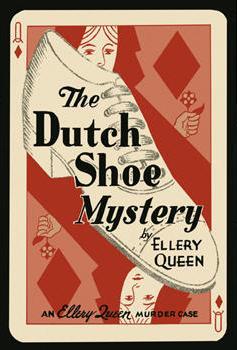
The Dutch Shoe Mystery
- Автор: Куин (Квин) Эллери
- Серия: Ellery Queen #3
- Год: 1931
- Язык: английский
- Год: Frederick A. Stokes
- Жанр: Классические детективы

Электронная книга - «The Dutch Shoe Mystery». Краткое содержание книги:
The inter-office communicator on the Inspector’s desk rasped. The Inspector lifted the receiver from the hook.
A muffled voice barked: “Man by the name of Kneisel wants to see you, Inspector. Says it’s important.”
“Kneisel!” The old man was silent, his eyes gleaming. “Kneisel, hey? Send him up, Bill.”
Sampson was leaning forward. “What the devil can Kneisel want?”
“Don’t know. Say, Henry... that gives me an idea.” They looked at each other, mutual comprehension in their crossed glances. Ellery said nothing.
A detective opened the door. The small figure of Moritz Kneisel appeared on the threshold.
The Inspector got to his feet. “Come in, Dr. Kneisel. Come in. All right, Frank.”
The detective left and the swarthy little scientist advanced slowly into the room. He was wearing a rusty greenish overcoat with a tawny velvet collar. He carried a green velour hat in his blotched hand.
“Sit down. What’s on your mind?”
He seated himself punctiliously on the edge of a chair, placing his hat on his knees. His soft dark eyes restlessly ranged over the office; in an abstracted, automatic way he seemed to be appraising, storing away what he saw.
He spoke suddenly. “When you interrogated me earlier to-day, I was naturally upset by the unfortunate death of my friend and colleague. I had no time to think carefully. Now I have surveyed the facts, Inspector Queen, and I tell you very frankly — I fear for my personal safety!”
“Oh, I see.”
The stilted phrases fell idly from the man’s lips. The District Attorney winked at the Inspector from behind Kneisel’s stiff figure. The Inspector nodded imperceptibly.
“Just what do you mean? Have you found out anything about the murder of Dr. Janney which we ought to know?”
“Not that, no.” Kneisel held up his hands and looked at their mangled, bleached skin absently. “But I have a theory. It has been bothering me all afternoon. It is a theory which, if true, makes me — victim number three in a diabolical series of murders!”
Ellery’s eyebrows bunched. Interest had crept into his eyes. “A theory, eh?” he murmured. “And a melodramatic one, too.” Kneisel looked at him sidewise. “Well, Kneisel, we’re a little short of theories to-day. So let’s have it in detail. It’s bound to prove refreshing.”
“Is the imminence of my death a matter of jest, Mr. Queen?” asked the scientist curtly. “I am beginning to alter my first opinion of you. I feel that you are mocking what you cannot understand... Inspector!”
He turned squarely away from Ellery, who slipped back on his spine again.
“My theory, summarily, is this: That a fourth party, whom I will call X, has engineered a series of murders beginning with the strangulation of Abigail Doorn, continuing with the strangulation of Dr. Janney — and concluding with the strangulation of Moritz Kneisel.”
“A fourth party?” The Inspector knit his brows. “Who?”
“I do not know.”
“For what reason, then?”
“Ah, that is another question!” Kneisel tapped the Inspector’s knee lightly. “To gain undisputed possession of the secret and profits of my alloy, doornite!”
“So that’s it...” Sampson looked skeptical. But the Inspector wore a serious frown; his eyes flickered from Ellery to Kneisel. “Murder for a secret worth millions. Not bad. Not bad at all... But why on earth murder Mrs. Doorn and Dr. Janney? It seems to me that your murder alone, after your formulæ were completed, would be enough.”
“It would not.” The scientist was coldly deliberate; he seemed made of iron. “Let us suppose that this hypothetical fourth party lurks somewhere in the background. And that he is most desirous of securing the results of my labors. And also, in doing so, leave himself sole possessor of the vital knowledge.”
“The murder of Abigail Doorn would be to his advantage. He allows her to live just so long as she furnishes funds for the continuation of the experiments. When she threatens to stop, he kills her and achieves two ends in doing so — he insures her financial support even after her death, and he eliminates one of the three holders of the secret.”
“Go on.”
“Then,” continued Kneisel imperturbably, “it is the turn of Dr. Kneisel’s partner, Dr. Janney. I am logical, you see... He precedes me in the order of our going for the reason that he is technically not so essential as I to the completion of the work. His usefulness, in providing me with the means of fulfilling my life-work, is past. So he is murdered; and the second of the triumvirate, whose continued existence would prevent the murderer from commercializing his theft without opposition, disappears from the scene. Do you follow me so far, gentlemen?”
“We follow you, all right,” said the Inspector harshly. “But I don’t quite see why it was necessary for Janney to be killed so soon after the old lady. What was the rush? And then your job is incomplete. Janney might have helped, even in a small way, to perfect the alloy.”
“Ah, but we are dealing with a person of subtlety and foresight,” said Kneisel. “If he had waited for the work to be done, it would then have been necessary to commit two murders at almost the same time. With Janney gone, now only one murder is required in order to eliminate the last of the trio and take undisputed possession of a secret worth millions.”
“Clever, but weak,” murmured Ellery.
Kneisel ignored him. “To continue. The deaths of Mrs. Doorn and Dr. Janney leave me a clear field, more than sufficient funds to work with, and the scientific ability to bring the experiments to a head... You see the possibilities.”
“Yes,” said Ellery softly, “we see the possibilities.”
Kneisel’s womanish eyes sharpened momentarily, but the glint died out and he shrugged his shoulders.
“That’s a pretty theory, Dr. Kneisel,” said the Inspector, “but after all we need more than guesses. Names, man, names! I’m sure you’ve some one in mind.”
The scientist closed his eyes. “Specifically, I have not. And why you should insist on concrete evidence from me I do not understand. Surely you don’t despise theories, Inspector? I believe Mr. Ellery Queen himself works on some such intellectual plan... This theory is solid, sir. It is based on a consideration of all the facts. It is—”
“Not true,” said Ellery distinctly.
Kneisel shrugged again. Ellery said, “It’s a poor syllogism that doesn’t educe an incontrovertible conclusion from its major and minor premises. Come now, Kneisel, you’re being cagy. What are you holding back?”
“Your guess is as good as mine, Mr. Queen.”
“Who besides Mrs. Doorn, Dr. Janney and yourself knows enough about the exact nature of your work to realize its financial possibilities? Of course we’ve known it since Mrs. Doorn’s death Monday, but weren’t there others before?” asked the Inspector.
“You force me to be dogmatic. I can think of one person who might very well have been informed by Mrs. Doorn of the secret. That is the lawyer who drew up her wills — Morehouse.”
“Preposterous,” said Sampson.
“Oh, no doubt.”
“But you know perfectly well,” said the Inspector, “that it might have been anybody in the Doorn household or in the circle of the old lady’s friends. Why pick on Morehouse?”
“No specific reason.” Kneisel looked bored. “He merely appears to me to be the logical person. I am quite sure I’m wrong.”
“You just said that Mrs. Doorn must have talked. Are you certain Dr. Janney mightn’t have done the same?”