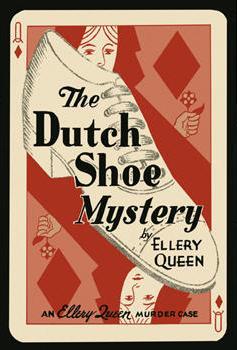
The Dutch Shoe Mystery
- Автор: Куин (Квин) Эллери
- Серия: Ellery Queen #3
- Год: 1931
- Язык: английский
- Год: Frederick A. Stokes
- Жанр: Классические детективы

Электронная книга - «The Dutch Shoe Mystery». Краткое содержание книги:
“Wire, like in the last one?” asked the Inspector.
“Yep. You can see for yourself.”
Queen stepped slowly toward the desk, accompanied by Sampson and the Commissioner. Gazing down at the grey head of the dead man they saw a dark thick clot. Both the Inspector and the Commissioner looked up quickly.
“He was hit on the head before he was strangled,” volunteered Dr. Prouty. “By some heavy blunt instrument — it’s hard to say what. There’s a contusion back there, directly over the cerebellar region.”
“Put him to sleep so he wouldn’t cry out when he was choked,” muttered the Inspector. “That tap is at the back of the head, Doc. How do you figure he was sitting when he was hit? Couldn’t have been taking a nap or something, could he, so that the blow might have been struck while the assailant stood in front of the desk? Because if he was sitting up it looks as if whoever hit him stood behind him.”
Ellery’s eyes glittered, but he said nothing.
“You’ve got it, Inspector.” Prouty’s lips writhed comically about his cold cigar. “Whoever hit him did stand behind the desk. You see, he wasn’t lying forward this way when we found him. He was sitting back in the chair — here, let me show you...” He stepped back and wriggled between the corner of the desk and the wall, to get behind the desk. Gently, but with complete unconcern, he lifted the dead man by the shoulders until the body perched upright in the swivel-chair, head slumped forward on the chest.
“That’s the way he was, wasn’t it?” demanded Prouty. “Hey, Mr. Queen?”
Ellery started, smiled mechanically. “Oh! Oh, yes. Quite.”
“Here. You can see the wire now.” Prouty lifted the head carefully. About the neck was a thin bloody line. The wire was so deeply imbedded in the dead flesh as to be almost invisible. Behind the neck the two ends of the wire were twisted into one strand, exactly as in the case of Abigail Doorn.
The Inspector straightened. “This is the way it goes, then. He was sitting here, somebody came in, got behind him, hit him over the head and then strangled him. Right?”
“That’s it.” Prouty shrugged, picked up the bag. “One thing I’ll take my oath on. That smack on the head couldn’t have been delivered from anywhere except behind the desk... Well, I’ll be off. Photographers have been here already, Inspector, and so have the fingerprint boys. Loads of prints all over the place, especially on this glass-top, I understand, but I guess most of ’em come from the fingers of Janney and that steno or assistant of his.”
The Assistant Medical Examiner jammed his hat on his head, took a fresh grip with his teeth on the battered cigar, and stumped out of the office.
They stared down at the dead man again. “Dr. Minchen, this wound on the head couldn’t have caused death, could it?”
Minchen gulped. His eyelids were red, his eyes bloodshot. “No,” he said in a low voice. “Prouty’s right. Just stunned him, that’s all. He died — he died of strangulation, Inspector, absolutely.”
They bent over the wire. “Looks like the same kind,” mused Queen. “Thomas, first chance you get, I want you to check up on that.” The giant nodded.
The body was still upright in the chair, as Prouty had left it. The Commissioner muttered something to himself as he carefully studied the face. It was devoid of horror, surprise, or fear. A characteristic blue tinge had crept under the swollen skin, but the features were calm — almost peaceful. The eyes were closed.
“Noticed it too, sir?” said Ellery suddenly, from his chair. “Doesn’t appear like the face of a man violently attacked and murdered, does it?”
The Commissioner faced about, regarding Ellery shrewdly. “Just what I was thinking, young man. You’re Queen’s son, aren’t you? — Strange is the word for it.”
“Exactly.” Ellery sprang from his chair and crossed to the desk to look reflectively at Janney’s face. “And the blunt instrument that Prouty talked about — that’s gone. Murderer must have taken it away... Notice what Janney was doing when he went West?”
He pointed to the pen in the dead man’s fingers, then to a sheet of white paper on the glass directly at the spot where the hand would rest if the body were leaning forward. The paper was half-covered with close, painstaking script; Janney had obviously stopped writing in the middle of a sentence, for the last word on the page ended with a convulsive jerk in a smear of ink.
“Working on his book when the blow came,” murmured Ellery. “That’s elementary. He and Dr. Minchen here, you know, have been collaborating on a technical work called Congenital Allergy.”
“What time did he die?” asked Sampson thoughtfully.
“Prouty puts it between 10:00 and 10:05, and John Minchen agrees.”
“Well, this isn’t getting us anywhere,” snapped the Inspector. “Thomas, have the body removed to the morgue downstairs. Don’t forget to go through his clothes thoroughly. And then come back — I want you. Sit down, Commissioner. You, too, Henry... Swanson!”
The ex-surgeon started. His eyes were staring. “I... can’t I go now?” he asked in a hoarse whisper.
“Yes,” said the Inspector gently. “We shan’t be needing you for a while. Thomas, send some one back to Port Chester with Mr. Swanson.”
Velie herded Swanson out of the door. He shuffled from the room without a word or a backward look; he seemed dazed, frightened.
Ellery swiftly roved the room. The Commissioner seated himself with a grunt and commenced a low-voiced conversation with the Inspector and Sampson. Paradise was still huddled in his chair, shaken. Minchen said nothing — merely stared at the bright linoleum.
Ellery stopped before him, looked down quizzically. “What are you looking at — the new linoleum?”
“What?” Minchen licked his dry lips, attempted to smile. “Oh... How do you know it’s new?”
“Rather obvious, John. Is it?”
“Yes. All these private offices were recovered just a few weeks ago...”
Ellery resumed his pacing.
The door opened again. Two internes entered with a stretcher. They were both white-faced, brusque in their movements.
As they were lifting the dead body from the chair Ellery paused at the window, frowned, and then looked back at the desk, which was laterally across the room. His eyes narrowed, and he strolled over to stand near the working internes.
As they deposited Janney’s limp form on the stretcher, Ellery wheeled and said sharply — every one looked up startled — “Do you know, there really ought to be a window behind this desk!”
They stared. Inspector Queen said, “What’s buzzing about inside your head now, son?”
Minchen laughed mirthlessly. “Is it getting you, too? Why, there’s never been a window there, Ellery.”
Ellery wagged his head. “An architectural omission that bothers me... It’s really too bad that poor old Janney didn’t remember the motto on Plato’s ring. How did it read? ‘It is easier to prevent ill habits than to break them...’”
Chapter Twenty-Two
Enumeration
Several hours later a small tight-lipped company sat in the dead man’s office, now murky with bluish-grey smoke-haze. From the set faces, the rigid jaws, the wrinkled foreheads it was evident that realization of failure was upon them, that Dr. Janney’s murder was as hopelessly far from explanation as Abigail Doorn’s.
Their numbers had dwindled. The Police Commissioner, his face the color of ashes, had gone. A subdued Harper had left an hour before to communicate certain news of importance to his paper. Sampson, his eyes screwed up with worry, had left the Hospital at the same time to return to his office and the inevitable task of facing the press and the public.