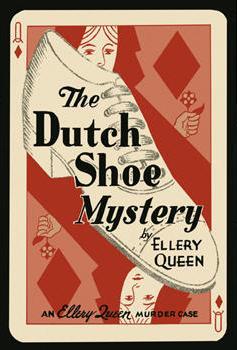
The Dutch Shoe Mystery
- Автор: Куин (Квин) Эллери
- Серия: Ellery Queen #3
- Год: 1931
- Язык: английский
- Год: Frederick A. Stokes
- Жанр: Классические детективы

Электронная книга - «The Dutch Shoe Mystery». Краткое содержание книги:
“It’s a fearful muddle,” said Ellery slowly, without turning away from the window. “Hulda Doorn, Hendrik Doorn, Dunning, Sarah Fuller, Kneisel, Morehouse — all in the Hospital and unaccounted for.”
Minchen stirred, smiling vaguely. “The only one who couldn’t have done it was this Big Mike Cudahy fellow. And me. You’re sure you don’t suspect me, Inspector? After this, anything is possible... Oh, God!” He buried his face in his hands.
The typewriter clacked on in the silence.
“Well,” said the old man grimly, “if you did it you’re a spiritualist, Dr. Minchen. Couldn’t be in two places at once...” They chuckled together; Minchen’s voice held a note of hysteria.
Ellery wrapped his overcoat tightly about him. “Come along,” he said in a sharp tone. “Come along before this damned brain of mine bursts from futile thinking.”
Chapter Twenty-Three
Triplication???
Chagrin and bafflement pursued Ellery Queen from the stricken corridors of the Dutch Memorial Hospital to the interior of his father’s office at Police Headquarters.
He had disgustedly expressed the desire to return to the Queen house on West 87th Street and bury his troubles in Marcel Proust. The Inspector, shrewdly appraising, would listen to no such proposal. They would all go down to his office, he had said, and have a quiet talk, and be bawled out en masse by the Mayor, and generally make merry...
So they sat, Richard and Ellery Queen and District Attorney Sampson, and two of them chatted pleasantly about everything but the Doorn and Janney murders.
The newspapers of New York City were making Roman holiday. Two murders in three days, and both victims of the utmost journalistic importance! City Hall Park seethed with reporters; the Police Commissioner had disappeared; the Mayor had retired to the privacy of his home “on advice of his physician.” Every person whose name had appeared, even briefly, in the case had been haunted by photographers and leg-men. The news about Thomas Swanson had leaked out and a journalistic hegira began with Port Chester as the goal. Inspector Queen had exerted every ounce of official pressure at his command to keep the true identity of Swanson a secret; thus far he had been successful, but the threat of disclosure hung over them. Swanson was by now under heavy guard.
Sergeant Velie was pursuing a will-o’-the-wisp. It had been his most pressing assignment to trace back the movements of the dead surgeon; and nothing met the eye other than a perfectly innocent series of contacts. Janney’s private correspondence at his apartment had been scanned with microscopic suspicion; aside from several letters from Thomas Janney which substantiated the Swanson story, this search too was fruitless.
Everywhere a blank wall...
Ellery’s long fingers played with a tiny figurine of the great Bertillon on the Inspector’s desk. The old man was, genially enough, relating an anecdote from out of his youth; but there were dark-shadowed pouches beneath his eyes, and his gayety was pitifully forced.
“Let’s not delude ourselves.” Ellery spoke abruptly and both the Inspector and Sampson turned to regard him with apprehension. “We’re like frightened children babbling in the dark. Dad, Sampson — we’re licked.”
Neither of the older men replied. Sampson hung his head, and the Inspector thoughtfully examined his square boot-toes.
“If it weren’t for my Gaelic pride, and the fact that no matter what I do, dad has to carry on,” continued Ellery, “I would figuratively fall upon my sword and seek peace in the warrior’s heaven...”
“What’s the matter with you, Ellery?” The Inspector did not look up. “I’ve never heard you talk this way before. Why, only yesterday you were saying that you had a pretty good idea who the murderer is.”
“Yes,” said Sampson eagerly, “if anything this second murder, which unquestionably is linked with the first, should throw light on the original problem. I’m sure something will turn up.”
Ellery grunted. “The curse of fatalism is the sublime spinelessness, which it engenders. You see, Sampson, I’m not so sure...” He pulled himself out of the chair, looked moodily down at them. “What I said yesterday still stands. I know in a vague way who strangled Abigail Doorn. I could name half a dozen people in the case who, from the nature of the clews, simply couldn’t have done for Abby. But—”
“There aren’t many more than a half-dozen in the case altogether,” said the Inspector challengingly. “So what’s worrying you?”
“Things.”
“Look here, son,” said the old man with energy, “if you’re upbraiding yourself because you didn’t prevent this second crime, forget it. How could you or any of us have foreseen that Janney, of all people would follow Abby?”
Ellery waved his hand negligently. “Oh, it’s not that. With all my suspicions, I couldn’t have foreseen Janney’s death, as you say... Sampson, you just said these two crimes are linked. What makes you so certain?”
Sampson looked startled. “Why — I took it for granted. The two crimes came so close together, the two victims were so intimately linked, the location is the same, the methods are identical, everything bears out the—”
“Seems Gospel, eh?” Ellery bent over. “Isn’t that just as good an argument for the belief that the two crimes aren’t linked? Assume two murderers instead of one. Abby Doorn is sent outward bound in a certain way under certain circumstances. Murderer Number Two says: ‘Aha! Here’s the perfect opportunity to avenge myself on Janney and make the police think Murderer Number One did the job!’ Consequently we perceive the similar locale, the similar method and all the rest of it. Refute this with evidence, please.”
The Inspector squirmed. “Oh, for goodness’ sake, boy, you can’t mean that. Why — we’d have to start all over again.”
Ellery shrugged. “Mind you, I’m not saying I believe a different person committed the second crime. I’m merely pointing out the possibility. So far one theory is as good as the other.”
“But—”
“I confess that the assumption of one criminal pleases me more than the assumption of two. But mark my words,” said Ellery earnestly, “if the same person committed both crimes we must look for a reason to explain why such a clever rogue should have taken the dangerous course of deliberately duplicating the method.”
“You mean,” asked the Inspector in a puzzled way, “that it would be more to the murderer’s advantage to avoid strangulation?”
“Of course it would. If Janney had been found shot, or stabbed, or poisoned, we’d have no physical reason at all to believe that the crimes were allied. Observe that in the second case the murderer actually struck Janney over the head before strangling him! Now why didn’t he finish the job with his bludgeon? Why merely stun him and then go to the trouble of putting a wire about his neck?... No, dad, it seems very likely that the murderer wanted us to see that the crimes were linked!”
“By golly, that’s right,” muttered the old man “It’s so right, to my mind,” replied Ellery, sinking wearily into his chair again, “that if I knew why the murderer wants us to believe the two murders part of the same crime, I’d know the whole story... But I’m keeping an open mind on this second homicide. I have still to see proof that the two crimes were committed by the same scoundrel.”