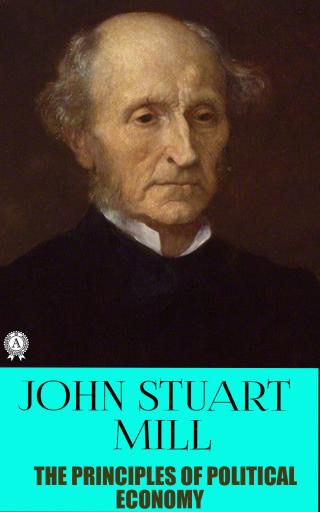
Principles Of Political Economy
- Автор: Mill John Stuart
- Год: 2022
- Язык: английский
- Год: Strelbytskyy Multimedia Publishing
- Жанр: Политика

Электронная книга - «Principles Of Political Economy». Краткое содержание книги:
Beside discussing descriptive issues such as which nations tended to benefit more in a system of trade based on comparative advantage (Mill's answer: those with more elastic demands for other countries' goods), the work also discussed normative issues such as ideal systems of political economy, critiquing proposed systems such as communism and socialism.
Along with A System of Logic, Principles of Political Economy established Mill's reputation as a leading public intellectual. Mill's sympathetic attitude in this work and in other essays toward contemporary socialism, particularly Fourierism, earned him esteem from the working class as one of their intellectual champions.
In considering the institution of property as a question in social philosophy, we must leave out of consideration its actual origin in any of the existing nations of Europe. We may suppose a community unhampered by any previous possession; a body of colonists, occupying for the first time an uninhabited country. (1.) If private property were adopted, we must presume that it would be accompanied by none of the initial inequalities and injustice which obstruct the beneficial operation of the principle in old society. Every full-grown man or woman, we must suppose, would be secured in the unfettered use and disposal of his or her bodily and mental faculties; and the instruments of production, the land and tools, would be divided fairly among them, so that all might start, in respect to outward appliances, on equal terms. It is possible also to conceive that, in this original apportionment, compensation might be made for the injuries of nature, and the balance redressed by assigning to the less robust members of the community advantages in the distribution, sufficient to put them on a par with the rest. But the division, once made, would not again be interfered with; individuals would be left to their own exertions and to the ordinary chances for making an advantageous use of what was assigned to them. (2.) If individual property, on the contrary, were excluded, the plan which must be adopted would be to hold the land and all instruments of production as the joint property of the community, and to carry on the operations of industry on the common account. The direction of the labor of the community would devolve upon a magistrate or magistrates, whom we may suppose elected by the suffrages of the community, and whom we must assume to be voluntarily obeyed by them. The division of the produce would in like manner be a public act. The principle might either be that of complete equality, or of apportionment to the necessities or deserts of individuals, in whatever manner might be conformable to the ideas of justice or policy prevailing in the community.
The assailants of the principle of individual property may be divided into two classes: (1) those whose scheme implies absolute equality in the distribution of the physical means of life and enjoyment, and (2) those who admit inequality, but grounded on some principle, or supposed principle, of justice or general expediency, and not, like so many of the existing social inequalities, dependent on accident alone. The characteristic name for this (first) economical system is Communism, a word of Continental origin, only of late introduced into this country. The word Socialism, which originated among the English Communists, and was assumed by them as a name to designate their own doctrine, is now, on the Continent, employed in a larger sense; not necessarily implying Communism, or the entire abolition of private property, but applied to any system which requires that the land and the instruments of production should be the property, not of individuals, but of communities, or associations, or of the government.
It should be said, moreover, that Socialism is to-day used in the distinct sense of a system which abolishes private property, and places the control of the capital, labor, and combined industries of the country in the hands of the state. The essence of modern socialism is the appeal to state-help and the weakening of individual self-help. Collectivism is also a term now used by German and French writers to describe an organization of the industries of a country under a collective instead of an individual management. Collectivism is but the French expression for the system of state socialism.
§ 2. The case for Communism against private property presented.
The objection ordinarily made to a system of community of property and equal distribution of the produce, that each person would be incessantly occupied in evading his fair share of the work, points, undoubtedly, to a real difficulty. But those who urge this objection forget to how great an extent the same difficulty exists under the system on which nine tenths of the business of society is now conducted. And though the “master's eye,” when the master is vigilant and intelligent, is of proverbial value, it must be remembered that, in a Socialist farm or manufactory, each laborer would be under the eye, not of one master, but of the whole community. If Communistic labor might be less vigorous than that of a peasant proprietor, or a workman laboring on his own account, it would probably be more energetic than that of a laborer for hire, who has no personal interest in the matter at all.
Another of the objections to Communism is that if every member of the community were assured of subsistence for himself and any number of children, on the sole condition of willingness to work, prudential restraint on the multiplication of mankind would be at an end, and population would start forward at a rate which would reduce the community through successive stages of increasing discomfort to actual starvation. But Communism is precisely the state of things in which opinion might be expected to declare itself with greatest intensity against this kind of selfish intemperance. An augmentation of numbers which diminished the comfort or increased the toil of the mass would then cause (which now it does not) immediate and unmistakable inconvenience to every individual in the association; inconvenience which could not then be imputed to the avarice of employers, or the unjust privileges of the rich.
A more real difficulty is that of fairly apportioning the labor of the community among its members. There are many kinds of work, and by what standard are they to be measured one against another? Who is to judge how much cotton-spinning, or distributing goods from the stores, or brick-laying, or chimney-sweeping, is equivalent to so much plowing? Besides, even in the same kind of work, nominal equality of labor would be so great a real inequality that the feeling of justice would revolt against its being enforced. All persons are not equally fit for all labor; and the same quantity of labor is an unequal burden on the weak and the strong, the hardy and the delicate, the quick and the slow, the dull and the intelligent.[146]
If, therefore, the choice were to be made between Communism with all its chances and the present state of society with all its sufferings and injustices, all the difficulties, great or small, of Communism, would be but as dust in the balance. But, to make the comparison applicable, we must compare Communism at its best with the régime of individual property, not as it is, but as it might be made. The laws of property have never yet conformed to the principles on which the justification of private property rests. They have made property of things which never ought to be property, and absolute property where only a qualified property ought to exist. Private property, in every defense made of it, is supposed to mean the guarantee to individuals of the fruits of their own labor and abstinence. The guarantee to them of the fruits of the labor and abstinence of others, transmitted to them without any merit or exertion of their own, is not of the essence of the institution, but a mere incidental consequence, which, when it reaches a certain height, does not promote, but conflicts with the ends which render private property legitimate. To judge of the final destination of the institution of property, we must suppose everything rectified which causes the institution to work in a manner opposed to that equitable principle, of proportion between remuneration and exertion, on which, in every vindication of it that will bear the light, it is assumed to be grounded. We must also suppose two conditions realized, without which neither Communism nor any other laws or institutions could make the condition of the mass of mankind other than degraded and miserable. One of these conditions is, universal education; the other, a due limitation of the numbers of the community. With these, there could be no poverty, even under the present social institutions: and, these being supposed, the question of socialism is not, as generally stated by Socialists, a question of flying to the sole refuge against the evils which now bear down humanity, but a mere question of comparative advantages, which futurity must determine. We are too ignorant either of what individual agency in its best form, or socialism in its best form, can accomplish, to be qualified to decide which of the two will be the ultimate form of human society.
146
For a further discussion of the difference between the motive powers under private property and under Communism, see Mr. Mill's posthumous “Chapters on Socialism,” “Fortnightly Review,” 1879 (vol. xxxi).