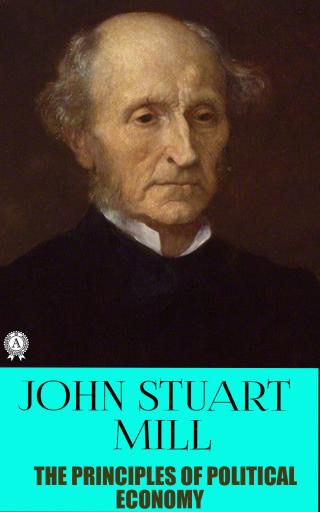
Principles Of Political Economy
- Автор: Mill John Stuart
- Год: 2022
- Язык: английский
- Год: Strelbytskyy Multimedia Publishing
- Жанр: Политика

Электронная книга - «Principles Of Political Economy». Краткое содержание книги:
Beside discussing descriptive issues such as which nations tended to benefit more in a system of trade based on comparative advantage (Mill's answer: those with more elastic demands for other countries' goods), the work also discussed normative issues such as ideal systems of political economy, critiquing proposed systems such as communism and socialism.
Along with A System of Logic, Principles of Political Economy established Mill's reputation as a leading public intellectual. Mill's sympathetic attitude in this work and in other essays toward contemporary socialism, particularly Fourierism, earned him esteem from the working class as one of their intellectual champions.
From this results the important corollary, that the necessity of restraining population is not, as many persons believe, peculiar to a condition of great inequality of property. A greater number of people can not, in any given state of civilization, be collectively so well provided for as a smaller. The niggardliness of nature,[140] not the injustice of society, is the cause of the penalty attached to over-population. An unjust distribution of wealth does not even aggravate the evil, but, at most, causes it to be somewhat earlier felt. It is in vain to say that all mouths which the increase of mankind calls into existence bring with them hands. The new mouths require as much food as the old ones, and the hands do not produce as much.
After a degree of density has been attained, sufficient to allow the principal benefits of combination of labor, all further increase tends in itself to mischief, so far as regards the average condition of the people; but the progress of improvement has a counteracting operation, and allows of increased numbers without any deterioration, and even consistently with a higher average of comfort. Improvement must here be understood in a wide sense, including not only new industrial inventions, or an extended use of those already known, but improvements in institutions, education, opinions, and human affairs generally, provided they tend, as almost all improvements do, to give new motives or new facilities to production.
The increase in the population of the United States has been enormous, as already seen, but the increase of production has been still greater, owing to the fertility of our land, to improvements in the arts, and to our great genius for invention, as may be seen by the following table (amounts in the second column are given in millions).[141] The steady increase of the valuation of our wealth goes on faster than the increase of population, so that it manifests itself in a larger average wealth to each inhabitant.
Decades. Valuation. Per cent of increase. Population. Per cent of increase. Per capital valuation. 1800 $1,742 .. 5,308,483 .. $328 1810 2,382 37 7,239,881 36 329 1820 3,734 57 9,633,882 33 386 1830 4,328 16 12,866,020 34 336 1840 6,124 41 17,069,453 33 359 1850 8,800 44 23,191,876 36 379 1860 16,160 84 31,443,321 35 514 1870 30,068 86 38,558,371 23 780 1880 40,000 33 50,155,783 30 798If the productive powers of the country increase as rapidly as advancing numbers call for an augmentation of produce, it is not necessary to obtain that augmentation by the cultivation of soils more sterile than the worst already under culture, or by applying additional labor to the old soils at a diminished advantage; or at all events this loss of power is compensated by the increased efficiency with which, in the progress of improvement, labor is employed in manufactures. In one way or the other, the increased population is provided for, and all are as well off as before. But if the growth of human power over nature is suspended or slackened, and population does not slacken its increase; if, with only the existing command over natural agencies, those agencies are called upon for an increased produce; this greater produce will not be afforded to the increased population, without either demanding on the average a greater effort from each, or on the average reducing each to a smaller ration out of the aggregate produce.
Ever since the great mechanical inventions of Watt, Arkwright, and their contemporaries, the return to labor has probably increased as fast as the population; and would even have outstripped it, if that very augmentation of return had not called forth an additional portion of the inherent power of multiplication in the human species. During the twenty or thirty years last elapsed, so rapid has been the extension of improved processes of agriculture (in England), that even the land yields a greater produce in proportion to the labor employed; the average price of corn had become decidedly lower, even before the repeal of the corn laws had so materially lightened, for the time being, the pressure of population upon production. But though improvement may during a certain space of time keep up with, or even surpass, the actual increase of population, it assuredly never comes up to the rate of increase of which population is capable: and nothing could have prevented a general deterioration in the condition of the human race, were it not that population has in fact been restrained. Had it been restrained still more, and the same improvements taken place, there would have been a larger dividend than there now is, for the nation or the species at large. The new ground wrung from nature by the improvements would not have been all tied up in the support of mere numbers. Though the gross produce would not have been so great, there would have been a greater produce per head of the population.
140
Henry George, as well as the Socialists, thinks poverty arises from the injustice of society, and here takes issue with the present teaching. But the question can be better discussed under Distribution.
141
Henry Gannet, “International Review,” 1882, p. 503.