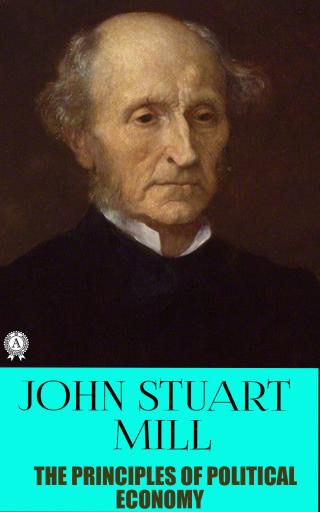
Principles Of Political Economy
- Автор: Mill John Stuart
- Год: 2022
- Язык: английский
- Год: Strelbytskyy Multimedia Publishing
- Жанр: Политика

Электронная книга - «Principles Of Political Economy». Краткое содержание книги:
Beside discussing descriptive issues such as which nations tended to benefit more in a system of trade based on comparative advantage (Mill's answer: those with more elastic demands for other countries' goods), the work also discussed normative issues such as ideal systems of political economy, critiquing proposed systems such as communism and socialism.
Along with A System of Logic, Principles of Political Economy established Mill's reputation as a leading public intellectual. Mill's sympathetic attitude in this work and in other essays toward contemporary socialism, particularly Fourierism, earned him esteem from the working class as one of their intellectual champions.
The essential principle of property being to assure to all persons what they have produced by their labor and accumulated by their abstinence, this principle can not apply to what is not the produce of labor, the raw material of the earth. If the land derived its productive power wholly from nature, and not at all from industry, or if there were any means of discriminating what is derived from each source, it not only would not be necessary, but it would be the height of injustice, to let the gift of nature be engrossed by individuals. (But) the use of the land in agriculture must indeed, for the time being, be of necessity exclusive; the same person who has plowed and sown must be permitted to reap.
But though land is not the produce of industry, most of its valuable qualities are so. Labor is not only requisite for using, but almost equally so for fashioning, the instrument. Considerable labor is often required at the commencement, to clear the land for cultivation. In many cases, even when cleared, its productiveness is wholly the effect of labor and art. One of the barrenest soils in the world, composed of the material of the Goodwin Sands, the Pays de Waes in Flanders, has been so fertilized by industry as to have become one of the most productive in Europe. Cultivation also requires buildings and fences, which are wholly the produce of labor. The fruits of this industry can not be reaped in a short period. The labor and outlay are immediate, the benefit is spread over many years, perhaps over all future time. A holder will not incur this labor and outlay when strangers and not himself will be benefited by it. If he undertakes such improvements, he must have a sufficient period before him in which to profit by them; and he is in no way so sure of having always a sufficient period as when his tenure is perpetual.
These are the reasons which form the justification, in an economical point of view, of property in land. It is seen that they are only valid in so far as the proprietor of land is its improver. Whenever, in any country, the proprietor, generally speaking, ceases to be the improver, political economy has nothing to say in defense of landed property, as there established.
When the “sacredness of property” is talked of, it should always be remembered that any such sacredness does not belong in the same degree to landed property. No man made the land. It is the original inheritance of the whole species. Its appropriation is wholly a question of general expediency. When private property in land is not expedient, it is unjust. The reverse is the case with property in movables, and in all things the product of labor: over these, the owner's power both of use and of exclusion should be absolute, except where positive evil to others would result from it; but, in the case of land, no exclusive right should be permitted in any individual which can not be shown to be productive of positive good. To be allowed any exclusive right at all, over a portion of the common inheritance, while there are others who have no portion, is already a privilege. No quantity of movable goods which a person can acquire by his labor prevents others from acquiring the like by the same means; but, from the very nature of the case, whoever owns land keeps others out of the enjoyment of it. When land is not intended to be cultivated, no good reason can in general be given for its being private property at all. Even in the case of cultivated land, a man whom, though only one among millions, the law permits to hold thousands of acres as his single share, is not entitled to think that all this is given to him to use and abuse, and deal with as if it concerned nobody but himself. The rents or profits which he can obtain from it are at his sole disposal; but with regard to the land, in everything which he does with it, and in everything which he abstains from doing, he is morally bound, and should, whenever the case admits, be legally compelled to make his interest and pleasure consistent with the public good.
Chapter II. Of Wages.
§ 1. Of Competition and Custom.
Political economists generally, and English political economists above others, have been accustomed to lay almost exclusive stress upon the first of (two) agencies (competition and custom); to exaggerate the effect of competition, and to take into little account the other and conflicting principle. They are apt to express themselves as if they thought that competition actually does, in all cases, whatever it can be shown to be the tendency of competition to do. This is partly intelligible, if we consider that only through the principle of competition has political economy any pretension to the character of a science. So far as rents, profits, wages, prices, are determined by competition, laws may be assigned for them. Assume competition to be their exclusive regulator, and principles of broad generality and scientific precision may be laid down, according to which they will be regulated. The political economist justly deems this his proper business: and, as an abstract or hypothetical science, political economy can not be required to do, and indeed can not do, anything more. But it would be a great misconception of the actual course of human affairs to suppose that competition exercises in fact this unlimited sway. I am not speaking of monopolies, either natural or artificial, or of any interferences of authority with the liberty of production or exchange. Such disturbing causes have always been allowed for by political economists. I speak of cases in which there is nothing to restrain competition; no hindrance to it either in the nature of the case or in artificial obstacles; yet in which the result is not determined by competition, but by custom or usage; competition either not taking place at all, or producing its effect in quite a different manner from that which is ordinarily assumed to be natural to it.
As stated by Mr. Cairnes,[161] political economy is a science just as is any recognized physical science—astronomy, chemistry, physiology. The economic “facts we find existing are the results of causes, between which and them the connection is constant and invariable. It is, then, the constant relations exhibited in economic phenomena that we have in view when we speak of the laws of the phenomena of wealth; and in the exposition of these laws consists the science of political economy.” It is to be remembered that economic laws are tendencies, not actual descriptions of any given conditions in this or that place.
Competition, in fact, has only become in any considerable degree the governing principle of contracts, at a comparatively modern period. The further we look back into history, the more we see all transactions and engagements under the influence of fixed customs. The relations, more especially between the land-owner and the cultivator, and the payments made by the latter to the former, are, in all states of society but the most modern, determined by the usage of the country. The custom of the country is the universal rule; nobody thinks of raising or lowering rents, or of letting land, on other than the customary conditions. Competition, as a regulator of rent, has no existence.
Prices, whenever there was no monopoly, came earlier under the influence of competition, and are much more universally subject to it, than rents. The wholesale trade, in the great articles of commerce, is really under the dominion of competition. But retail price, the price paid by the actual consumer, seems to feel very slowly and imperfectly the effect of competition; and, when competition does exist, it often, instead of lowering prices, merely divides the gains of the high price among a greater number of dealers. The influence of competition is making itself felt more and more through the principal branches of retail trade in the large towns.
161
“Logical Method,” pp. 34, 36.