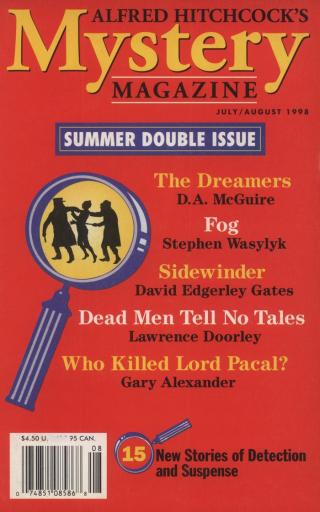
Alfred Hitchcock’s Mystery Magazine. Vol. 43, No. 7 & 8, July/August 1998
- Автор: Alexander Gary, Crawford Dan
- Год: 1998
- Язык: английский
- Год: Dell Magazines/Crosstown Publications
- ISBN: ISSN: 0002-5224
- Жанр: Другие детективы

Электронная книга - «Alfred Hitchcock’s Mystery Magazine. Vol. 43, No. 7 & 8, July/August 1998». Краткое содержание книги:
That brought a little smile, a wistfully woeful smile.
“Thanks, Mike, that helps. But you haven’t seen Ginny Barnes.”
“The hell with Ginny Barnes. Now, listen to me.” He reached into his pocket. “Here’s a check for what you need. Take it, damn it, take it, don’t shake your head. Buy your mother the condo. That will put you on equal terms with the femme fatale. Come on, take it.”
Martha shied away.
“I can’t. You told me about your huge alimony payment and indicated that losing the commission for Ebb and Flow would be a terrible blow. Besides, I feel responsible for what happened. I should have kept a copy in spite of what you said. Bad things happen. But — have you had time to read my manuscript?”
“I’ve read enough of it to know that it’s dam good,” said Mike, and he meant it. “I’m confident I’ll be able to sell it.”
Martha looked as if she were going to cry.
“What’s the matter, Martha?”
“Well, I’m... I’m elated that you think it’s... it’s publishable. But... oh I don’t believe I’m saying this. I’m almost forty, Mr. Wilson... I mean Mike. This is awful... I’m in love. I can’t let Walter... what I mean is, can we pretend that my manuscript is an earlier work of Mr. Baxter’s? Is it possible, you know?”
Mike knew. He could hardly believe. Wow, what we do for love.
Back in New York the next day, Mike telephoned five publishers, called the Times reporter, phoned Pete Yardley, Harry’s attorney.
“You’re telling me the Easterfield manuscript that Harry was working on was destroyed in the fire,” said Yardley. “Which I was afraid had happened. But what’s that about an earlier work you’ve had for several years?”
Mike explained that Appalachian Elegy was actually Baxter’s first work.
“He didn’t think it was good enough,” Mike explained, “but two or three years ago he sent it to me. And told me to hold it. Actually, I’d almost forgotten about it until the fire. And I’ll bet Harry had forgotten about it.”
“And you mean you can sell it? For how much?”
“Hell, yes, I can sell it. How much? Six million at least. I have five publishers eager to bid on it. After all, it’s Harry’s last work.”
“Well, I’ll be damned, poor old Harry. I was ready for the worst, figured that all he had was the insurance on the Connecticut place.”
“About the will, Pete. I don’t suppose you’re going to tell me who the heirs are?”
“Can’t do it, Mike. But there’ll be a few surprises. And there’s no use having the reading until you sell that manuscript. When do you think that’ll be?”
“Two weeks at the latest. I’ll be in touch.”
Baxter’s death galvanized The National Beacon. Cathy and Linda, their dreams of vast wealth shattered, had been paid a total of fifteen hundred dollars for their sensational scoop on the famous writer and the smalltown typist. Take it or leave it, they were told. They took it. Having already lost a hundred thousand to Baxter, the editor wasn’t about to attack him again on the dubious hearsay of a couple of hairstylists. But the information was worth keeping in case something came up.
Something did come up, Harry Baxter’s number. A reporter and photographer were rushed to Hillsdale.
Ten days later, in affluent Palm Beach, Florida, a well-preserved sixty-five-year-old widower, a retired president of an international construction company, picked up the latest copy of the The National Beacon while waiting his turn at Henry’s Barber Shop. There was a picture of two women on the front page. The headline screamed, HICK TOWN OLD MAID WROTE HARRY BAXTER’S BESTSELLERS: WRITER A FRAUD.
The man stared at the picture, stared, stared. He shook his head, looked again. He read the story, went back to the picture. My God, it’s her, she. And look at her, still a beauty. And she’s a widow now. Who said you don’t get a second chance?
Helen did look great. The photographer had snapped her surreptitiously as she emerged from Lil’s, having had the works. Poor Martha, bleak and bedraggled, had been snapped from behind a blooming forsythia bush on her way home from work. Her hair was mussed, her chin down, her countenance hopeless. She looked exactly like someone undergoing a horrible ordeal.
Which she was. She was now involved in one more crime — fraud. Mike had tried to talk her out of it, and he had been sincere, but she had insisted, had abandoned all claims to the novel that had taken her excruciating years to write.
Henry, the barber, had to call the next customer twice.
“Mr. Zablonsky,” he called louder, “you’re next.”
The customer leaped up and almost ran to the chair, holding the tabloid in his hand.
“I want a perfect cut, Henry, your best effort. I want to look my best, my best.”
“Hah hah,” said Henry grinning. “I knew it, I knew it. Haven’t I been telling you that one of those sexy widows would finally wear you down? Which one is it, 9-D or 12-C?”
“Neither. See this woman on the cover, the one on the left? That’s my old flame — wow, was she a beauty. And look at her. She still is. I’m phoning her today, heading north tomorrow.”
“Well, how about that? And to think I wasn’t going to renew my subscription to that scandal sheet when it came due a month ago. Boy, you never know, do you?”
Naturally, when that issue of The National Beacon hit Hillsdale, it created a ton of excitement, and four different women rang up Helen on Friday to tell her about it. Helen, scared to death of what Martha was going to say, couldn’t keep from hoping that she herself had taken a good picture. She hurried down to the supermarket and bought three copies. The checkout girl said they were going like hotcakes.
Helen managed a weak smile, hastened home. She studied the picture thinking, my, don’t I look nice, read the story, heart pounding.
The tabloid described Baxter as “a sly, swindling Svengali who used his well-honed sorcery to bewitch a naive smalltown spinster into allowing him to use his name on her brilliant novel with the promise of sharing the book’s royalties, the bulk of which he kept for himself.”
Poor Martha. She was “a pliant, plain-looking, gullible spinster victimized by the infamous writer, whose inept first novel had been rejected by numerous publishers before he somehow learned that she’d written a novel but was too timid to send it to a publisher. And after the incredible success of the first book, Baxter had no difficulty convincing the credulous spinster that his name could sell any manuscript, and she had written two more. Again he paid her a paltry sum.”
There was more, most of it preceded by “neighbors say,” “gossip at the local beauty parlor,” “rumor insists.” It was rough on Baxter and unflattering to Martha, and Helen didn’t escape entirely.
She was reputed to be “an autocratic, complaining, domineering mother who was the town heartbreaker in her youth and who now spent hours at the beauty parlor trying to disguise the ravages of time.”
Helen was outraged. I’ll sue them. How dare they. Then she thought of Martha. Oh my God, she must be horrified. What’s she going to say to me? Whatever it is, I deserve it. I’ve ruined that dear, dear girl.
By noon three different women had come in to the agency with copies of the tabloid (it was amazing how many women in that little poverty-stricken town subscribed to tabloids). One kind soul left her copy with Martha, a dumbfounded, stricken Martha. Look at me, she wailed. I look like the mother instead of the daughter. She read the story, making pitiful little sounds.
It’s all Mother’s fault, all that irresponsible talk at Lil’s. But listen to me; poor Mother, she must be half crazy. And it isn’t her fault, it’s mine. All she did was repeat what I’ve been saying, about all the extra work I had to do on Mr. Baxter’s manuscripts. What will this do to Appalachian Elegy? If I had Ginny Barnes here, I’d... I’d... choke her to death.