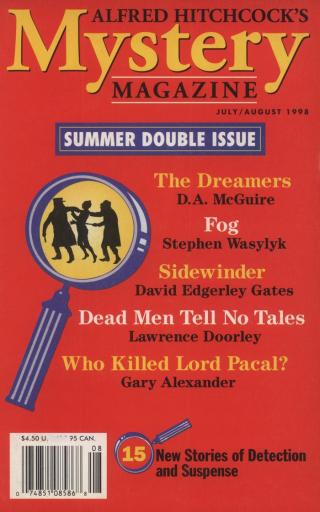
Alfred Hitchcock’s Mystery Magazine. Vol. 43, No. 7 & 8, July/August 1998
- Автор: Alexander Gary, Crawford Dan
- Год: 1998
- Язык: английский
- Год: Dell Magazines/Crosstown Publications
- ISBN: ISSN: 0002-5224
- Жанр: Другие детективы

Электронная книга - «Alfred Hitchcock’s Mystery Magazine. Vol. 43, No. 7 & 8, July/August 1998». Краткое содержание книги:
If you had been on the trail today, I would have seen you, Efrain thought.
The light was fading. “I need to go,” Efrain said.
As he walked away, the brother called after him, “I guess tomorrow I’ll build a shelter.” He obviously hoped for an offer of help. Efrain pretended not to hear.
When he was out of the brother’s sight, Efrain broke into a run. He jumped the stream. With his machete he cut a branch from an ollita sapling. He reached in his pocket for the matches he’d gotten at the store, struck one, and fit the branch to use as a torch — ollita would burn when green. He squatted by the footprints.
Boots up, boots down. A jaguar print here, there, and there. Efrain concentrated on the cat tracks. It was hard to follow the complete trail because the prints only showed well in the clay near the stream. The rest of the ground was covered with fallen leaves.
He pictured the cat smelling newborn calf on the breeze, then slinking up on the cow. He compared the prints to his visualization. They did not mesh. The prints weren’t spaced the way a jaguar would walk. In fact, the cat tracks only appeared in a couple of clear clay patches, as though the animal had purposely left its marks where a passerby couldn’t miss them.
Efrain studied the bootprints. One pair of boots with fairly good soles. But here was a boot with a chip out of the left heel. He held the smoky torch lower. Two pairs of boots had been here. The good boots went uphill and came back. The scarred boots had left only uphill tracks.
Efrain cut another branch to use as a staff. Swinging the staff through the leaves in front of him as a snake guard, he followed the drag marks farther into the forest.
In a few hundred yards he found the calf. Its throat had been slit with one long clean cut. There were no other marks on it, no slashes or rips, no deep killing bite at the neck. No jaguar had killed this calf.
An odd-shaped piece of wood in the leaves caught Efrain’s eye. He picked it up.
It was a jaguar’s paw whittled from balsa wood.
Efrain looked at its base. The cat pads were carefully carved.
A different picture grew in his mind: the brother pretending to leave yesterday but instead hiding in the forest. Killing the newborn calf in the night and dragging it out of sight. The cow’s enraged bellows leading Olmedo into the ambush. Jaguar tracks carefully placed for whoever discovered the body.
He went home and told Sulema what had happened. They took turns staying up all night and watching, just in case. At dawn he went to get Catalino the Indian. Then with his old rifle in hand, he and Sulema — the baby dozing on her back — and Catalino hurried along the trail in the direction of the store.
When they passed Olmedo’s farm, the brother was looking over the bean field. Fortunately he was too far away to ask where they were going.
They explained everything to the storekeeper. He came out and shut the unpainted wooden door to show the store was closed. Then they all walked back up the trail to Olmedo’s farm.
The brother had collected a few palm fronds to start his shelter. He looked surprised to see them.
“You can’t stay,” Efrain told him.
“What do you mean?”
Efrain held out the wooden jaguar foot. The brother stepped back.
“You have to go,” the storekeeper said.
The brother stared at them for a long moment. Then he turned and walked down the trail that would take him past the store, to town, and eventually to the city.
The storekeeper waited a few minutes so as not to have to walk near the brother. Then he set off for his store. Catalino went with him in case the brother stopped at the store to make trouble. Catalino had to buy coffee anyway.
Efrain and Sulema walked the other way on the trail. They found Olmedo’s cow standing exhausted in the stream. She needed to be milked. Efrain pulled off his rope belt and put it around her neck. He tugged gently and she followed.
As they walked toward their house, he said, “Oh, Sulema, the storekeeper said this is still the old year. New Year’s Day is tomorrow.”
He had almost forgotten why he’d gone to the store.
Death Penalty
by N. Nelson
“Darcy Hayes did kill someone. Guilt is not the issue. It rarely is in a criminal case. Our concern is what he will be convicted of, and even more important, what his punishment will be,” said Wilson McGraw, the defense attorney.
To Thomas Clark, fresh from passing the bar exam and only a few months out of law school, this sounded awfully cynical and mercenary. But he was in no position to disagree, it being only his second month with McGraw. McGraw had agreed to give Clark a job on a week-to-week basis.
The arrangement was that Clark worked for a pittance the first month and after that his pay gradually increased until, at the end of a year, he’d be making just under what some people started at. McGraw was neither Simon Legree nor the Salvation Army. Jobs for young attorneys were scarce, and Clark was more than willing to forgo some wages for the chance to follow the highly respected McGraw around to gain experience. McGraw, for his part, got an intelligent, eager mind to handle some of his more routine matters. He figured the association was workable unless Clark showed flaws McGraw couldn’t live with. McGraw had enough of his own flaws to live with.
McGraw’s client, Darcy Hayes, was a twenty-five-year-old high school dropout who made a living at many things. Thing one was auto theft. Thing two was robbery. McGraw knew of these vocations because Hayes had been convicted of them. As an adult, he had been convicted of car theft three times and robbery twice. Most recently he’d spent four years of a six year sentence in the state prison for armed robbery.
A month ago Hayes tried robbing a gas station. The attendant resisted, Hayes picked up and swung a lug wrench lying on the counter, and the attendant died.
He was identified both by fingerprints found on the wrench and by a motorist who pulled into — and then quickly out of — the station as he saw the attendant go down. As a multiple offender Darcy Hayes faced the death penalty if indicted for either first degree premeditated murder or second degree intentional murder without premeditation.
McGraw was explaining strategy to Clark.
“Our goal is to get the best possible deal without a trial, to lock in a sentence. Darcy will no doubt be convicted in a trial. If he is convicted, the prosecutor can request and the judge can impose any sentence allowed by law. In this case that could mean the death penalty. Darcy Hayes does not want to die.”
The district attorney could present the case to a grand jury in a couple of weeks, and McGraw wanted to settle before then if possible. So far, Hayes was charged by criminal complaint with second degree felony murder; a death penalty charge could only be brought with a grand jury indictment.
“Once they get the indictment,” McGraw explained, “they’re likely to push for the death penalty. It would look bad to plead down a capital case. The best we might hope for then is for the judge to sentence Hayes to life without parole.”
“Why don’t they go ahead and get the indictment? Why should they talk settlement now?” Clark asked.
“They’re required to at least discuss the case with the defense attorney and the judge to see if it can be resolved. Our court system is so inundated that only by getting pleas in most cases can it keep functioning. In a capital case there would be years of costly appeals before the death sentence was carried out.
“Beyond that, though the grand jury will give them the indictment on the most serious charge they request, the petit jury, which decides guilt or innocence, may convict on a lesser charge. Every trial lawyer knows there’s no certainty in trial.” McGraw said the jury might not find first degree murder with premeditation because the lug wrench was at the scene and Hayes only used it once, but they certainly might find second degree intentional murder. To fight off an intentional murder charge Hayes would have to testify because only he could testify that he meant only to rob, not to kill.