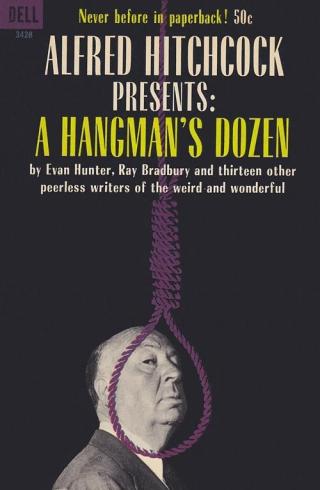
Alfred Hitchcock’s A Hangman’s Dozen
- Автор: Артур Роберт, Брэдбери Рэй Дуглас
- Год: 1962
- Язык: английский
- Год: Dell Publishing
- Жанр: Другие детективы

Электронная книга - «Alfred Hitchcock’s A Hangman’s Dozen». Краткое содержание книги:
“Tommy! What are you doing here?”
“I had to see you, Wanda. I knew Joe was in the pool, so I thought it would be a good time. Looks like he’ll be there the rest of the day—”
“You’re probably right.”
She was flustered, but tried not to show it. She offered him a drink, but he said no. She tried to make small talk, but he wasn’t interested. In the next minute, she was in his arms. But she was uncomfortable there, and soon broke from him and started to talk about her husband.
“You just don’t know what he’s like. Every year he gets worse, every day. All he thinks about is the act, night and day it’s escape, escape, escape. Sometimes I think I’ll go crazy, Tommy, I mean it. When we were in Louisville, last year, I actually went to a head-shrinker for a while, did you know that? For three months I went, and then he got the job in Las Vegas, so that ended that.”
“If you ask me,” Baggett growled, “he’s the one that’s crazy, treating you the way he does.”
“You know he even escapes in his sleep sometimes? No kidding. He wakes up m the middle of the night, throws off the covers, and takes a bow.” She laughed without a change of expression, and then the tears flowed. Baggett surrounded her in his arms again. “Sometimes I wish he’d get tied up where he can’t escape. Not ever—”
“What do you mean?”
She looked up at him.
“You know the water trick, where he gets thrown in a lake? He’s going to do it in a couple of weeks. You know what I’ve been thinking about, ever since he decided on it?”
She went to the window, looking down at the pool where Ferlini was still stubbornly plowing the water.
“I was thinking that maybe something would go wrong. He’s good; I know that. He can escape from almost anything. But if one little piece of the act doesn’t work right — he’d drown. Do you think I’m terrible, having a thought like that?”
“I don’t blame you for a minute!” Baggett said loyally.
Moving slowly, Wanda went to the bureau and opened the second drawer. From a welter of paraphernalia, she removed a pair of steel handcuffs and two small metal objects.
She brought the handcuffs to Baggett, and said, “Do me a favor, Tommy? Put these on?”
He blinked. “You mean it?”
“Please.”
He held out his wrists willingly, and she clamped them around them, pushing the lock into place.
“Now try and get out,” she said.
Baggett, a thin, romantic type, strained mightily, until the blood rushed up in a crimson column on his neck.
“I can’t do it!” he panted.
“Of course you can’t. Nobody could, not even Ferlini, unless he happened to have this on him somewhere.” She held up a small key, and handed it over. “Now try it,” she said.
Twisting his fingers, his tongue tucked into the corner of his mouth, Baggett managed to insert the tiny key into the hole. He turned it, but nothing happened.
“It’s not working,” he said. “The key doesn’t turn.”
“No,” Wanda said dreamily. “It doesn’t, does it?”
“But why not? What’s wrong?” There was a hint of panic in Baggett’s voice.
“It’s the wrong key,” Wanda said. “That’s the problem. This is the right one.” She held up a second key, then came over and inserted it herself. The lock sprung free, and the handcuffs came off. Baggett, rubbing his wrists, looked at her questioningly.
“I think you better go now,” Wanda said.
Phil Roscoe was pleased with the results of his publicity campaign. Four local newspapers in the Denver area were touting the event, and one major news service had put it on the wire. But the great Ferlini wasn’t so easily pleased; his visions had been of television coverage, national magazines, and Hollywood offers, but these were sugarplums that Roscoe had been unable to obtain.
“For the love of mike,” Roscoe told him, “don’t expect the moon out of this. It’s not big news anymore, not since Houdini did it. Be satisfied with what you got.”
Ferlini grumbled, but was satisfied.
On the day of the event, Wanda Ferlini woke up looking older and more haggard than ever before. It had been a bad night; her husband had twice startled her out of sleep with his wild dreams of incredible escapes. But it wasn’t only sleeplessness which dulled her eyes and slowed her responses. It was anticipation, the dread of something going wrong.
Roscoe had hired a chauffeur-driven, open-top Cadillac for the occasion; they drove up to the site of Ferlini’s adventure in style. Wanda, sitting beside Roscoe in the back seat of the car, wore her best dress and never looked worse. Roscoe, flushed with excitement and bourbon, held tightly to her hand. Ferlini, riding the high seat of the Cadillac, waving his arms to the crowd, wore a full dress suit with a white tie, his muscular shoulders stretching the glossy fabric almost to the point of bursting seams.
If Ferlini had any further complaints about Roscoe’s publicity build-up, they were forgotten now. The crowd on the edge of Lake Truscan numbered in the hundreds. Roscoe’s efforts to enlist the mayor in the program had failed, but there was a city councilman, the chief of police, the assistant fire commissioner, and two of the town’s leading businessmen in attendance. The supper club had supplied the affair with its full six-piece orchestra, and their ragtime marches made the occasion seem more festive and significant than it really was. Best of all, there were a dozen newsmen and photographers.
Roscoe had planned it all well, but there were still some disappointments. The public address system developed a high-pitched squeal that made its use impossible; so there were no introductory speeches. The weather had seemed ideal in the early morning, but by one-thirty, a black trimmed cloud had moved overhead. Wanda Ferlini shivered when she saw it. Roscoe, moving busily among the officials, tried to speed up the program before rain made Ferlini’s escape attempt even more difficult.
They were ready to go at two.
The handcuffs were snapped on first, by the police chief; it seemed appropriate. The chief, a bluff man with a forced smile, examined the handcuffs carefully before placing them on Ferlini’s wrists, and pronounced them thoroughly genuine.
The two businessmen were selected to wind the thick rope about Ferlini’s body. He stripped off his coat jacket, his white tie, and his formal shirt, and then kicked off his shoes. In the T-shirt, his muscular chest drew admiring exclamations from the crowd’s female element. The businessmen were both short and pudgy, and they were puffing by the time they had the fifty-foot rope coiled around Ferlini’s body.
“Knot it, knot it!” Ferlini urged them, exposing the teeth made strong and sharp by years of tearing and biting at ropes. They knotted it, in odd, lumpy knots that accented the coil from head to foot. They were so busy that neither they nor the spectators were aware that Ferlini was pumping his lungs full of air, increasing the circumference of his chest by almost seven inches. He smiled complacently when they were through, confident that he could wriggle free of his bonds in only a few seconds.
The assistant fire commissioner was given the task of assisting Ferlini into the cloth sack. He rested it on the ground, and Ferlini was lifted over it; then the official lifted up the cloth until it covered the escape artist completely. The crowd murmured when the cloth was securely fastened over Ferlini’s head.
But it was the sight of the huge iron chest that brought the sharpest reaction from the spectators. Somewhere in the throng, a woman screamed, and Roscoe grinned with pleasure. It was great showmanship. He sought Wanda’s eyes to share the moment, but he found her face pale and drawn, her own eyes closed and her lips moving soundlessly.