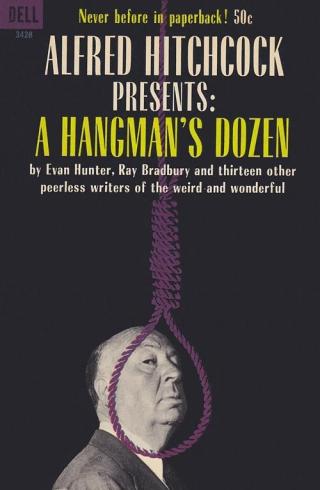
Alfred Hitchcock’s A Hangman’s Dozen
- Автор: Артур Роберт, Брэдбери Рэй Дуглас
- Год: 1962
- Язык: английский
- Год: Dell Publishing
- Жанр: Другие детективы

Электронная книга - «Alfred Hitchcock’s A Hangman’s Dozen». Краткое содержание книги:
The star.
Randolph Blair.
Tonight, he would be a star again. Tonight, he would accomplish the murder of Atkins with style and grace. When they closed the doors of the store, when the shoppers left, when the endless questions, the endless requests stopped, he would go to Atkins’ office. He would not even change his clothes. He would go straight to Atkins’ office and he would collect his pay envelope and he would shoot him. He would run into the streets then. In the streets, he would be safe. In the streets, Randolph Blair — the man whose face was once known to millions — would be anonymously safe. The concept was ironical. It appealed to a vestige of humor somewhere deep within him. Randolph Blair would tonight play the most important role of his career, and he would play it anonymously.
Smiling, chuckling, he listened to the requests.
The crowd began thinning out at about four-thirty. He was exhausted by that time. The only thing that kept him going was the knowledge that he would soon kill Mr. Atkins.
At four forty-five, he answered his last request. Sitting alone then, a corpulent unsmiling man, he watched the clock on the wall. Four fifty. Four fifty-two. Four fifty-seven. Four fifty-nine.
He got off the chair and waddled to the elevator banks. The other employees were tallying the cash register receipts, anxious to get out of the store. He buzzed for the elevator and waited.
The door slid open. The elevator operator smiled automatically.
“All over, huh?” he asked.
“Yes, it’s all over,” Blair said.
“Going to pick up your envelope? Cashier’s office?”
“Mr. Atkins pays me personally,” he said.
“Yeah? How come?”
“He wanted it that way,” he answered.
“Maybe he’s hoping you’ll be good to him, huh?” the operator said, and he burst out laughing.
He did not laugh with the operator. He knew very well why Atkins paid him personally. He did it so that he would have the pleasure each week of handing Randolph Blair — a man who had once earned $5,000 in a single week — a pay envelope containing forty-nine dollars and thirty-two cents.
“Ground floor then?” the operator asked.
“Yes. Ground floor.”
When the elevator stopped, he got out of it quickly. He walked directly — to Atkins’ office. The secretary-receptionist was already gone. He smiled grimly, went to Atkins’ door, and knocked on it.
“Who is it?” Atkins asked.
“Me,” he said. “Blair.”
“Oh, Nick. Come in, come in,” Atkins said.
He opened the door and entered the office.
“Come for your pay?” Atkins asked.
“Yes.”
He wanted to pull the Luger now and begin firing. He waited. Tensely, he waited.
“Little drink, first, Nick?” Atkins asked.
“No,” he said.
“Come on, come on. Little drink never hurt anybody.”
“I don’t drink,” he said.
“My father used to say that.”
“I’m not your father.”
“I know,” Atkins said. “Come on, have a drink. It won’t hurt you. Your job’s over now. Your performance is over.” He underlined the word smirkingly. “You can have a drink. Everyone’ll be taking a little drink tonight.”
“No.”
“Why not? I’m trying to be friendly. I’m trying to...”
Atkins stopped. His eyes widened slightly. The Luger had come out from beneath Blair’s coat with considerable ease. He stared at the gun.
“Wh... what’s that?” he said.
“It’s a gun,” Blair answered coldly. “Give me my pay.”
Atkins opened the drawer quickly. “Certainly. Certainly. You didn’t think I was... was going to cheat you, did you? You...”
“Give me my pay.”
Atkins put the envelope on the desk. Blair picked it up.
“And here’s yours,” he said, and he fired three times, watching Atkins collapse on the desk.
The enormity of the act rattled him. The door. The door. He had to get to it. The wastepaper basket tripped him up, sent him lunging forward, but his flailing arms gave him a measure of balance and kept him from going down.
He checked his flight before he had gone very far into the store. Poise, he told himself. Control. Remember you’re Randolph Blair.
The counters were already protectively concealed by dust-sheets.
They reminded him of a body, covered, dead. Atkins.
Though he bolted again, he had enough presence of mind this time to duck into a rest room.
He was unaware of how long he had remained there, but when he emerged it was evident he had completely collected himself. His walk suggested the regal, or the confident calm of an actor sure of his part. And as he walked, he upbraided himself for having behaved like a juvenile suddenly overwhelmed by stage fright.
Randolph Blair pushed through the revolving doors. There was a sharp bite to the air, the promise of snow. He took a deep breath, calmly surveyed the people hurrying along, their arms loaded with packages.
And suddenly he heard laughter, a child’s thin, piercing laugh. It cut into him like a knife. He turned and saw the laughing boy, tethered by one hand to the woman beside him, the boy’s pale face, his arm and forefinger pointing upwards, pointing derisively.
More laughter arose. The laughter of men, of women. A festive carousel, in the show window to one side of him, started up. Its music blared. It joined in the laughter, underscoring, counterpointing the laughter.
Blair felt caught in a punishing whirlpool. There seemed no way he could stop the sound, movement, everything that conspired to batter him.
Then the sight of policemen coming out of the store was completely unnerving. They appeared to be advancing toward him. And as he pulled the Luger on them, and even as he was overpowered and disarmed, a part of his mind felt that this was all unreal, all part of the dramatic role which he was playing.
But it was not a proper part for one wearing the red coat and trousers, the black belt and boots of a department store Santa Claus, the same clothes three thousand other men in the city were wearing. To blend into their anonymity, he lacked only a white beard, and he had lost his in the frantic exit he had made from Atkins’ office.
And of course to a child — and even to some adults — a Santa Claus minus a beard might be a laughing matter.
Most Agreeably Poisoned
Fletcher Flora
Here we have an attempt to solve a marital problem somewhat differently, by means of poison — as sophisticated and swift a solution, incidentally, as any that has been put forward up to this time. Of course, a question arises: Who shall take the poison? The interesting thing is it doesn’t much matter — just as long as somebody does.
“Darling,” Sherry said, “I’m so glad you’re behaving like a civilized being.”
“Oh, I’m a great believer in civilized beings,” I said. “In my opinion, they are essential to civilization.”
“Nevertheless,” she said, “it is absolutely exceptional of you to suggest that the three of us get together and talk things out quietly and courteously. Not,” she added, “that it will change anything in the end.”
“What do you mean, not that it will change anything?”
“I mean that I am quite determined to leave you, of course. Surely you understand that.”
“I understand that it’s your intention, but I am hoping to change your mind.”