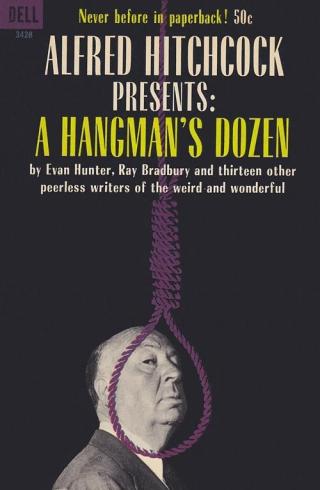
Alfred Hitchcock’s A Hangman’s Dozen
- Автор: Артур Роберт, Брэдбери Рэй Дуглас
- Год: 1962
- Язык: английский
- Год: Dell Publishing
- Жанр: Другие детективы

Электронная книга - «Alfred Hitchcock’s A Hangman’s Dozen». Краткое содержание книги:
George hunched his short, heavy body a little closer to Harvey and looked at him expectantly. “You mean about what we was discussing last night, Harvey?”
Harvey smiled. “No, George. I was wondering if you were interested in second-hand furniture.”
“Yours?”
“Yes. I’ve been thinking about outfitting the house with new stuff, from top to bottom. You interested?”
George nodded. “Sure. What’re you asking?”
Harvey took a forkful of his eggs. “Suppose you take a look at it,” he said. “I know you’ll do right by me, George.”
“Sure,” George said. “That’s one thing you can count on, Harvey. When’d you want me to look at it?”
“This morning okay?”
“Couldn’t be better. You got some nice things out there, Harvey.”
“I was thinking I might look around the stores this morning,” Harvey said. “Why don’t you just drive on out there, George? Doris’ll be glad to show you around.” He paused. “One thing, though. She might be sleeping a little late. If she doesn’t answer the bell, go around to the bedroom window and knock on it with your car keys or something. That’ll raise her.”
“Sure,” George said, getting to his feet. “I think we’ll be able to make a good deal, Harvey.”
“I’ll be seeing you,” George said, and turned toward the door.
“You haven’t finished your breakfast,” Harvey said.
“Business first,” George called back over his shoulder as he walked rapidly toward the door.
Harvey ate slowly, enjoying his food for the first time in months. He wouldn’t have long to wait, he knew. It was only a matter of minutes. George Helm was probably rapping on the bedroom window at this very moment — rapping and then, naturally, looking inside at the man and woman on the bed. Maybe he had already discovered them and was on his way back to town. Much better having George the first person on the scene. And George would have to come back to town, for Harvey had no phone, and Cal Lambert wouldn’t be available to loan George his. All George could do was bring the bad news back to town with him.
Harvey finished eating, went back to the service counter for a second cup of coffee, and lighted a cigarette. He had no intention of going over to Franklin’s to price new furniture. George would look for him in the cafeteria first anyhow.
He sipped at his coffee, savoring it, making it last through these final few minutes. It was strange, he thought, but Doris was already beginning to lose reality for him. And as for Cal Lambert... Lambert had been just a prop, just a thing to explain why Doris had gone to sleep with the heater on and the window shut and the door closed.
Harvey mashed out his cigarette carefully, rose, and walked outside. It would be better to receive the news on the street, he decided. Besides, there was just a chance that George Helm might waste time by going over to Franklin’s after all. He crossed the street and paused in front of the bank, as if waiting for it to open; and then, as he leaned back against the wall to light another cigarette, he saw George’s ancient car careening down the street toward him and he smiled.
George braked the car to a shuddering stop, leaped out, and ran over to Harvey. His face was a sickly white and his eyes seemed ready to burst from his head.
“Harvey!” he said hoarsely. “Harvey! Oh, my God!”
Harvey looked at him questioningly. “You look like you’d seen a ghost, George. What’s wrong?”
“Harvey,” George said. “They’re out there.”
“They?” Harvey asked. “What do you mean?”
“I saw them in there,” George said, glancing about him wildly. “On the bed. I knew something was mighty wrong, and I busted the glass out, and then all that gas hit me in the face and I—”
“George!” Harvey said sharply. “Get hold of yourself. What are you talking about?”
“My God,” George said. “I don’t hardly know how to tell you, Harvey. It... it was your wife — her and Cal Lambert.”
“What!” Harvey exclaimed.
“Jesus, I hate saying this, Harvey. They was on the bed, see, and they’d left the gas heater on, and it must have gone out during the night. They — they’re dead, Harvey — both of them. The gas killed ’em both.”
Harvey clutched George by both shoulders and shook him. “Killed them? What the hell are you saying, George?”
“They was on the bed,” George said raggedly. “Laying there naked as they could get. There was a bottle on the floor beside the bed. I guess they must have passed out or something.”
“You’re lying!” Harvey shouted. “Damn you, George! You’re lying to me!”
“No,” George said, almost sobbing. “No, I ain’t, Harvey. You can still smell the gas on me. It almost got me, too, when I busted in there. It... it’s just plain hell out there, Harvey.”
Harvey stared at George for a long moment; then he turned, walked to George’s car, and sank down on the running board and covered his face with his hands.
It’s all over now but the acting, he thought. Everything came off exactly the way I wanted it to. I’m set for life, really set...
George Helm walked over slowly and put his hand on Harvey’s shoulder very gently. “You poor guy,” he said. “I wish there was something I could do for you.”
The Last Escape
Jay Street
The worker of magic draws your attention to one hand, so he can do his foul trickery with the other. This, technically, is known as misdirection and is the greatest thing from a magician’s standpoint since the invention of the rabbit.
They lashed the heavy braided cord about Ferlini’s wrists and knotted it tightly. Of the two men the smaller was the most belligerent; he yanked and tugged until the cord seemed to bite through flesh. Grunting, they put the leg irons on his ankles, slamming the thick metal locks shut and testing their security. Finally, panting with their exertions, they stood over their victim and seemed smugly satisfied with his helplessness.
Then the woman was putting the screen in front of Ferlini’s bound body. In less than a minute, it was thrown aside by Ferlini himself, the cord and the irons upraised triumphantly in his outstretched hands.
The audience of the small supper club gasped, and then exploded into tumultuous applause. Ferlini glowed at the sound of it. He was fair-skinned, almost albino, even the desert sunshine failed to alter his color, but an audience’s approbation could tint his cheeks with the red flush of gratified vanity.
The two volunteers from the audience, shaking their heads and grinning sheepishly, returned to their tables and their jeering companions, and the six-piece band swung into a traveling theme. Wanda, Ferlini’s wife and professional partner, moved mechanically across the floor to pick up the screen and carry it backstage. There were some catcalls and a smattering of light applause, but she knew it was only in appreciation of her bare-legged costume. She was over forty, and her face was dependent on increasing layers of theatrical makeup for its passable beauty, but her legs were still long, lithe, and without blemish.
On her way to the dressing room, Baggett stepped in front of her and displayed his soulful eyes. “Let me help,” he said, putting his hand on the screen.
“It’s all right,” Wanda whispered. “You better not, Tommy.”
“They liked him tonight, didn’t they?”
She frowned, putting cracks in the thick makeup. “It’s that kind of crowd.” She shrugged. “They’ll like you, too.”
“Thanks,” Baggett, an aging crooner, said dryly.
“No, I didn’t mean it that way.” She placed the screen against a concrete wall and swayed toward him, her eyes dreamy. “You know what I think of you. Tommy. Your singing, I mean.”