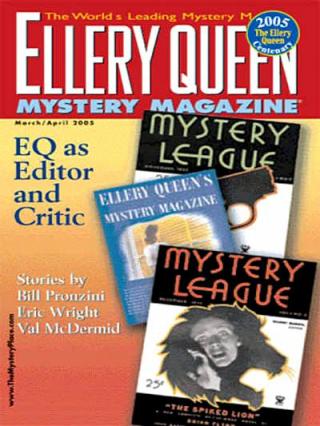
Ellery Queen’s Mystery Magazine. Vol. 125, No. 3 & 4. Whole No. 763 & 764, March/April 2005
- Автор: Dean David, Dempsey Timothy F.
- Год: 2005
- Язык: английский
- Год: Dell Magazines
- ISBN: ISSN 1054-8122
- Жанр: Другие детективы

Электронная книга - «Ellery Queen’s Mystery Magazine. Vol. 125, No. 3 & 4. Whole No. 763 & 764, March/April 2005». Краткое содержание книги:
The “tinge” of guilt I had felt about my underlying purpose in making the visit ratcheted up to “strong sense” after what I took to be the implication of my aunt’s words. Inwardly I cursed the wretched woman as a cynic — which, on reflection, I suppose made me a hypocrite.
She had shaken hands with me from her brightly cushioned raffia chair, but there had been no kissing. After repeating the performance with Jenny, she motioned us to sit. The other woman, now identified as a Mrs. Claire Amhurst, had left to find extra cups and to replenish the contents of the silver coffee pot. In her absence, my aunt explained that Mrs. Amhurst was a widow who had accepted to be her companion more than a year earlier. “The arrangement works very well,” she enlarged woodenly. “As you would expect, of course, between ladies with similar educated tastes, values, and... and religious beliefs.” There was special emphasis on the last two words. I had never been aware that my aunt was at all religious, and as for her educated tastes, she was one of the most uninformed women I had ever known. “Are you an architect, too, Miss, er... Miss Lagden?” she continued. We had already explained that we intended to marry.
“Please, call me Jenny,” my fiancée responded brightly. “No, I’m not an architect. Not clever enough for that. I’m an actress.”
There was a distinct drawing in of breath as my aunt digested what appeared for her to be undisguisedly unwholesome tidings. “Indeed. We seldom go to the theatre,” was her limited verbal response. I took it that “we” meant herself and her companion, not “we” in the way Queen Victoria always turned herself into a crowd, but I wouldn’t have put it past Aunt Gloria to have assumed regal appendages in her dotage.
“Jenny’s a very fine actress,” I put in defensively, adding unnecessarily, “She’s often on the TV.”
Before Aunt Gloria had the opportunity to tell us that “we” seldom watched television, her companion had reappeared.
It was Mrs. Amhurst who enquired whether we could stay for lunch. We refused politely, explaining that we were, genuinely as it happened, engaged to lunch with my mother. But I was intrigued to note that the invitation had come unprompted from Mrs. Amhurst, and without instigation or clearance from her employer — unless the two had been operating some especially subtle method of secret communication, and I doubted that. It did appear, though, in this and other contexts, that whilst Mrs. Amhurst was overly solicitous for my aunt’s every pleasure and whim, it was the companion who made the decisions, both small and large — such as whether my aunt should keep her hat on against the sun, or as in the matter of the luncheon invitation. It seemed that my aunt was very much under the other’s control.
Aunt Gloria had shown no dismay about our need to depart quite soon, and while she took the opportunity at the mention of my mother to enquire after her health, her concern did not extend beyond that cursory politeness. Her interest in my life and Jenny’s, and in our future together, was similarly scant — except Mrs. Amhurst tried to make the going here, too, most particularly where Jenny was concerned. Mrs. Amhurst had been distantly related to a prominent but now deceased actor with whom Jenny had appeared, in minor roles, during a short season with the Royal Shakespeare Company. Their exchanges on this subject proved thoroughly engaging, until my aunt rudely interrupted them with a dissertation about her wretched dog’s arthritis. The episode clearly irritated Jenny, whose normal disposition is warm and tolerant.
Just ahead of our departure, Mrs. Amhurst had absented herself again, unprompted, but I assumed out of good manners, on the pretext of removing the tray of coffee things. In her warmest yet comment on any thing or any body, my aunt then broke into a voluble commendation of her companion.
“Her presence here has given me a new savour for life,” she pronounced earnestly. “With her beside me I’m good for many years yet, to be cared for with unlimited affection.” She sniffed, long and pointedly, looking from me to Jenny, then back again. “Claire Amhurst’s dedication to me has to be experienced to be appreciated,” she continued. “Nothing is too much trouble for her if it brings me comfort. Such sacrifice is quite exceptional in today’s selfish world... She’s a treasure I rate above riches.”
“I’m so glad for you, Aunt, very glad,” I offered, wondering if the last comment was a way of self-excusing the fact that she was overpaying her companion: That would have been typical of her established skinflint ways.
“Good,” she replied. “And I’m glad you young people are making such a success of your lives, I hope spiritually as well as materially. Mrs. Amhurst hadn’t enjoyed many material benefits before she came to me. She had to nurse a very sick husband for many years before he died. Such dedication. He’d been a poor country parson before that.” She paused, shaking her head while she allowed us to ponder on the likely privations of life in the vicarage. “So that she will never need to want again, I’ve made her, in effect, my heir. After I’m gone she’ll not be too old to enjoy life fully for the first time.” There was another pause during which, despite the bombshell, I tried to appear objectively unaffected. “Although the... the family has chosen to neglect me all these years,” she went on, “I’ve still left you a modest legacy in my will, Digby. You must accept, even so, that our fortune is nothing, relatively speaking, to what it was in your uncle’s day. Taxes and living costs have soared so mercilessly.” Aunt Gloria had lost none of her directness — nor her exasperating way of rewriting history. “Of course,” she ended, “I took into account that you still enjoy the benefit of your grandfather’s trust fund, which he generously set aside for your father and his progeny, at the unselfish instigation of my dear husband and myself.” She hadn’t been able to resist this last invented and unprovable assertion.
The beatified Mrs. Amhurst materialised again at that point, wearing a disarmingly humble expression, possibly a bit of playacting, I thought, if she’d been behind the terrace door listening to the conversation. We left a minute or so later.
I was seized with fury about the glib way in which Aunt Gloria had chosen to as good as disown me, and my mother, too. If that cold and gullible woman had not systematically spurned our company, she could have enjoyed all the family love and goodwill she could ever have wanted. I could not countenance that my aunt had needed to look outside the family for good example when my mother had been exhibiting just that since the time she had married my father. More personally, I was the next natural heir to my grandfather’s fortune. Clearly, I could have accepted things if my aunt and uncle had produced any children, but they hadn’t. For the bulk of what was still my grandfather’s original estate now to be left to a virtual stranger, and conceivably a plausible trickster, passed my understanding. As for Mrs. Amhurst, it was unlikely that anyone in her right mind would lavish affection on my aunt except for an underlying profitable motive — and justifiably so.
In the next few months my anger at the injustice of the situation developed into a fixation that soured my disposition, the quality of my work, and prevented me from sleeping for nights on end. It came to the point that, for the second time in my life, I could think of nothing that gave me satisfaction except the plotting of a deadly vengeance against my unfeeling aunt, born of an ire I easily sublimated as revenge for the offence she had caused by belittling my Guinevere.