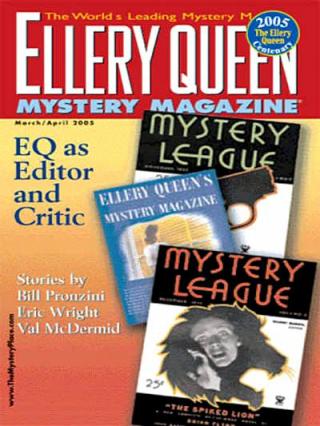
Ellery Queen’s Mystery Magazine. Vol. 125, No. 3 & 4. Whole No. 763 & 764, March/April 2005
- Автор: Dean David, Dempsey Timothy F.
- Год: 2005
- Язык: английский
- Год: Dell Magazines
- ISBN: ISSN 1054-8122
- Жанр: Другие детективы

Электронная книга - «Ellery Queen’s Mystery Magazine. Vol. 125, No. 3 & 4. Whole No. 763 & 764, March/April 2005». Краткое содержание книги:
For my own part, I was hurt beyond measure when my furious aunt later bawled me out to a degree quite disproportionate to the size of my mistake — which, after all, had begun as a well-intentioned good deed. But much worse than that was my later overhearing the outrageously scathing words she addressed to my saintly mother on the subject.
“Digby is an uncontrolled, ill-mannered little horror,” she asserted: The actual words are implanted in my mind. “It’s entirely your fault, Phyllis, for indulging him in every possible way. You should keep him under control. Not only do you demean yourself by giving him free rein, you let down the memory of our dear Arnold.” I should explain that Arnold Betcher was my dead father.
“You simply have to pull yourself together,” she went on mercilessly, “behave like a responsible mother, not a scared, scatterbrained, wimpish shopgirl.” By now she had reduced my sensitive mother to floods of tears. Her weeping had been clearly audible through the closed double doors to the drawing room before I threw them open dramatically and rushed to her side, shouting to my aunt to stop being such a bitch.
That did it, of course, not least because I was supposed to be confined to my room until Uncle Wilfred came home. When he did, he made far less of the curtain incident than his wife had done, though my calling her a bitch got me six hard whacks on my bottom with a slipper, plus my having to make a formal apology to my aunt, which was received with even less grace than I showed when offering it.
Despite the whacks, it really wasn’t Uncle Wilfred I had it in for next day when I dug the sizable hole on the narrow path which led down steeply between the overgrown rhododendrons at the bottom of their garden. This was where Aunt Gloria walked her bad-tempered, overfed Pekingese after breakfast on most mornings. I covered my excavation with a lattice of twigs disguised by grass cuttings. My expectation was that Aunt Gloria would step into the hole, break her neck, and, being unable to summon help, expire from loss of blood, or pneumonia, or starvation before her absence was noticed and her decomposing body discovered.
It was an outrageously improbable scenario, of course, but it was a brave knight’s stalwart intention that counted, after all.
Unfortunately, Aunt Gloria didn’t take her walk on the succeeding two days because it rained. Early on the third morning, the boy from next-door fell into the hole when we were playing hide-and-seek in the garden. He hurt his ankle and face and had to be ferried by Ogden, the decrepit gardener, in a wheelbarrow back up to the house, dazed and with a blackening eye and a bleeding lip. I took consolation from the fact that my plan had worked in principle, albeit against the wrong target.
“Danged squirrels digging up everything again, Mrs. Betcher,” Ogden complained to Aunt Gloria after the other boy’s mother had taken him away. I dearly wanted to inform the old fool that squirrels didn’t make holes that big, but naturally held my tongue.
The school-holiday visit to our only Betcher family relatives (my aunt and uncle had no children) ended the following day. I made no further attempt to exterminate Aunt Gloria on that occasion. Indeed, until late last summer, I never felt the same totally irresistible urge to get rid of her again. But that childhood effort to do so, I suppose, endured in my mind still as a sort of dark fairy tale — and endure it did.
My father had perished in a car accident. Driving while drunk, he had hit a tree. I was three at the time. His passing was deeply mourned by my mother, who never remarried. His memory was respected by Uncle Wilfred, who, for reasons that will become clear, for a time unfairly blamed himself for not having done enough to help and inspire his half-brother to make more of life, especially since in terms of inheritance, their father had treated Arnold as a less deserving, lower-grade offspring. More surprisingly, Aunt Gloria seemed desolated by my father’s demise, though according to contemporaries, she had shown him a good deal less affection in life than she did after he’d departed from it. Certainly she exhibited reducing concern for his grieving widow. An inveterate snob, my aunt was given to insisting, intentionally once in my hearing when I was eighteen, that my father had made “a quite unsuitable marriage to a little copy-typist who had driven him to drink.” I came to the conclusion then that my “well-born,” childless Aunt Gloria resented my mother, first, for having “married above her station,” and, secondly, for having been blessed with child — the last cause for bitterness embracing me as well. She was also incredibly mean with money.
Uncle Wilfred had been twenty-six when my father was born. Father was the only child of my grandfather’s late second marriage, as Wilfred had been of the first. Since Grandfather himself expired five years later, the older son increasingly grew to be a father figure to his only sibling. It was Wilfred who was to inherit the family business from my grandfather, whose will had made adequate and specific material provision for my Grandma Emma, his second wife, and “any progeny from our union,” under the terms of the couple’s marriage settlement. A later codicil to the will also looked to Wilfred “to care for Arnold’s general well-being until he is eighteen,” at which time he was to come into the income from a GBP10,000 trust fund my grandfather had set up for him, it seems as an afterthought.
It was pretty decent of Uncle Wilfred to have observed Grand-father’s wishes about my father’s situation until he came to his majority, especially as there had been nothing obligatory in the loose way those wishes had been expressed. Meantime, my Grandma Emma seems to have spent most of her settlement on herself rather than on her son. For instance, but for Wilfred’s generosity, Father would not have been sent to one of England’s most expensive private boarding schools, though it seems he lacked the intelligence, and probably the ambition, to benefit from the standard of tuition offered. Uncle also gave my father an allowance until, in 1953, he came into the income from the trust fund which would have produced around GBP600 a year — then just enough for a young bachelor to live on, but not lavishly.
In a sense, it was probably a pity that my father had any private income at all because, again according to contemporaries, being at heart just an engaging, good-looking playboy, he did no more than dabble with various jobs in the surety that when he failed in them he always had the trust income to fall back upon. One of his early jobs had been as a trainee salesman with the family firm. This had been created for him by my uncle, and it seems my father had failed at it miserably. At least he’d had the grace to resign his position rather than to further embarrass my uncle.
In 1961, when my parents married, far from being a lowly “copy-typist” (though that was one notch higher than “shopgirl” in my aunt’s social order), my mother had been private secretary to an important company director. This was the kind of responsible post she continued to fill, up to, and for thirty years after, my father’s death. She told me often what a charming, engaging, and entertaining man he was, that really his true vocation should have been in the creative arts — in music, acting, writing, or design (although I believe this was wishful thinking on her part) — and that he had only taken to drinking “a little too much” through frustrations stemming from his lack of career progress. She had adored him in his lifetime — and with added fervour after it when the causes of his failures would have been easier for her to disguise.