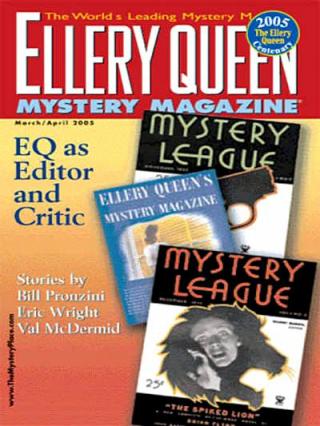
Ellery Queen’s Mystery Magazine. Vol. 125, No. 3 & 4. Whole No. 763 & 764, March/April 2005
- Автор: Dean David, Dempsey Timothy F.
- Год: 2005
- Язык: английский
- Год: Dell Magazines
- ISBN: ISSN 1054-8122
- Жанр: Другие детективы

Электронная книга - «Ellery Queen’s Mystery Magazine. Vol. 125, No. 3 & 4. Whole No. 763 & 764, March/April 2005». Краткое содержание книги:
There was no doubt that it was my mother’s income that enabled the couple to live as well as they did at their pretty Victorian cottage in a country town twenty or so miles northwest of Uncle Wilfred’s mansion. After she became pregnant with me, though, it seems Father determined to take his responsibilities as a husband and future parent more seriously. As Mother admitted to me years later, he had gone to Uncle Wilfred desperately begging to be given another chance with the firm, and promising faithfully to justify the opportunity. Uncle had accepted his word, but because his half-brother’s previous attempts to become a salesman had proved so abysmal, this time he was put into the personnel department. It was unfortunate that three years later he proved to be a failure there as well.
The company manufactured metal components for the automotive industry. Uncle Wilfred was a graduate engineer and a business high-flyer. Under his direction, the organisation had grown hugely, so much so that it became an attractive takeover target, and in 1962 was merged with the market leader. Brilliant Wilfred was made chief executive of the much enlarged company and had risen to be chairman before his death from heart failure — which happened without warning in 1977 — relatively early for someone of his age. Grandma Emma was called to her reward, as my mother put it, in the same year at the French Riviera apartment where she had lived for many years, having severed relations with the family. I hope her heavenly reward was better than the one she left her relatives on earth. This was precisely nothing after her properties were sold and her debts paid.
This left only me, my mother, and Aunt Gloria — if you exclude her Pekingese, not the same one, but it was just as bad-tempered as the previous two.
Surprisingly, Uncle Wilfred had died legally intestate — meaning that he left no will. Probably this was because he had been too busy, or had not seen the need for a will at sixty-eight — something which could also have been stoked by a surreptitious but overweening belief in his own indestructibility, a common syndrome in ageing ex-whiz kids. Whatever the reason or reasons for his overlooking my continued existence, he left me without benefit or prospect of benefit from his life’s work.
In other words, Aunt Gloria got the lot.
I had never been involved with my uncle’s company — nor ever needed to be. After my father’s death, and definitely after the curtain-dyeing episode, my mother and I had seen less and less of the older Betcher couple. As time went on, my mother had grown in self-confidence and independence. In a sense, this played into the hands of Aunt Gloria, who was no doubt glad when we withdrew voluntarily from the scene. I suspect Uncle Wilfred had been too busy to notice, or that he left arrangements for family socialising to his wife, so that when there wasn’t any he assumed that this was how we wanted it. While it is possible that things might have been different if the original firm had survived, after it was subsumed, as it were, into a much larger public company, any sentimental, tribal attachments had withered on the bough.
The gift of a modest block of shares in the now mammoth corporation would not have seriously upset my mother’s principles, certainly if they had been left to me. We still had the income from the trust fund. This had grown over the years, but not nearly so much as the fund itself could have done if Grandfather had not specified that the capital could only be invested in government funds with a safe but unexciting yield. No matter: I had done well in the local state schools, entered architectural college at eighteen, and graduated, with no debts, five years later. It was not until then, of course, that I was able even to think about trying to repay my mother for looking after my every need since my father’s death, chiefly out of her own salary. In fact, she wouldn’t take a penny of my earnings, but at least I never had to accept any more of hers.
Three years ago I was made a full partner in a successful architectural practice in Birmingham after winning an international architectural competition for the design of a new town centre. As a result of that, I was headhunted to run the in-house design department of an international construction company with headquarters in London, with the promise of a seat on the board.
My mother was over the moon at all this — and so was Jenny Lagden, the woman who had just agreed to marry me. Blond, pretty, vivacious Jenny, eight years younger than me, was a talented actress who was close to making it onto London’s West End stage, while playing lead roles with good touring companies and showy supporting parts in TV dramas. In short, things were looking good for me — which is why, perhaps, I was greedy to make them even better.
It was a Sunday morning in mid September when I was driving Jenny from London to my mother’s. We were to spend the night with her. Mother had recently retired, but still lived in the house where she had brought me up. On a whim, more or less, I decided to make a diversion and drop in on Aunt Gloria. I didn’t telephone ahead because I wasn’t going to give my aunt the chance to make an excuse not to see us. She and I hadn’t met for over a decade, and I thought it was time to heal the rift. There were other reasons, too, one of them not quite so virtuous nor even so charitable as the others. Of course I wanted to show off Jenny, and perhaps to demonstrate to her that there was a stately home in the family. Then, to be absolutely honest, I also wanted to waken my immensely wealthy aunt to the fact that she had a successful nephew shortly to be wed, who deserved a wholesome wedding present or at least a place in her will.
Nor, all things considered, am I ashamed of that last aspiration — even if my mother would have been. Aunt Gloria was now in her eighties, and I felt it would be a pity if I allowed myself to be passed over from receiving a family legacy simply because I hadn’t troubled to remind her, in person, of my continued existence. We exchanged Christmas cards every year, but that was the current extent of our relationship.
Turning into the drive, my first impression was how much smaller the house was than I remembered. Even so, it was still a substantial, well-maintained Victorian pile with a large garden in a very desirable commuter area. At today’s prices, I figured it had to be worth close on two million pounds.
The person who answered the door was not my aunt. It was a younger, tallish woman, aged around sixty, who greeted us with a polite, enquiring smile. Slim, with dark, short, well-shaped hair, she was dressed conservatively in a white blouse under an oatmeal-coloured cardigan, and a flared tweed skirt. There was a short string of small matching pearls around her neck. What I noticed most about her, though, were the intelligent blue eyes — and the steely assessment, tinged perhaps with apprehension, that they were making of the two people standing before her.
When we introduced ourselves, the woman stiffened for a moment before offering her hand. “I thought I recognised a family likeness, Mr. Betcher. Well now, I thought we might never meet,” she said in a softly modulated, cultured voice and accent. “Do come in. Your aunt is on the terrace. I’m sure she’ll be delighted to see you. We were taking coffee outside in the sunshine.” She led us from the hall into the drawing room — through the double doors I recalled so well — and from there to the stone-flagged, south-facing terrace.
Unlike the house, Aunt Gloria had not worn well. She had shrunk, as most older people do, of course, but had also lost a good deal of weight. Her face was unduly wizened, and there was a walking stick propped against her chair. But she recognised me instantly, and her tone was firm as she proffered, less affably than the occasion merited: “So, as I expected, Digby, you hadn’t intended to abandon me permanently. Even so, you’ve left it quite late” — the last sentence came as she was studying Jenny.