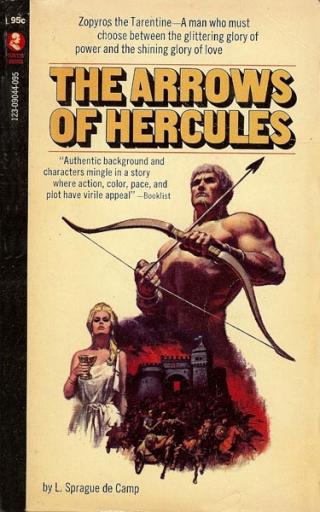
The Arrows of Hercules
- Автор: Де Камп Лайон Спрэг
- Язык: английский
- Жанр: Научная фантастика

Электронная книга - «The Arrows of Hercules». Краткое содержание книги:
“Exciting and quite believable adventures.”—Classical World
“Rousing piece of fiction...pace is rapid and unrelenting.” —The Arizona Republic
They stood for another hour in heat and dust. Zopyros' knees began to ache. Little Ahiram fussed a little, cried a little, and went to sleep in the arms of his father, who growled:
"The accursed priests never begin these things on time. An the gods ever desert the Republic, the cause will be that they've wearied of waiting for their tardy worshipers."
At last a gong boomed, followed by a blast of trumpets. The hawkers scampered away. Men with brooms and dustpans passed along the avenue after them, stirring denser clouds of dust.
Then came the boom of drums, the clash of cymbals, the twang of harps, the clang of sistra, and the wail of flutes and pipes. The odor of incense filled the air. The first group of paraders appeared, from the temple of Bes.
In front marched a musical band. Then came groups of singers and dancers, the latter bounding and cavorting. Little girls threw flower petals at the crowd. The god himself, a painted and gilded statue on a litter borne by a dozen priests, followed. The priests wore thin, transparent robes over white loincloths. Bucket-shaped gauze caps covered their shaven heads.
The statue was that of a long-bearded, snub-nosed, dancing dwarf, naked but for a lion's skin thrown over one shoulder. Ostrich plumes waved from the corners of the litter. Other temple folk followed: priests swinging censers, which filled the avenue with blue clouds of sweet-smelling smoke; sacrificers, lamplighters, sacred barbers, lay brothers, temple slaves and serfs.
The crowd cheered the god of mirth and merriment. Another group of musicians followed, and after them came the float of Eshmun, the healer. This was a statue of a long-bearded, long-robed god seated in a gilded wagon drawn by four mules. The god held out his arms to bless the people. Priests, walking beside the wagon, wore bandages, or had their arms in slings, or pretended to limp on crutches to show the ills of which their god cured his worshipers. After them came more ranks of minor temple personnel; for today even the meanest temple slave had his moment of glory.
More incense, more music. The next float was that of Hiyon, the divine artificer, beating a piece of metal on his anvil. A real fire glowed in his forge. The priests who walked beside his wagon bore tools for working wood, stone, leather, and metal.
Next came Dagon, with his fish's tail. His priests carried his litter. Other priests, dressed in iridescent scales, went through the motions of fish, while yet others in blue-green cloaks swayed back and forth like waves. Pretty priestesses in green gauze sprinkled scented water on the crowd from golden aspergilla.
Then came Kusor, the mariner and inventor. Priests pulled his wagon, which was a fishing boat on wheels. In the boat, the statue of Kusor sat at a table and tinkered with a device of wheels and levers.
So far these were minor gods. Zopyros nudged Evnos and glanced towards Ahiram, astride his father's neck. The two watchmen closely flanked their master. Zopyros could not see the remotest chance of getting the boy away without a struggle, in which he would be outnumbered by Elazar's party and surrounded by the excited crowd. Elazar had only to shout: "Seize that rascally Greek!" and Zopyros would be torn to pieces.
Evnos followed Zopyros' gaze, shrugged, and spread his hands, muttering: "The gods of Carthage are guarding their own today. I'm sorry Segovax will miss the procession for nothing."
Now the cheers became louder, mingled with prayers and snatches of hymns. The wagon of Milkarth, drawn by white horses, came into view. The hero stood, wrapped in a lion's skin—a real skin, Zopyros noted, not a sculptured one—with his sword in one hand and the head of the demoness Masisabal in the other. Blood dripped realistically from the head. A squad of kohanim, with embroidered stoles over their shoulders, marched barefoot in front of the wagon, chanting the legends of the labors of Milkarth from scrolls they held before them.
Next came the wagon of Resheph. A pair of black bulls drew it; a white ass, to be sacrificed at the end of the day, was led behind. The statue showed the god as standing on a bull and wearing a horned helmet. In one hand he held a battle-ax and in the other a three-pronged thunderbolt. The priests carried his emblems on poles: black thunderclouds of cloth, zigzag silver spears representing lightning, and silver vultures with outspread wings.
The float of Mether bore an image of the god, in the form of a beardless youth in Persian coat and trousers, stabbing a bull. Although it was full daylight, the attendant priests carried guttering torches. Two of them walked naked with masks in the form of lions' heads over their faces and a live python draped over their shoulders.
Now the wagon bearing the statue of Anath, the warrior goddess, swayed into view. The goddess rode a lion, with a shield on her right arm, a spear in her right hand, and an ax in her left hand. A necklace of severed human heads hung round her neck. A live lion, aged and blinking, was led beside her carriage. Her priests carried shields and spears, which they clashed together in unison.
The maddening rhythm of clang—step—clang—step—made Zopyros want to shout or punch somebody. A man ducked under the line of spears and ran, shrieking and foaming, towards the divine wain. An officer, rushing up, brained him with an ax. The body was pushed back against the feet of the foremost spectators and lay in a widening pool of blood while the procession marched on.
Next came El, seated in a chariot drawn by two red bulls. The symbols carried on poles included bulls' horns, rayed sun disks, and long blue streamers representing rivers.
Then came Ashtarth. The cheers became deafening. She had the largest band and the most exotic corps of priests. Some, their eyelids painted green, pranced in a sacred dance with their skirts hiked up to their waists, flapping their genitals at the crowds. Others manipulated phalli of painted leather, two to three cubits long, attached to the fronts of their costumes. Temple harlots danced in embroidered robes cut away to leave the fronts of their bodies bare, with multitudes of little flowers affixed in their pubic hair. Painted boys wiggled their hips.
The crowd screamed its pleasure and roared ribald jests. Zopyros nudged Elazar, caught his eye, and glanced at the painted boys. Elazar said something of which Zopyros caught only the last words: "... but that is religion!"
In turning, a peculiar motion had caught Zopyros' eye. Directly behind him, a man and a woman were copulating, standing against the wall. Their neighbors cheered them on, while the ecstatic pair quivered and gasped with slack mouths and drooping eyelids, oblivious to all about them.
A living woman played the part of the goddess Ashtarth. She lounged on her wagon wearing a robe of many colors, draped to expose her body, while she threw kisses to the crowd. Her priests carried spiked silver balls, representing the planet Venus, and sexual symbols made of precious metals and adorned with jewels.
The clouds of dust and incense made Zopyros cough. He shot another look at Ahiram. The boy's legs were firmly locked around his father's neck, while his hands gripped Elazar's beard. Zopyros could not see any possible way to pry him loose without open violence.
The crowd quieted down, because the greatest gods of Carthage were now approaching. The priests of Tanith marched solemnly by, wearing fillets of gold and silver about their foreheads. The chariot of the moon goddess was drawn by a pair of strange animals. They looked like mules but were covered all over with narrow black and white stripes. They shied, skitted, and pulled nervously at their bridles, gripped by a pair of stalwart Negroes who walked at their heads. The statue of the goddess wore a robe of gray doves' feathers. Priests in hideous masks danced around the chariot to scare off demons. Others bore poles with the symbols of the goddess: stuffed doves, palm fronds, silver lunar crescents, and golden pomegranates. A chorus sang a solemn hymn.