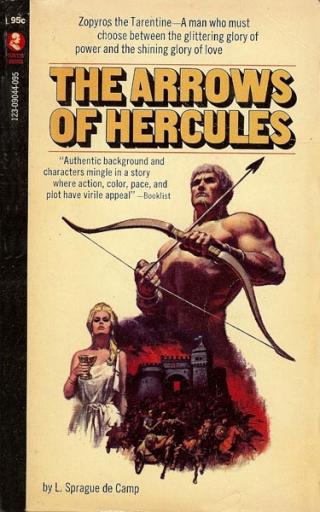
The Arrows of Hercules
- Автор: Де Камп Лайон Спрэг
- Язык: английский
- Жанр: Научная фантастика

Электронная книга - «The Arrows of Hercules». Краткое содержание книги:
“Exciting and quite believable adventures.”—Classical World
“Rousing piece of fiction...pace is rapid and unrelenting.” —The Arizona Republic
Besides the tall apartment houses and a town hall, Motya contained a number of temples. Some were purely Greek; others Punic. At each of the latter, a high brick wall surrounded the temenos, but the gates were open so that the foreign visitors could see in, even though they might not enter without special permission. The temenos was cluttered with shrines, stelae, and obelisks placed at random, while in the midst of this confusion of masonry stood the temple.
The Punic temples themselves were small, plain, boxlike buildings of whitewashed brick. Their few decorations—sometimes a pair of bronzen pillars in front of the doors, sometimes a huge lustral bowl—were wrought in a hybrid Graeco-Egyptian style. One new temple had a whole row of Ionic columns across its front, but without the peaked roof and pediment that such a row of pillars would support in Hellas. Zopyros asked:
"In which temple burn they the babes?"
"In this one: the temple of Baal Hammon. See you the touch of Greek artistry about the fane?"
These words started a train of thought in Zopyros' mind. He asked: "Why did the lord Elazar move to Carthage?"
"He has long owned a house and possessed business interests there ..."
"Aye; but I understand he had long dwelt in Motya."
Abarish lowered his voice and glanced about nervously. "Know you not the talc of his wife and son? He wedded a Hellene of Messana, and she did try to flee back to her parents with the infant. The boy she failed to carry off, but fled herself to avoid chastisement. Now her kinsmen hound my poor master, demanding dowry—to which they have no right—and the child as well. Fearing some desperate attempt to abduct the lad, Elazar removed to Carthage where, methinks, such desperate deeds have no likelihood of success. Remind me ere we part to give you a token to present to Elazar. He's a suspicious man, and rightly so. Otherwise he might turn you out of doors without ceremony."
The next day, Abarish saw them to the wharf. He bent himself double with repeated bows and wrung their hands. Zopyros could have sworn that, as the man bade them farewell, a pair of tears ran down his cheeks into his vast black beard. Abarish said:
"Your visit has honored me, my lords! Would you could stay for months, further to enlighten me about the secrets of the universe! Never, I fear me, shall I see you again, for last night I dreamt a dream and it boded ill. Forget not, sirs: You must say nought to my master of these excursions into philosophy. For, an he knew, he'd dismiss me eftsoons as a wicked atheist."
"Have no fear of us, friend Abarish," said Zopyros, who felt he had talked enough philosophy to last him the rest of his life. "Was I not to ask you in parting for a hospitality token?"
"Aye, aye; I had forgot. Here!" Abarish dug into his wallet and handed over a half of a broken Carthaginian half shekel. "The gods—whatever gods there be—prosper you!"
On the left the sun, rising over the rocky mountains of Cape Hermes, shot ruddy beams through the scattered clouds and sprinkled the waves of the Bay of Carthage with rubies. To starboard, the long sandy beaches of the Carthaginian coast broke into rising sand dunes and then into steep red cliffs, along which ran the huge outer wall of Carthage.
The city—one of the world's greatest—crowned the end of a peninsula that jutted out into the Bay of Carthage. This peninsula broadened out at its tip on either side, so that it had the shape of a hammer or a pick. The two horns almost inclosed two bodies of water, Lake Ariana to the north and the Lake of Tunis to the south; while shallow channels, suitable for small craft, joined each lake to the sea. The city proper occupied the head of the peninsula, between the two horns.
As the ship sailed southward past Cape Carthage, the hills of the Megara—the suburb—rose behind the outer wall, which here ran close to the sea. Villas, surrounded by fields and orchards, were scattered over these hills. Here and there a temple crowned a hilltop. The glass roof ornaments of these temples caught the rays of the rising sun and shot them back to the ship in rainbow hues.
The hills of the Megara flattened out as the ship sailed on, until it came abreast the Byrsa. The Byrsa—the inner city—was surrounded by its own wall, which joined the outer wall along the waterfront to form a single enormous rampart, strengthened at intervals by towers. Behind the double wall could be seen the tops of houses five or even six stories high. Beyond these, and separated by a short distance from the hills of the Megara, stood the single fortified hill of the citadel.
Between the great wall and the sea ran a paved causeway, with a parapet along its outer edge. Ships tied up along this quay by ropes looped around the crenelations of the parapet. As Zopyros' ship proceeded, the causeway narrowed into a long point, directed south, and ended in a huge built-up stone pier. The captain tied up near the end of this pier.
As Zopyros and his companions disembarked, a donkey boy came running up, leading his animal. Knowing from the steward's directions that Elazar's house was over a league from the port, they hired the ass to carry their gear. When the three duffel bags had been roped into place, the travelers set out northwards towards the base of the pier and the great wall.
To the left of the pier was a gap in the wall, through which Zopyros glimpsed the inner harbor. This harbor, rectangular and ten by sixteen plethra, was crowded with merchant ships, some in the water and some hauled out on skids around the margins. Beyond this inner harbor but connected with it lay the cothon or naval harbor, surrounded by a massive circular wall. A trireme, issuing from the cothon, nosed its way through the merchantmen, like a shark in a pool of turtles, with shouted threats and warnings to clear the way.
As the three reached the base of the pier, they approached one of the gates in the main wall. Flanking this gate were a pair of towers with a portcullis, like that of Ortygia, working between them. Behind the portcullis was the main portal, comprising a pair of wooden doors whose timbers were whole tree trunks squared, held together with massive bronzen brackets. The portcullis was raised and the gates stood open. Several soldiers in corselets of gilded metal scales mounted guard at the gate. One soldier questioned Zopyrus and his companions closely before letting them into the city.
Once within the gate, the travelers followed the animal past the merchant harbor, across which they could see the tophet or temenos of the temple of Tanith and Baal Hammon, with its groves and shrines and stelae surrounding the home of the divine pair. They trailed the ass around the curve of the wall of the naval harbor into the tangle of stone-paved streets beyond.
"Valetudo preserve us, but the houses are even taller here than in Motya!" said Segovax, looking apprehensively at the towering whitewashed facades on either side. The height of the buildings made dark canyons of the bustling streets, into which an occasional scorching sunbeam struck slantwise. The dust made Zopyros cough; the rank city smells were overpowering.
The travelers jostled loose-robed Phoenicians, tattooed Libyans wearing ostrich-plume headdresses, and lean, swarthy Numidians capped with turbans of wildcat skins. There were Negroes from beyond the deserts: some of them huge, muscular men; others mere Pygmies, less than five feet tall.
They brushed past snake charmers, sorcerers, and beggars holding out fly-crusted sores and the stumps of withered limbs. They dodged around the litters, borne by gigantic blacks, of bejeweled oligarchs. They pushed past the flocks of goats and sheep that flowed like freshets along the narrow streets, with a skin-clad herdsman and his dog walking briskly behind each flock.