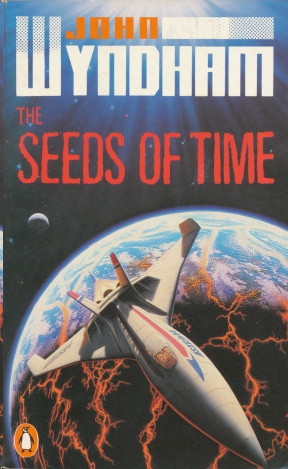
The Seeds of Time
- Автор: Уиндем Джон Паркс Лукас Бейнон Харрис
- Язык: английский
- Год: Michael Joseph
- ISBN: 0-7181-0362-9
- Жанр: Научная фантастика

Электронная книга - «The Seeds of Time». Краткое содержание книги:
She looked at me steadily.
‘Yes,’ she said. ‘He’s been successful at last. It is a real transference this time.’
I thought it over. I was strangely unsurprised. I suppose I had been working up to the realization before it actually came. But there was a lot I wanted to know about the why and how as it affected me. I asked her for more details. ‘Hymorell wanted to get as far as possible,’ she told me.
‘The limit was the point where he could be sure of assembling the parts to make an instrument that would get him back here. If he went too far, certain essential metals would not be known, instruments would be inaccurate, electric power unavailable. In that case it might take him years to build the instrument, if he could do it at all. The knowledge of nuclear fission was the line he decided to draw. Further away than that, he thought, might be dangerous. Then he had to find a contact. It had to be a subject where the integration was not good-where there was a lesion weakening the attachment of the personality to the physical shape. When we perform the operation we can prepare the subject, so it is easy, but he had to find one already in a suitable state. Unfortunately, those he could find were nearly all on the point of death, but he found you at last, and then he had to study the strength of your tie. He was puzzled because it fluctuated a great deal.’
‘That would be the dope?’ I suggested.
‘Possibly. Anyway, he worked out a rhythmic incidence of lesion, and then tried. This is the result.’
‘I see,’ I said, and thought awhile. ‘How long did he reckon it was going to take him to build the instrument for his return?’
‘He couldn’t tell that. It depends on his facilities for assembling materials.’
‘Then it’s going to take him quite a while, I’d say. A legless cripple wasn’t a convenient subject to choose, from that point of view.’
‘But he’ll do it,’ she said.
‘Not if I can help it,’ I told her.
She shook her head. ‘Once you have transferred you never can have the perfect integration you had with your own original body. If at no other time, he will put on more power and get at you when you’re sleeping.’
‘We’ll see about that,’ I said.
Afterwards I saw the instrument that he had used for the transfer. It was not large. In appearance it was little more than a liquid-filled lens mounted upon a box the size of a portable typewriter from which there protruded two polished, metal handles. But within the box there was such an intricacy of wiring, tubes, and strange whizzits as to fill me with great satisfaction. No one, I reckoned, was going to knock a thing like that together in a few days, or even a few weeks.
The days drifted the life by with them. That placidity which was their chief characteristic was, at first, restful; after that there came periods when I wanted to go wild and break up something just for the diversion. Clytassamine took me here and there in the great green building. There were concerts at which I understood not a thing. I sat there, bored and musing to myself, while around me the audience went into an intellectual trance, finding something in the strange scales and queerer harmonies that was utterly beyond my perception. And there was one hall where colours played on a large fluorescent screen. They seemed to be projected from the spectators themselves in some incomprehensible way. Everybody but me enjoyed it, you could feel that, and now and then, for no reason that I could perceive, they would all sigh or laugh together. Nevertheless, I thought some of the effects very pretty, and said so; by the way it was received it was the wrong thing to say. Only in the performances of three-dimensionally projected plays was I occasionally able to follow the action for a while, and when I thought I could, it usually shook me badly. Clytassamine became short with my comments. ‘How can you expect to feel when you measure civilized behaviour by primitive taboos?’ she asked, curtly.
She took me to a museum. It was not like any I had thought of, being mostly a collection of instruments projecting sound or images, or both, according to selection. I saw some horrible things. We went back, back, and still further back.
I wanted to see or hear something of my own time, but: ‘There’s only sound,’ she said. ‘No images from so far away.’ ‘All right,’ I told her. ‘Some music.’ She worked at the keyboard of the machine. Into that great hall a familiar sound stole softly and mournfully. As I listened to it I had a sense of emptiness and vast desolation. Memories flooded back as if the old world-not, oddly enough, that which I had left, but that in which I was a child-were suddenly round me. A wave of sentimentality, of overwhelming self-pity and nostalgia, for all the hopes and joys and childhood that had vanished, utterly engulfed me, and the tears streamed down my face. I did not go to that museum again. And the music which conjured a whole world up from the aged dust?-No, it was not a Beethoven symphony, nor a Mozart concerto: it was, I confess, ‘The Old Folks at Home.’…
‘Do you never work? Does nobody work?’ I asked Clytassamine.
‘Oh, yes-if he wants to,’ she said.
‘But what about the unpleasant things-the things that must be done?’
‘What things?’ she asked, puzzled.
‘Well, growing food, providing power, disposing of waste, all that kind of thing.’
She looked surprised.
‘Why, naturally, the machines do all that. You wouldn’t expect men to do those things. Good heavens, what have we got brains for?’
‘But who looks after the machines-keeps them in order?’
‘Themselves, of course. A mechanism that couldn’t maintain itself wouldn’t be a machine, it would be just a form of tool, wouldn’t it?’
‘Oh,’ I said. And I suppose that was so, though the thought was new to me.
‘Do you mean to say,’ I went on, ‘that for your fourteen generations-some four hundred years or so-you’ve done nothing but this?’
‘Well, I’ve had quite a lot of babies-and three of them were quite normal. And I’ve worked on eugenic research from time to time-almost everybody does that when he thinks he’s got a new lead, but it never does lead anywhere.’
‘But how can you stand it-just going on and on?’
‘It is not easy sometimes-and some of us do give up, but that is a crime, because there is always chance. And it’s not quite so monotonous as you think. Each transfer makes a difference. You feel as if the world had become a different place then. The spirit rises in you like sap in spring…. And those glands you think so much of are not entirely without effect, because you are never quite the same person with quite the same tastes. Even in one body tastes can change quite a lot in one lifetime, and they inevitably differ slightly between bodies. But you are the same person, you have your memory, yet you are young again, you’re hopeful, the world looks brighter, you think you’ll be wiser this time….
And then you fall in love again, just as sweetly and foolishly as before. It’s wonderful-like a re-birth. You can only know just how wonderful if you have been fifty, and then become twenty.’
‘I can guess,’ I said. ‘I was something worse than fifty before this happened. But love!… For four years I haven’t dared to think of love….’
‘You dare now,’ she said. ‘Daren’t you …?’
There was so much I wanted to know.
‘What happened to my world?’ I asked her. ‘It seemed pretty well headed for disaster, as I saw it. I suppose it nearly wiped itself out in some vast global war?’
‘Oh dear, no. It just died-the same way as all the early civilizations. Nothing spectacular.’
I thought of my world, its intricacies and complexities. The mastery of distance and speed; the progress of science.