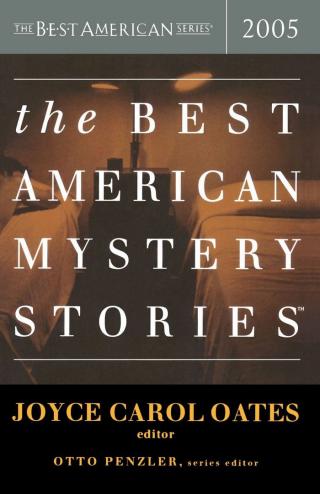
The Best American Mystery Stories 2005
- Автор: Хиггинс Джордж, Камински Стюарт Мелвин
- Год: 2005
- Язык: английский
- Год: Houghton Mifflin Harcourt
- ISBN: 978-0-618-51744-2
- Жанр: Другие детективы

Электронная книга - «The Best American Mystery Stories 2005». Краткое содержание книги:
“Not about money,” said Wally. “I’ve got eleven thousand, four hundred and six dollars in savings at First Farmers.”
“I do something to you?” asked John Roy. “I mean, you got a grudge, something? I knock up your sister or cousin or something, insult you or your family? Hell, I was a kid.”
“You’re everybody,” Wally said as John Roy started to raise his arms, though no one had asked him to.
John Roy glanced at Richie for help. Richie had none.
The idea had just come to Wally. Right out of the blue nowhere. John Roy Worth was everybody. John Roy Worth wasn’t just a country singer who used to live in Bardo, Texas. John Roy was Texas, was the United States, was the world. The world had 110 meaning. That’s what had started Wally down this gun-weighted road. It was all made up. All a story people told each other to make them forget they were going to die and the world was going to blow up or blow away or freeze or burn someday.
Maybe Monty had said something like this once and the idea had just slept all curled up inside him and woke up just now wondering what was going on.
Wally was going to be a shooting star. He was going to be a bright light for a few seconds. He was going to shoot a star. He was going to be a star. It was that or just keep painting signs till his fingers got too much arthritis like his father’s had and then he’d live alone in the house and watch television with his mother and father and eat cereal with freeze-dried fruit in it that got soggy when you added milk.
Richie said, “Wally, no.”
Wally pulled the trigger. He was no more than a dozen feet from John Roy Worth, but he had never fired a gun before and missed, shattering the window behind the man who had written and sung “Hard-Drinking Woman.”
Then, in that little snip of an instant that hardly covered any real time and seemed like a dream, Wally saw the young cowboy drop to the floor and pull something out of his pocket.
Wally was going to fire again. Maybe he did. He didn’t remember. The thump on his chest like someone jabbing him to make a point pushed him back a step. Then something stuck in his throat the way a big vitamin pill did sometimes. He dropped to his knees and felt like coughing and sneezing at the same time. And then Wally fell forward on his face into shattered glass from the window.
The gun was no longer in his hand. Nothing was in his hand. His head was to his left side. He could see shards and bits of glass forming some kind of figure. He imagined chance or God or his own imagination was starting to make a stained-glass window. A flying white horse?
Someone turned him over. He looked up at John Roy Worth, who held a little gun in his hand. John Roy was shouting, “Call the police!”
Wally wanted to talk but words wouldn’t come.
“You crazy son of a bitch,” John Roy said.
Somewhere far away, maybe as far as Houston, Richie was talking to someone on the phone.
“Hero,” Wally gasped, and choked.
John Roy brushed some shards of glass from Wally’s face.
“You’re no hero,” said John Roy. “Just be quiet. Police are coming.”
“No,” said Wally. “You. You’re the hero. Shot it out with a crazy sign painter. Beat him to the draw. All over the news. That gun registered?”
John Roy nodded and tilted his cowboy hat back like Roy Rogers or James Garner.
Wally wanted to say something else. Me wasn’t sure what it was, but it didn’t matter because he could no longer speak. He closed his eyes. John Roy lifted Wally’s head and Wally suddenly, vividly saw the flying white unicorn and John Roy Worth astride it, cowboy hat in one hand, horse bucking in the clouds.
Someone was breathing into his mouth. John Roy was trying to keep him alive. Hero.
It was then that Wally Czerbiak decided not to die. And he didn’t.
Dennis Lehane
Until Gwen
From The Atlantic Monthly
Your father picks you up from prison in a stolen Dodge Neon, with an 8-ball of coke in the glove compartment and a hooker named Mandy in the back seat. Two minutes into the ride, the prison still hanging tilted in the rearview, Mandy tells you that she only hooks part-time. The rest of the time she does light secretarial for an independent video chain and tends bar, two Sundays a month, at the local VFW. But she feels her calling — her true calling in life — is to write.
You go, “Books?”
“Books.” She snorts, half out of amusement, half to shoot a line off your fist and up her left nostril. “Screenplays!” She shouts it at the dome light for some reason. “You know — movies.”
“Tell him the one about the psycho saint guy.” Your father winks at you in the rearview, like he’s driving the two of you to the prom. “Go ahead. Tell him.”
“OK, OK.” She turns on the seat to face you, and your knees touch, and you think of Gwen, a look she gave you once, nothing special, just looking back at you as she stood at the front door, asking if you’d seen her keys. A forgettable moment if ever there was one, but you spent four years in prison remembering it.
“... so at his canonization,” Mandy is saying, “something, like, happens? And his spirit comes back and goes into the body of this priest. But, like, the priest? He has a brain tumor. He doesn’t know it or nothing, but he does, and it’s fucking up his, um—”
“Brain?” you try.
“Thoughts,” Mandy says. “So he gets this saint in him and that does it, because, like, even though the guy was a saint, his spirit has become evil, because his soul is gone. So this priest? He spends the rest of the movie trying to kill the Pope.”
“Why?”
“Just listen,” your father says. “It gets good.”
You look out the window. A car sits empty along the shoulder. It’s beige, and someone has painted gold wings on the sides, fanning out from the front bumper and across the doors. A sign is affixed to the roof with some words on it, but you’ve passed it by the time you think to wonder what it says.
“See, there’s this secret group that works for the Vatican? They’re like a, like a...”
“A hit squad,” your father says.
“Exactly,” Mandy says, and presses her finger to your nose. “And the lead guy, the, like, head agent? He’s the hero. He lost his wife and daughter in a terrorist attack on the Vatican a few years back, so he’s a little fucked up, but—”
You say, “Terrorists attacked the Vatican?”
“Huh?”
You look at her, waiting. She has a small face, eyes too close to her nose.
“In the movie,” Mandy says. “Not in real life.”
“Oh. I just — you know, four years inside, you assume you missed a couple of headlines, but...”
“Right.” Her face is dark and squally now. “Can I finish?”
“I’m just saying,” you say and snort another line off your fist, “even the guys on death row would have heard about that one.”
“Just go with it,” your father says. “It’s not, like, real life.”
You look out the window, see a guy in a chicken suit carrying a can of gas in the breakdown lane, think how real life isn’t like real life. Probably more like this poor dumb bastard running out of gas in a car with wings painted on it. Wondering how the hell he ever got here. Wondering who he’d pissed off in that previous real life.
Your father has rented two rooms at an Econo Lodge so that you and Mandy can have some privacy, but you send Mandy home after she twice interrupts the sex to pontificate on the merits of Michael Bay films.