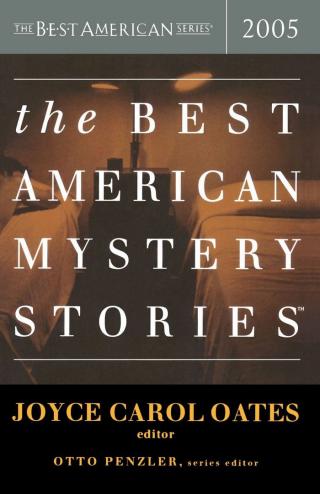
The Best American Mystery Stories 2005
- Автор: Хиггинс Джордж, Камински Стюарт Мелвин
- Год: 2005
- Язык: английский
- Год: Houghton Mifflin Harcourt
- ISBN: 978-0-618-51744-2
- Жанр: Другие детективы

Электронная книга - «The Best American Mystery Stories 2005». Краткое содержание книги:
Wally listened to Monty talk as Monty cut his hair. Monty was a throwback. He had seen barbers in movies, old movies where the barber just talks and talks. That was a major reason Monty had become a barber. He liked to talk about anything. Baseball, the market, the latest gossip about drug abuse by some million-million-dollar basketball player, Rhoda Brian’s stomach stapling.
Wally just sat and listened. Songs ran through his head, background music that fit the scene. For Wally, the major factor in his becoming a sign painter was that his father was a sign painter till arthritis crippled him and he turned over his brushes and paints to Wally. Wally had a natural talent, and it was easier to just paint signs than do what was necessary to become a doctor or something. The fact was that Wally couldn’t think fast on his feet. School had always been a puzzle he couldn’t solve, a game whose rules he could never learn.
Besides, Wally was proud of some of his work, the real challenges, like the sign he did a few months ago, black letters on yellow, Old English: piece of cake, with a picture Wally drew of a cake with white icing in a flowing, delicate pattern.
The cake was vanilla with cherries inside. You couldn’t tell that by looking at the sign, but Wally knew it. It was important to him to know things like that so he could make the cake look real. Without knowing what was inside, it was just a hollow shell.
Sometimes Wally felt like a hollow shell. When that happened, he quickly filled the shell with food. He was thinking of a Big Mac while Monty kept talking. He was thinking of a Big Mac and how he would kill John Roy Worth.
“You understand?” Monty said.
Monty looked like a twig, a bald twig with wide brown suspenders. Monty had blue eyes and peppermint breath. He popped Certs like Wally’s cousin Kenneth had popped uppers back in the 1980s, when they were kids.
“Yes,” said Wally, looking at himself in the mirror, watching the hair fall in ringlets as Monty cut and talked, narrow knobby shoulders huddled, holding today’s suspenders. The Clean Cut was old, ceiling a patterned tin, floor white tile with cracks that ran like meandering rivers, walls covered in paper with repeating pictures of ancient airplanes. Monty was alone today. The other barber chairs sat empty, and only Mr. Rosenberg, who lived in the Garden Gables Assisted Living facility, sat waiting. Mr. Rosenberg had been driven by the bus from the Garden Gables. It would be back for him in an hour. Mr. Rosenberg didn’t care if it was five hours. He liked the smell of the barbershop. He liked fingering the curled edges of the magazines that flopped on the small table next to him. He liked listening to Monty and throwing in an observation when he could.
“So, it’s a miracle,” Monty said. “All this.”
He paused to wave his comb and point it around the shop. Wally could see him in the mirror.
“You gotta think about it, Wally,” he went on. “People were on the earth with nothing, nothing at all, nothing at all. Just people and the earth and the animals and whatever was growing. And they made from it houses and cars and computers and cake mixers.”
“And streets and telephones and airplanes,” said Mr. Rosenberg.
“I’m going to shoot someone today,” said Wally softly, looking at the elegant letters painted on the window more than forty years ago by his father, saying this, indeed, was The Clean Cut Barbershop.
“That a fact?” said Monty. “Something eating you?”
“No, nothing special. It’s just the day I’m going to shoot someone,” said Wally again, very softly, calmly, looking in the mirror to be sure Monty was cutting his hair just the way he liked it, not too short. Too short and his face looked like a balloon, like John Candy.
“You got to kill somebody, kill Dwight Spenser,” said Mr. Rosenberg. “No loss there. You gotta kill somebody, kill Spenser, get it out of your system, rid the world of an anti-Semite.”
“I don’t know Spenser,” said Wally.
“Room next to mine,” said Rosenberg. “Must be a hundred years old. God’s keeping him alive to punish those around him who’ve screwed up their lives. I’m eighty-six. He’ll outlive me. The bad die ancient. You know what I’m saying?”
“I know what you’re saying,” said Wally. “But I’ve got to kill someone important.”
“Like who?” asked Rosenberg. “Who’s important in Bardo?”
“John Roy Worth,” said Wally.
“And that’s who?” asked Rosenberg.
“Country singer,” said Monty dreamily, still thinking about the miracle of the world, the wonders of a comb, the marvel of the scissors in his hand. “Born and grew up right here in Bardo. Mother and father still here. Won the Grammy last year for singing something about dirty women. He in town?”
“‘Hard-Drinking Woman,”‘ Wally said. “Youngest country-and-western singer to win a Grammy. Yes, he’s in town.”
“Done,” said Monty, sweeping the sheet out from under Wally’s chin so that the hairs on it floated neatly to the floor like snowfall in a glass bulb. Monty twirled the sheet like a toreador and laid it neatly in one movement on the empty barber chair next to him. It was Monty’s trademark. That little move.
Wally got out of the chair. He always gave Monty a dollar tip. Monty always said, “Thank you kindly, Mr. Czerbiak, sir.”
He did this time too. Rosenberg had put down the magazine and was walking slowly, stoop-shouldered, toward the chair. He looked like a gnome with a secret. Rosenberg had perfected the knowing look to hide his basic lack of intelligence.
Such, thought Wally, is the way of the world.
“You got a gun?” asked Monty, wrapping the cloth around Rosenberg’s wrinkled neck.
“Yeah,” said Wally as he went out the door and onto Fourth Street. The gun in his pocket belonged to his father. Kept it loaded in a drawer in the shop.
And this is what John Roy Worth was doing in Bardo, Texas. He was visiting his father and mother. He came back when he was in the area. He brought them something they didn’t need or want whenever he made his brief visits. John Roy’s mother and father always acted pleased to get the modern-looking lamp or new television to replace their new television. John Roy never stayed long, an hour or two at the most. He was always in a hurry, had someplace to go. John Roy’s mother had come to expect this.
“Go, Johnny,” she would say. “I know you’re busy. We’re proud of you.”
“Very proud,” John Roy’s father, Lee, would say with a smile he didn’t mean, happy that his son, who had dyed his hair and wore an earring and a cowboy hat, would be out of his life. Lee was a cop, retired. Sheriff’s office. He couldn’t carry a tune. Neither could his wife, and Lee didn’t think their son John Roy did an awful goddamn good job of it, either. Besides, Lee could tell from his breath that John Roy had been smoking. The smell was also on his son’s clothes. He was glad when John Roy, named for his mother’s father, was gone, back on the television and the radio and the tapes, where he could be turned off.
It was toward the apartment of Mr. and Mrs. Lee Worth that Wally, clean-shaven, freshly cut hair, determined look on his face, headed. He walked. He could have taken his car. He had a 1997 Geo Prizm. It was blue. He kept it in good condition, but didn’t have much of anywhere to drive it.
He didn’t need his car. Not today. He was going to shoot John Roy Worth with the gun in his pocket and then wait for the police. There might be someone with John Roy. He would shoot him or her or them too. He might have to shoot John Roy three or four or more times. There were enough bullets in the gun. He wanted to be sure. He didn’t want to be the man who tried to kill the sort-of-famous John Roy Worth. He wanted to be the man who killed the celebrity.