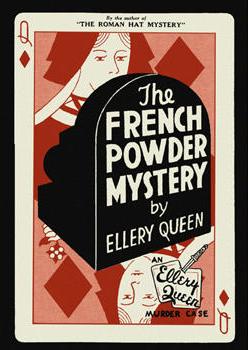
The French Powder Mystery
- Автор: Куин (Квин) Эллери
- Серия: Ellery Queen #2
- Год: 1930
- Язык: английский
- Год: Frederick A. Stokes
- Жанр: Классические детективы

Электронная книга - «The French Powder Mystery». Краткое содержание книги:
Without another word the antique dealer turned and left the apartment.
“Well, what do you think of Mr. Carmody?” asked Queen quizzically.
“I’ve never known an antiquarian who wasn’t queer in some way, laughed Ellery. “Cool customer, however... Dad, I should very much like to see Monsieur Lavery again.”
The Frenchman was pale and nervous when he was conducted into the library. He seemed excessively tired and sank into a chair at once, stretching his long legs with a sigh.
“You might have provided chairs outside in the corridor,” he said reproachfully to the Inspector. “My good fortune to be the last called! C’est la vie, hein?” He shrugged his shoulders humorously. “May I smoke, Inspector?”
He lit a cigaret without waiting for a reply.
Ellery rose and shook himself vigorously. He looked at Lavery, and Lavery looked at him, and both smiled for no apparent reason.
“I shall be brutally frank, Mr. Lavery,” drawled Ellery. “You are a man of the world. You will not be constrained by a false sense of discretion... Mr. Lavery, have you ever suspected during your stay with the Frenches, that Bernice Carmody is a drug addict?”
Lavery started, regarded Ellery with alert eyes. “You have discovered that already? And without seeing the girl? My felicitations, Mr. Queen... To your question, let me reply without hesitation — yes.”
“Oh, I say!” protested Weaver suddenly, from his corner. “How could you know, Lavery? On such a short acquaintance?”
“I know the symptoms, Weaver,” said Lavery mildly. “The sallow, almost saffron complexion; the slightly protruding eyeballs; the bad teeth, the unnatural nervousness and excitability; a certain air of furtiveness constantly maintained; the sudden hysteria and the more sudden recovery; the excessive thinness, growing more patent with every passing day — no, it was not difficult to diagnose the young lady’s ailment.” He turned to Ellery with a quick gesture of his thin fingers. “Let me make it perfectly clear that my opinion is just an opinion, little more. I have no definite evidence of any kind. But, short of medical advices to the contrary, I should be ready as a layman to swear that the girl is a drug fiend in an advanced stage!”
Weaver groaned. “The Old Man—”
“Of course, we’re all terribly sorry about that,” put in the Inspector quickly. “You suspected her of being an addict at once, Mr. Lavery?”
“From the moment I laid eyes on her,” said the Frenchman emphatically. “It was a source of constant astonishment to me that more people did not observe what was so perfectly plain to me.”
“Perhaps they did — perhaps they did,” muttered Ellery, brows drawn taut. He brushed a vagrant thought away and addressed Lavery once more.
“Have you ever been in this room before, Mr. Lavery?” he asked à propos of nothing.
“In Mr. French’s apartment?” cried Lavery. “Why, every day, sir. Mr. French has been more than kind, and I have used this room incessantly since my arrival in New York.”
“Then there is nothing more to be said,” Ellery smiled. “You may now retire to your lecture-room, if it isn’t too late, and carry on the grand work of continentalizing America. Good day, sir!”
Lavery bowed, showed his white teeth all around, and left the apartment with long strides.
Ellery sat down at the desk and wrote earnestly on the flyleaf of his sadly abused little book.
19
Opinions and Reports
Inspector Queen stood Napoleonically in the center of the library, staring vindictively at the anteroom door. He muttered to himself, turning his head slowly from side to side like a terrier.
He beckoned to Crouther, the head store detective, who was assisting one of the photographers at the door of the cardroom.
“Look here, Crouther, you ought to be in a good position to know about this.” The Inspector filled his nostrils with snuff. “Seeing that door there reminded me. What in heaven’s name was French’s idea in having a special spring lock put on the corridor door? Seems to me that for an apartment only occasionally used this is pretty well guarded.”
Crouther grinned deprecatingly. “Now don’t go bothering your head about that, Inspector. The old boy’s just a bug on privacy, that’s all. Hates to be interrupted — that’s a fact.”
“But a burglar-proof lock in a burglar-proof building!”
“Well,” said Crouther, “you either have to take him that way or go nuts. Matter of fact, Inspector,” he lowered his voice, “he’s always been a little queer on some subjects. I can remember like today the morning I got a written order from the boss, with signatures and a lot of that bunk, requisitioning a special made lock. That was when they were remodeling the apartment, about two years ago. So I followed my orders and had an expert locksmith manufacture the dingus on that outside door. Boss liked it pretty much, too — was happy as an Irish cop.”
“How about this business of setting a man at the door?” demanded the Inspector. “Certainly that lock would keep out anybody who wasn’t wanted.”
“We-ell,” said Crouther hesitantly, “the boss is such a bug on this privacy business that he didn’t even want knocks on the door. Guess that’s why he asked me for a man to stand guard every once in a while. Always kept the boys in the corridor, too — they hate the job, the whole crew of ’em. Couldn’t even come into the anteroom and sit down.”
The Inspector scowled down at his regulation policeman’s boots for a moment and crooked his finger at Weaver.
“Come here, my boy.” Weaver trudged wearily across the rug. “Just what’s behind French’s craze for privacy? From what Crouther tells me, this place is like a fortress most times. Who in heaven’s name is allowed in here besides his family?”
“It’s just an idiosyncrasy of the Old Man’s, Inspector,” said Weaver. “Don’t take it too seriously. He’s a good deal of an eccentric. Very few people see the inside of this apartment. Apart from myself, the immediate family, the Board of Directors, and during the last month Mr. Lavery, practically no one in the store organization is allowed in here. No, that’s not quite true. MacKenzie, the store manager, is called in occasionally to get direct orders from the Old Man — was in last week, in fact. But aside from MacKenzie, this place is a complete mystery to the store forces.”
“You tell ’em, Mr. Weaver,” put in Crouther jocularly.
“And that’s how it is, Inspector,” continued Weaver. “Not even Crouther has been here in the past few years.”
“Last time I saw this place before this morning,” amended Crouther, “was two years ago when they were redecorating and refurnishing it.” He grew red in the face at the thought of some secret injury. “That’s a heck of a way to treat a head store detective, believe me.”
“You ought to work for the city, Crouther,” said the Inspector grimly. “Shut up and be satisfied with a soft job!”
“I should explain, if I haven’t done so before,” added Weaver, “that the taboo is more or less limited to employees. A great many people come here, but most of the visits are strictly by appointment with the Old Man, and his visitors come on Anti-Vice League business. Clergymen, most of them. A few politicians, not many.”
“That’s a fact,” put in Crouther.
“Well!” The Inspector shot a keen glance toward the two men before him. “It looks mighty bad for this Carmody girl, eh? What do you think?”
Weaver looked pained and half-turned away.
“Well, I don’t know about that, Inspector,” said Crouther with heavy importance. “My own ideas about this case—”