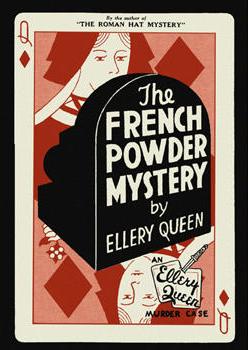
The French Powder Mystery
- Автор: Куин (Квин) Эллери
- Серия: Ellery Queen #2
- Год: 1930
- Язык: английский
- Год: Frederick A. Stokes
- Жанр: Классические детективы

Электронная книга - «The French Powder Mystery». Краткое содержание книги:
“Must have cost Gray a pile of dollars,” mumbled Weaver.
“Oh, they were a gift to French?”
“Gray gave them to him on his last birthday — in March. They were imported, I know — I remember Lavery commenting on their rarity and beauty a few weeks ago.”
“Did you say — March?” asked Ellery suddenly, bringing the black shining book-end closer to his eyes. “That’s only two months ago, and this—” He quickly picked up the companion piece to the book-end in his hand. He placed them side by side on the glass top of the desk, all at once handling them with meticulous delicacy. He beckoned to Weaver. “Do you see any difference between these?” he asked in some excitement.
Weaver leaned over, put out his hand to lift one of them...
“Don’t touch it!” said Ellery sharply. “Well?”
Weaver stood up straight. “No call to shout, Ellery,” he said reproachfully. “As far as I can see, the felt under this one seems faded a little.”
“Don’t mind my rude manners, old son,” Ellery said. “I thought that difference in shade wasn’t wholly my imagination.”
“I can’t understand why the green felts should vary in color,” remarked Weaver in a puzzled way, returning to his chair. “Those book-ends are nearly new. They must have been all right when the Old Man got them — they were, in fact. I’d have noticed the discoloration had there been one.”
Ellery did not answer at once. He stared down at the two pieces of carved onyx. They were both cylindrical in shape, with the carving on the outer sides. On the under sides, where the book-ends were to be placed against the desk, were pieces of fine green felt. In the strong clear afternoon sun, steaming through the big window, one exhibited a marked difference in the shade of green.
“Here’s a pretty mystery,” muttered Ellery. “And what it means, if it means anything at all, I can’t see at the moment...” He looked up at Weaver with a glint in his eye. “Have these book-ends ever been out of this room since Gray presented them to French?”
“No,” replied Weaver. “Never. I’m here every day, and I would know if they’d been moved.”
“Have they ever been broken, or repaired, even here?”
“Why, of course not!” said Weaver, puzzled. “That seems sort of silly, El.”
“And yet essential.” Ellery sat down and began to twirl his pince-nez, his eyes riveted on the book-ends before him. “Gray’s an ultimate of French, I take it?” he asked suddenly.
“His best friend. They’ve known each other for over thirty years. They have good-natured quarrels periodically about the Old Man’s obsessions in the matter of white slavery, prostitution and the like, but they’ve always been unusually close.”
“Which is as it should be, I suppose.” Ellery sank into deep and concentrated thought. He did not take his eyes from the book-ends. “I wonder, now...” His hand dipped into his coat pocket and emerged with a small magnifying-glass. Weaver regarded his friend in astonishment, then burst into laughter.
“Ellery! Upon my word! Just like Sherlock Holmes!” His mirth was unadulterated, inoffensive, like the man himself.
Ellery grinned sheepishly. “It does seem theatrical,” he confessed. “But I’ve found it a handy little tool at times.” He bent lower, applied the glass to the book-end with the darker green felt.
“Looking for fingerprints?” chuckled Weaver.
“You can never tell,” said Ellery sententiously. “Although a glass isn’t infallible. You need fingerprint powder to make absolutely sure...” He discarded the book-end and bent the glass on its mate. As he scanned the lighter green of its felt, his hand shook convulsively. Disregarding Weaver’s cry of “What is it?” he fixed his attention rigidly on a portion of the material where the felt met the onyx, at an edge. A thin line, so thin that to the naked eye it was like a hair, broadened slightly under the magnification of the lens. This line, which extended all around the bottom of the book-end, was actually composed of glue — the glue with which the felt was pasted to the onyx. The second book-end also had the glue-line.
“Here, take the glass, Wes, and focus it at the juncture of felt and onyx,” commanded Ellery, pointing to the under side of the book-end. “Tell me what you see — be careful you don’t touch the surface of the onyx!”
Weaver bent over and eagerly looked through the glass. “Why, there’s a sort of dust stuck in the glue — it’s dust, isn’t it?”
“Unorthodox-looking dust,” said Ellery grimly, seizing the lens and again examining the felt at that portion of the glue-line. In another moment he had swept the eye of the glass over the other surfaces of the book-end. He employed the same tactics with the second book-end.
Weaver uttered a short exclamation. “I say, El, mightn’t it be the same stuff you found in Bernice’s lipstick? Heroin, I think you called it!”
“Smart guess, Westley,” smiled Ellery, his eye fast to the lens. “But I seriously doubt it... This will require analysis, and immediately. Something twitters a warning message in my subconscious.”
He dropped the magnifying glass on the table, thoughtfully regarded the two book-ends once more, then reached for the telephone.
“Get Sergeant Velie — yes, detective-sergeant — on the wire for me immediately.” He spoke rapidly to Weaver while he waited, receiver to ear. “If this stuff is what I am beginning to think it is, old boy, the plot thickens like a purée. However, we’ll see. Get me a good wad of absorbent cotton from the bathroom-closet, will you, Wes? Hello, hello — Velie?” he said into the telephone, as Weaver disappeared through the brass studded door, “this is Ellery Queen speaking. Yes, from the apartment upstairs... Velie, send me one of your best men at once... Who?... Yes, Piggott or Hesse will do. At once! And mum’s the word in the hearing of Welles... No, you can’t help — yet. Hold in, you bloodhound!” He chuckled as he hung up.
Weaver returned with a large carton filled with absorbent cotton. Ellery took it from him.
“Watch me, Wes,” he announced with a laugh. “Watch carefully, because it may be necessary for you in the not remote future to testify on the witness stand as to precisely what I did here to-day... Are you ready?”
“I’m all eyes,” grinned Weaver.
“Allay-oop!” With a prestidigitator’s flourish Ellery whipped out of the large pocket of his sack-coat a curious metal packet. He pressed a tiny button and the lid flew open, disclosing black leather pads of thin tough texture, pierced for small bits of waded thread, each of which held a shining little instrument.
“This,” said Ellery, showing his even white teeth, “is one of my most prized possessions. Given to me with the benediction of Herr Burgomeister of Berlin last year for the little aid I gave him in snaring Don Dickey, the American gem-thief... Cunnin’, isn’t it?”
Weaver fell back weakly. “What on earth is it?”
“One of the handiest contraptions ever conceived by the mind of man for the use of the criminal investigator,” replied Ellery, his fingers busy with the thin leather mats. “This was created especially for your humble servant through the gratitude of the Berlin mayor and the cooperation of the German central detective bureau. At my own specifications, incidentally — I knew what I wanted... You’ll observe that an almost incredible number of articles are packed in this amazingly small aluminum container — aluminum for its lightness, by the way. Every thing in it that a first-class detective might conceivably need during a scientific investigation — on a lilliputian scale, but strong, compact, and extraordinarily utilitarian.”