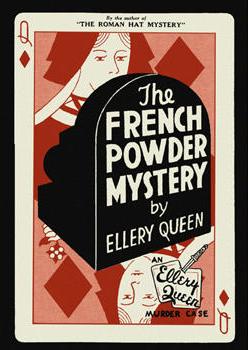
The French Powder Mystery
- Автор: Куин (Квин) Эллери
- Серия: Ellery Queen #2
- Год: 1930
- Язык: английский
- Год: Frederick A. Stokes
- Жанр: Классические детективы

Электронная книга - «The French Powder Mystery». Краткое содержание книги:
“Eh? Your own ideas?” The Inspector looked startled, then suppressed a smile. “What are your own ideas, Crouther? Might be of some value — never can tell.”
Ellery, who had been sitting abstractedly at the desk, listening to the conversation with half-cocked ears, jammed his little volume into his pocket, rose, and sauntered idly over to the group.
“What’s this? A post-mortem?” he demanded, smiling. “And what do I hear, Crouther, about an idea of yours on the case?”
Crouther looked embarrassed for a moment and shuffled his feet. But then he squared his thick shoulders and lashed out into speech, openly enjoying his role of orator.
“I think,” he began—
“Ah!” said the Inspector.
“I think,” Crouther repeated, unabashed, “that Miss Carmody is a victim. Yes, sir, victim of a frame-up!”
“No!” murmured Ellery.
“Go on,” said the Inspector curiously.
“It’s as plain as the nose — beg pardon, Inspector — on your face. Who ever heard of a girl bumping her own mother off? It ain’t natural.”
“But the cards, Crouther — the shoes, the hat,” said the Inspector gently.
“Just hooey, Inspector,” said Crouther with confidence. “Hell! That’s no trick, to plant a pair o’ shoes and a hat. No, sir, you can’t tell me Miss Carmody did the job. Don’t believe it and won’t believe it. I go on common sense, and that’s a fact. Girl shoot her own mother! No, sir!”
“Well, there’s something in that,” remarked the Inspector sententiously. “What do you make of Miss Marion French’s scarf, while you’re analyzing the crime, Crouther? Think she’s mixed up in it anywhere?”
“Who? That little girl?” Crouther expanded, snorted. “Say, that’s another plant. Or else she left it here by mistake. Kind o’ like the plant idea, though, myself. Fact!”
“You would say, then,” interpolated Ellery, “while you’re on the Holmesian track, that this is a case of — what?”
“Don’t get you entirely, sir,” said Crouther stoutly, “but it looks darned near like a case of murder and kidnapping. Can’t see any other way to explain it.”
“Murder and kidnapping?” Ellery smiled. “Not a bad idea at that. Good recitation, Crouther.”
The detective beamed. Weaver, who had resolutely refrained from commenting; heaved a sigh of relief when a knock on the outer door interrupted the conversation.
The policeman stationed outside opened the door to admit a wizened little man, completely bald, carrying a bulging brief-case.
“Afternoon, Jimmy!” said the Inspector cheerfully. “Got anything for us in that bag of yours?”
“Sure have, Inspector,” squeaked the little old man. “Got down here as fast as I could. — Hello, Mr. Queen.”
“Glad to see you, Jimmy,” said Ellery, and the expression on his face was one of intense expectancy. At this moment the photographers and fingerprint investigators trooped into the library, hats and coats on, their apparatus stowed away. “Jimmy” greeted them all by name.
“Through here, Inspector,” announced one of the photographers. “Any orders?”
“Not at the moment.” Queen turned to the fingerprint men. “Anybody find anything?”
“Got a lot of prints,” reported one of them, “but practically all came from this room. Not a one in the card-room and none in the bedroom, except for a few stray prints of Mr. Queen’s, here.”
“Anything in the prints from this room?”
“Hard to say. If the room’s been used all morning by this Board of Directors, chances are they’re all legitimate. Well have to get hold of these people and check their prints. Okay, Inspector?”
“Go ahead. But be nice about it, boys.” He waved them toward the door. “So long, Crouther. See you later.”
“Good enough,” said Crouther cheerfully, and departed behind the police workers.
The Inspector, Weaver, the man called “Jimmy,” and Ellery were left standing in the center of the room. The detectives personally attached to Queen lounged about in the anteroom, conversing in low tones. The old man carefully closed the anteroom door and hurried back toward the group, rubbing his hands briskly together.
“Now, Mr. Weaver—” he began.
“Perfectly all right, dad,” said Ellery mildly. “No secrets from Wes. Jimmy, if you’ve anything to tell, tell it rapidly, graphically, and above all rapidly. Talk, James!”
“Okay,” responded “Jimmy,” scratching his bald pate dubiously. “What would you like to know?” His hand dived into the bag he carried and reappeared with an article painstakingly wrapped in soft tissue paper. He carefully unwrapped the package, and one of the onyx book-ends emerged. The second book-end, similarly sheathed in tissue, he placed by the side of the first on the glass top of French’s desk.
“The book-ends, eh?” muttered Queen, bending forward curiously to examine the barely visible glue lines where felt and stone met.
“In the onyx itself,” ventured Ellery. “Jimmy, what were those whitish grains I sent you in the glassine envelope?”
“Ordinary fingerprint powder,” replied “Jimmy,” at once. “The white variety. And how it got there, maybe you can answer — I can’t, Mr. Queen.”
“Not at the moment,” smiled Ellery. “Fingerprint powder, eh? Did you find any more in the glue?”
“You got nearly all of them,” said the little bald-headed man. “Did find a few, though. Found a bit of foreign matter, of course — some dust chiefly. But the grains are what I’ve told you. There’s not a print on either of them, except your own, Mr. Queen.”
Inspector Queen stared from “Jimmy” to Weaver to Ellery, a strange light dawning on his face. His hand fumbled nervously for his snuff-box.
“Fingerprint powder!” he said in a stunned voice. “Is it possible that—?”
“No, I’ve checked on what you’re thinking, dad,” said Ellery soberly. “This room was not entered by the police before I myself found the grains in the glue. As a matter of fact, I suspected their identity at once, but of course I wished to be certain... No, if you’re thinking that one of your men sprinkled the powder on these book-ends, you’re mistaken. They couldn’t have, possibly.”
“You realize what this means, of course?” The Inspector’s voice grew shrill with excitement. He took a short turn on the rug. “I have had all sorts of experience,” he said, “with criminals who use gloves. That’s one of the accepted habits of the law-breaking profession, it seems — maybe it’s an outgrowth of fiction and newspaper exposés. Gloves, canvas, cheesecloth, felt — they’re all used either to prevent leaving fingerprints or to destroy what prints may be left. But this — this is the work of a—”
“A super-criminal?” suggested Weaver timidly.
“Exactly. A super-criminal!” replied the old man. “Sounds dime-novelish, does it, El? Coming from me, too — with comparative butchers like Tony the Wop and Red McCloskey waiting for me down at the Tombs. Most cops scoff at the mere suggestion of super-criminals. But I’ve known them — rare and precious birds when they do crop out...” He looked at his son defiantly. “Ellery, the man — or woman, for that matter — who committed this crime is not the usual criminal. He — or she — is so careful as to do the job and then, not satisfied with possibly using gloves and letting it go at that, sprinkles the room with the policeman’s pet crime-detector, fingerprint powder, to bring out his or her own prints in order to wipe them out of existence!.. There isn’t the slightest doubt in my mind — we’re dealing with a most unusual character, a habitual criminal who’s risen far above the stupidity of his generally dull-witted kind.”
“Super-criminal...” Ellery thought for a moment, then shrugged his shoulders lightly. “It does look that way, doesn’t it?... Commits the murder in this room, then goes about the enormously ticklish job of cleaning up afterward. Has he left prints? Perhaps. Perhaps the work he had to do was so delicate as to make it impossible for him to use gloves — there’s a thought, eh, dad?” He smiled.