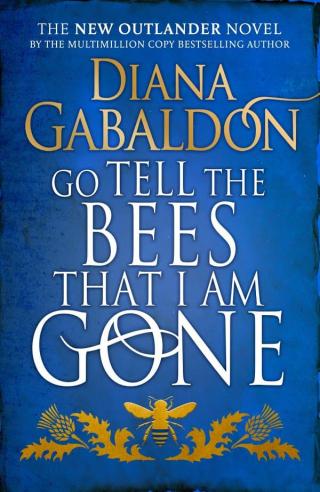
Go Tell the Bees That I Am Gone
- Автор: Гэблдон Диана
- Серия: Outlander #9
- Год: 2021
- Язык: английский
- Год: Delacorte Press
- ISBN: 978-1-473-51900-8
- Жанр: Исторические приключения

Электронная книга - «Go Tell the Bees That I Am Gone». Краткое содержание книги:
The past may seem the safest place to be . . . but it is the most dangerous time to be alive. . . .
Jamie Fraser and Claire Randall were torn apart by the Jacobite Rising in 1746, and it took them twenty years to find each other again. Now the American Revolution threatens to do the same. It is 1779 and Claire and Jamie are at last reunited with their daughter, Brianna, her husband, Roger, and their children on Fraser’s Ridge. Having the family together is a dream the Frasers had thought impossible. Yet even in the North Carolina backcountry, the effects of war are being felt. Tensions in the Colonies are great and local feelings run hot enough to boil Hell’s teakettle. Jamie knows loyalties among his tenants are split and it won’t be long until the war is on his doorstep. Brianna and Roger have their own worry: that the dangers that provoked their escape from the twentieth century might catch up to them. Sometimes they question whether risking the perils of the 1700s—among them disease, starvation, and an impending war—was indeed the safer choice for their family. Not so far away, young William Ransom is still coming to terms with the discovery of his true father’s identity—and thus his own—and Lord John Grey has reconciliations to make, and dangers to meet . . . on his son’s behalf, and his own. Meanwhile, the Revolutionary War creeps ever closer to Fraser’s Ridge. And with the family finally together, Jamie and Claire have more at stake than ever before.
The City Tavern was an actual tavern in Salisbury and was actually called “City Tavern.” (For the benefit of sharp-eyed readers who will be thinking to themselves that “city tavern” shouldn’t be capitalized …) The Salisburyites were apparently a pragmatic lot, given the names of local attractions such as “Town Creek” and “Old Stone House (1766).” “Great Wagon Road” is about as romantic as it got in that neck of the wood—and Salisbury didn’t name the road, just abutted it.
Colonel Johnson of the Southern Department (Indian agents)—There were two Johnsons who headed the department, one succeeding the other, though I don’t think they were related.
a vos souhaits / a tes amours—The traditional French Canadian blessing upon hearing someone sneeze. Translated literally, it means “to your dreams / to your loves.” (A little more graceful than “Gesundheit” or the onomatopoetic “Blesshu” perhaps …)
stercus—“Excrement” (Latin).
filium scorti—“Son of a bitch” (Latin).
cloaca obscaena—“Obscene sewer” (Latin).
“tace is the Latin for a candle”—This is a common tag in eighteenth-century conversation among the upper classes (who spoke Latin). “Tace” is the imperative meaning “keep silent,” and the candle is symbolic of light. Ergo, the expression means (essentially) “keep it dark”—in other words, “be discreet and don’t say anything regarding what we’ve been talking about.”
pozegnanie—“Farewell” (Polish).
Gáidhlig phrases and figures of speech are defined in the text.
Shreddies—RAF-issue underwear. So called, apparently, because the woven pattern of the cloth from which they were made strongly resembled the appearance of a Shredded Wheat biscuit.
Part Three’s Heading is derived from a quote by the novelist Florence King:
“In social matters, pointless conventions are not merely the bee sting of etiquette, but the snake bite of moral order.”