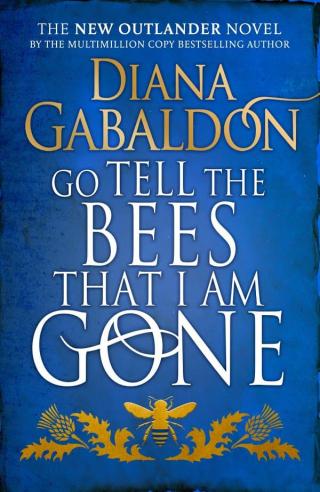
Go Tell the Bees That I Am Gone
- Автор: Гэблдон Диана
- Серия: Outlander #9
- Год: 2021
- Язык: английский
- Год: Delacorte Press
- ISBN: 978-1-473-51900-8
- Жанр: Исторические приключения

Электронная книга - «Go Tell the Bees That I Am Gone». Краткое содержание книги:
The past may seem the safest place to be . . . but it is the most dangerous time to be alive. . . .
Jamie Fraser and Claire Randall were torn apart by the Jacobite Rising in 1746, and it took them twenty years to find each other again. Now the American Revolution threatens to do the same. It is 1779 and Claire and Jamie are at last reunited with their daughter, Brianna, her husband, Roger, and their children on Fraser’s Ridge. Having the family together is a dream the Frasers had thought impossible. Yet even in the North Carolina backcountry, the effects of war are being felt. Tensions in the Colonies are great and local feelings run hot enough to boil Hell’s teakettle. Jamie knows loyalties among his tenants are split and it won’t be long until the war is on his doorstep. Brianna and Roger have their own worry: that the dangers that provoked their escape from the twentieth century might catch up to them. Sometimes they question whether risking the perils of the 1700s—among them disease, starvation, and an impending war—was indeed the safer choice for their family. Not so far away, young William Ransom is still coming to terms with the discovery of his true father’s identity—and thus his own—and Lord John Grey has reconciliations to make, and dangers to meet . . . on his son’s behalf, and his own. Meanwhile, the Revolutionary War creeps ever closer to Fraser’s Ridge. And with the family finally together, Jamie and Claire have more at stake than ever before.
Golf and Golf Balls
Golf has been played in the British Isles since the fifteenth century, and therefore golf balls are quite familiar to William (section 3).
“enough spin on the question as to take the skin off Percy’s hand if he tried to catch it”—This is a reference to cricket, not baseball.
Sergeant Bradford—I’m sorry that I don’t know Sergeant Bradford’s first name. He is the delightful reenactor who (in 2019, at least) took visitors to the Savannah Museum of History through a walk-on tour of the Battle of Savannah, both museum and battlefield, including the chance to fire period weapons (unloaded, alas) from the redoubt. He gave me/us a wonderfully detailed account of the battle, with side notes on many of the political and military figures involved, as well as the squashed-miter shape of his distinctive uniform cap.
Joseph Brant (Thayendanegea)—One of the most interesting personalities of the Revolutionary War period, Joseph Brant lived in two worlds, very effectively. An important military leader among the Iroquois (though he was eventually denounced as a traitor for selling lands to the British and thrown out of the Iroquois confederacy), he was also college-educated and traveled to England (upon invitation) to visit the King—who, not unreasonably, wanted to establish a cordial relationship with the Iroquois and other Native groups so that they would help in the suppression of the American rebels.
Patrick Ferguson—Definitely a real person, Major Ferguson was given the job of building a Loyalist militia in the South and using it to force the submission of local rebels. Sometimes this worked better than others …
Frederick Hambright—One of the militia commanders (actually a second-in-command to William Chronicle, who was killed early in the battle) who took part in the Battle of Kings Mountain was one Frederick Hambright, who had been a colonial officer prior and local patriot. I generally walk the battlefields I write about—often more than once. I’d walked Kings Mountain perhaps fifteen years ago but had a chance to do it again, more recently. On this occasion, I arrived late in the day and, having passed through the entrance lobby, was greeted by a park ranger whose name tag read Hambright. He told me that there was only an hour before the park closed, and I might not make it around the (circular) trail. I assured him I could—it’s less than a mile—and I did. I met him again on the way out and paused to say goodbye. We chatted for a bit and he told me that one of his ancestors had fought in the Battle of Kings Mountain. I thanked him and assured him I would mention his ancestor in the book—which I hadn’t yet begun writing. I remembered, though; I mean, “Hambright” isn’t a name you’d forget.
Benjamin Lincoln and narcolepsy—General Benjamin Lincoln was an important player in the Southern Campaign of the Revolution. He has the unfortunate distinction of having surrendered to the British four times, the last time (the Siege of Charles Town) having to surrender an entire army as prisoners. He’s also thought to have suffered from narcolepsy—an affliction wherein the sufferer frequently falls asleep without warning. This naturally can’t be documented for sure, but mention of it is common enough that I allowed him to be napping when Roger went looking for Francis Marion, just before the Battle of Savannah.
Francis Locke—The commander of the “Regiment of Militias” in North Carolina during the American Revolution. As you will have noted, reading this book, there were a lot of independent militia companies, owing to the irregular terrain and spotty distribution of people. It was Locke’s notion to bring all of these companies together so that they could work in concert— a notion that probably was better in concept than execution. The Regiment of Militias (or part of it) fought in only two small actions during the Revolution. As Jamie notes, distance and difficulties of communication made the regiment unsuitable for small emergencies and unwieldy for large occasions.
Francis Marion—aka “the Swamp Fox.” Francis Marion was a notable person in the Southern Campaign. Beginning as an independent commander of his own company (which might have been described as militia, but which also might have been described as freelance guerrilla raiders; he really did pursue and kill freed slaves who fought for the British, which—as Claire notes—is not something Disney chose to include in their show about him), he later fought in a more orthodox fashion, as part of the Continental army, where he served as a lieutenant colonel and then a brigadier general.
Casimir (Kasimierz) Pulaski—A dashing and effective Polish cavalryman who volunteered to fight with the Continental army and became a general and the army’s Commander of Horse. Pulaski was killed in a risky charge during the Battle of Savannah—save that he didn’t die immediately. And there begins a series of mysteries that endures to the present day.
Pulaski was seriously wounded by grapeshot—shot in both the head and body (you see Roger attempting to stanch the bleeding on the battlefield, before Pulaski’s men came to get him)—but didn’t die immediately. He was seen briefly by a Continental surgeon, but then, at his own request—reportedly—he was put aboard the navy cutter Wasp (which was lurking nearby) and was taken out to sea, under the care of a different doctor. He died aboard the ship a day or so later, and his body was taken ashore. Reportedly, he was buried somewhere nearby, though his (presumably his) bones were later reburied under a monument in the city of Savannah (the monument is still there).
This rather odd behavior might be explained by a twenty-first-century discovery, made when what were assumed to be Pulaski’s bones were removed temporarily during a renovation of the monument—and said bones were discovered to be those of (apparently) a woman.
Well, stranger things have happened; vide the recent stir when the lead coffin of (presumably) Simon Fraser, the Old Fox, was opened and proved to contain the body of a young woman. In this instance, though, it’s possible that the feminine-appearing bones may really have been those of Casimir Pulaski, as recent DNA analysis appears to indicate that the bones belonged to an “intersex” person or hermaphrodite.
If the bones are indeed Pulaski’s and if he was in fact intersex or female, that’s a very good explanation for why he wanted to be taken aboard the Wasp, rather than being treated by an army physician ashore, where his secret would have been discovered and made public.
Haym Salomon—“The Financier of the Revolution.” A Polish Jew with a talent for banking, Salomon was one of the most important contributors to the success of the American Revolution, as time after time he succeeded in obtaining loans that kept Washington’s army afloat.
St. John’s Island—Was later named “Prince Edward Island,” as it’s called today. This is where Jocasta MacKenzie Cameron Cameron Cameron Innes and her fourth husband, Duncan Innes, moved after the beginning of the Revolution.